

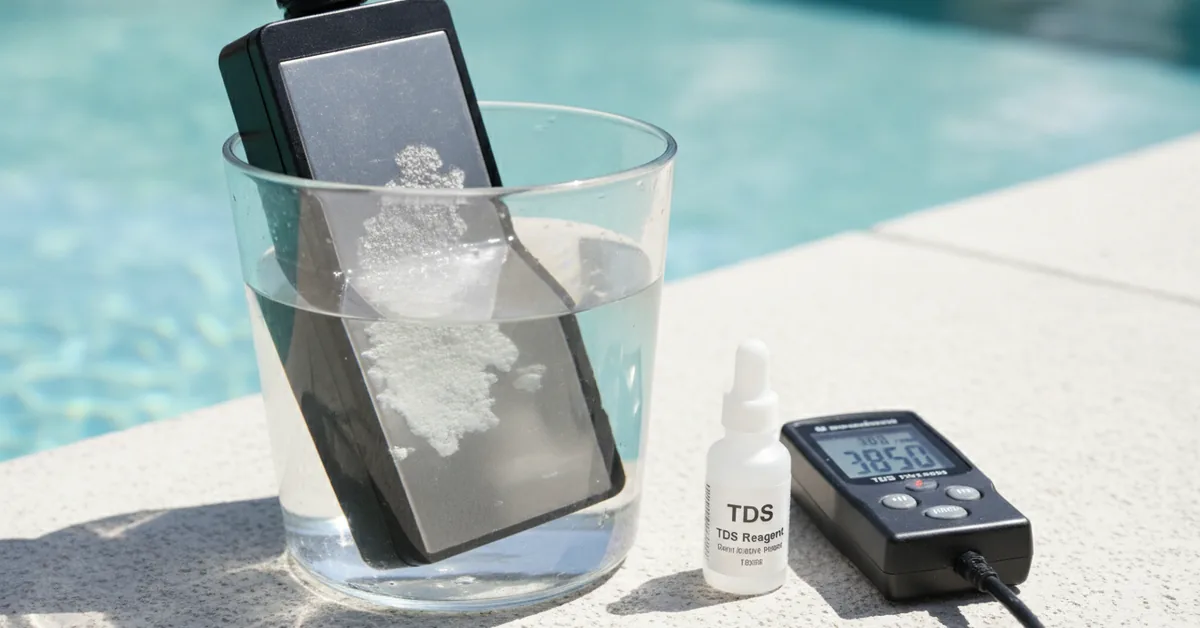
Replacing a premium salt chlorinator cell every 18 months instead of its normal 5-to-7-year lifespan drains roughly $1,200 to $1,800 unnecessarily from a pool owner's pocket. Most homeowners assume their salt chlorinator is failing due to poor manufacturing or mechanical defects, completely unaware that an invisible accumulation of dissolved minerals, cyanuric acid, carbonates, and bathers' waste—collectively known as Total Dissolved Solids (TDS)—is silently short-circuiting their equipment. When TDS climbs past recommended thresholds, water chemistry shifts dramatically, forcing salt cells to run hotter, draw erratic amperage, and prematurely strip precious ruthenium coatings off titanium electrolytic plates.
Executive Summary: TDS Management for Salt Pool Longevity
Total Dissolved Solids (TDS) represent the sum of all organic and inorganic substances dissolved in your pool water, ranging from necessary sodium chloride to accumulated chemical byproducts. Controlling non-salt TDS accumulation is the single most effective strategy to protect your electrolytic salt cell from premature burnout and maintain pristine, crystal-clear water.
- Salt cells require a specific conductivity window; high non-salt TDS tricks sensors into misreading actual sodium chloride levels.
- Excessive TDS dramatically alters water saturation parameters, accelerating calcium scaling on cell plates even when pH appears balanced.
- Water saturation limits cause high-TDS pools to look dull, feel harsh on eyes and skin, and resist normal sanitization.
- Partial water dilution is the only permanent, reliable method to lower non-salt TDS once it exceeds 1,500 ppm above your baseline salt level.
Deconstructing TDS: Salt Content vs. Heavy Organic and Mineral Load
In a saltwater pool, TDS can be a confusing metric because sodium chloride (salt) is, by definition, a dissolved solid. When I test water on my service routes, I break TDS into two distinct categories: functional salt TDS (the sodium chloride added to produce chlorine) and non-salt background TDS. If your salt chlorine generator requires 3,200 parts per million (ppm) of salt to operate efficiently, your total baseline TDS reading will automatically start around 3,200 to 3,500 ppm. The real danger lies in the additional non-salt TDS that accumulates over months and years through liquid chlorine, shock treatments, algaecides, fill water minerals, and bather waste.
As fresh water evaporates from your pool, pure water vapor leaves while every grain of dissolved salt, mineral, and chemical byproduct stays behind. When non-salt TDS creeps above 1,500 ppm over your salt baseline (pushing total TDS past 5,000 to 5,500 ppm), water conductivity shifts. The salt chlorinator control board measures salinity based on electrical current passing between the cell plates. Non-salt TDS creates false conductivity, which deceives the control module into displaying normal or even elevated salt levels when actual sodium chloride is critically low. Homeowners who rely solely on their chlorinator panel often unknowingly allow salt levels to drop, causing the cell plates to work harder, run hotter, and break down electrolytically.
Field Case Study: The $1,400 Salt Cell Burnout Mystery in Scottsdale
Two summers ago, I took over a pool pad in Scottsdale, Arizona, where the homeowner had replaced his 40,000-gallon salt cell twice in under three years. The pool store told him his water was balanced because the pH was 7.5 and chlorine was holding at 3.0 ppm. However, his salt chlorinator continually threw a "Low Salt" error despite him pouring bag after bag of pool salt into the deep end. By the time I hooked up my digital conductivity meter, the total salt reading on the cell read 2,400 ppm, but my independent liquid silver nitrate titration showed sodium chloride was sitting at an astonishing 6,100 ppm.
The issue was severe non-salt TDS accumulation. The total TDS in that pool was hovering near 9,400 ppm due to hard fill water and years of heavy chemical additions. Because the background ionic load was so dense, the current jumping across the cell plates was severely distorted. High current draw had overheated the power center transformer and scorched the titanium plates. High amperage draw caused by non-salt ions literally bakes the coating off cell plates, turning a 7-year component into scrap metal. We performed a 60% drain and refill, restoring non-salt TDS to under 1,000 ppm. Three years later, his replacement salt cell is still operating at full output capacity.
| Water Quality Metric | Target Range (Salt Pool) | Impact of Excessive High TDS | Corrective Action |
|---|---|---|---|
| Total Dissolved Solids (Total) | 3,500 – 5,000 ppm | Dull water, reduced sanitation, false conductivity readings | Partial water drain and refill |
| Non-Salt TDS Component | Under 1,500 ppm | Excessive amperage draw, rapid plate scaling, cell burnout | Dilute with fresh source water |
| Sodium Chloride (Salt) | 3,000 – 4,000 ppm (per manufacturer) | Under-generation if low; cell shutoff/overcurrent if high | Add pool salt or dilute as needed |
| Calcium Hardness | 200 – 400 ppm | Accelerated calcium bridging across chlorinator plates | Lower TDS via drain; balance LSI |
How TDS Interacts with LSI, Calcium Hardness, and Cell Scaling Dynamics
To understand why high TDS ruins salt cells, you have to look inside the cell housing while it is actively generating chlorine. Electrolysis splits sodium chloride molecules and water into hypochlorous acid and sodium hydroxide. This reaction creates an extremely localized, ultra-high pH environment (often exceeding 11.0 pH) right along the surface of the titanium plates. In this high-pH micro-environment, dissolved calcium instantly drops out of solution and crystallizes on the plates as calcium carbonate scaling.
When total background TDS is high, the ionic strength of the water increases, making calcium scaling vastly more aggressive. If your water has elevated Calcium Hardness combined with high TDS, these scale bridges short-circuit the gap between cell plates. Many pool owners attempt to solve this by repeatedly soaking their cell in a harsh muriatic acid bath. Acid washes strip calcium away, but every acid wash strips a layer of ruthenium oxide coating from the cell plates. Over-cleaning a cell plagued by high-TDS scale will ruin the cell just as quickly as the scale itself. The solution is not more acid washing; it is managing TDS to prevent the scale from precipitating in the first place.
Step-by-Step Field Check: How to Diagnose TDS Issues at Your Pool Pad Today
- Turn off power to the pump and salt generator control box at the main breaker before inspecting hardware.
- Unscrew the cell unions, remove the salt cell, and visually inspect the internal titanium plates for white, chalky bridging or severe dark discoloration.
- Test your water for true Sodium Chloride using a calibrated chemical reagent drop test (such as Taylor K-1766) rather than relying on test strips or your chlorinator screen.
- Measure Total TDS using a calibrated digital electronic TDS meter. Subtract your chemical salt reading from the Total TDS reading to determine your background non-salt TDS load.
- Check your variable speed pump basket and main filter pressure gauge; clean or backwash the filter media to guarantee maximum flow rate (GPM) across the cell, ensuring heat dissipates properly.
Advanced FAQs: Operational Troubleshooting for High TDS in Salt Systems
- Why does my chlorinator read "Low Salt" when a liquid reagent test proves sodium chloride levels are perfect?
- This discrepancy usually points to scaled cell plates, a failing salinity sensor, or severe non-salt TDS interference. When background minerals and chemical residues contaminate the water, electrical resistance across the cell plates changes. The control module interprets this abnormal electrical current as a drop in sodium chloride concentration, prompting an erroneous "Low Salt" warning.
- How does elevated TDS affect the actual power draw and thermal output of a variable speed pump and salt generator control box?
- High TDS increases water density and conductivity. Increased conductivity forces the salt generator transformer to pull higher electrical current (amperage) to maintain electrolysis. This added current generates extreme heat inside the power center enclosure, leading to blown fuses, burned display cards, or premature failure of the transformer coils, while placing slight additional friction head-loss on circulation equipment.
- Can chemical sequestering agents or TDS clarifiers reduce high TDS without draining water?
- No. Chemical sequestrants and clarifiers do not remove dissolved solids from pool water; they merely bind to metal ions or suspend particles temporarily so the filter can grab them. True dissolved solids exist at a molecular level and pass straight through cartridge, sand, and DE filters. The only scientifically proven way to lower high TDS is physically removing concentrated pool water and replacing it with fresh, lower-TDS source water.