

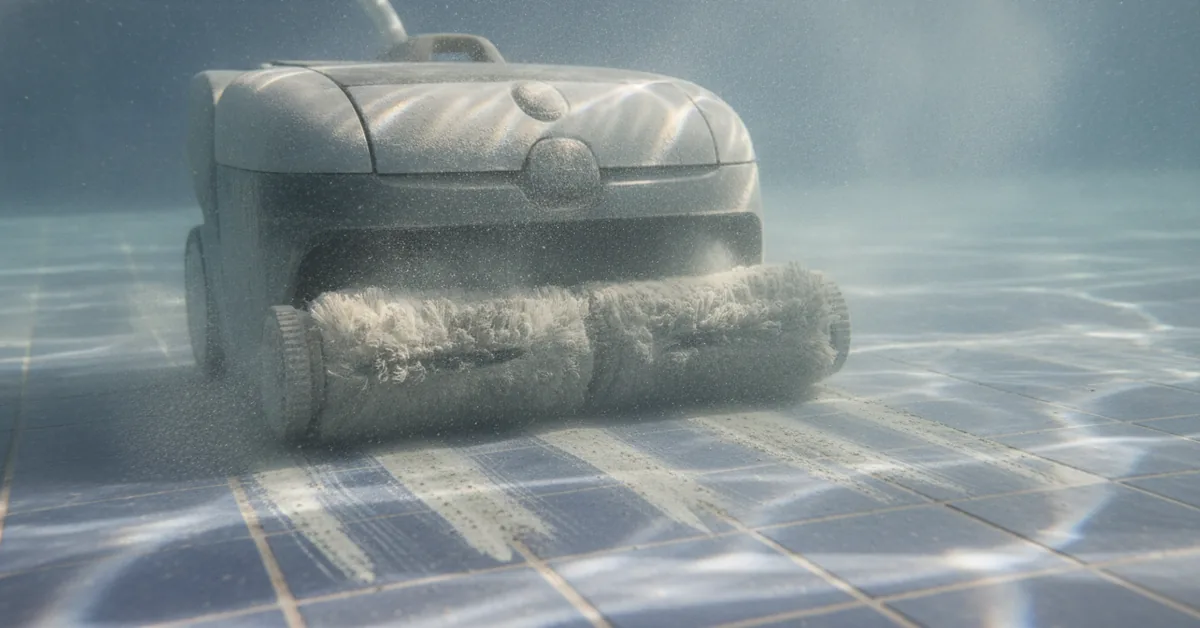
Buying a top-tier $1,500 robotic pool cleaner is completely useless if your water's Total Dissolved Solids (TDS) have silently climbed past 2,500 ppm above your baseline fill water. Most pool owners blame worn drive tracks, clogged impellers, or failing booster pumps when their automatic sweep begins crawling sluggishly or floating aimlessly across the plaster. In reality, the fluid dynamic resistance and micro-abrasive wear caused by saturated water chemistry are often the true mechanical killers hiding in plain sight.
Executive Summary: How Water Saturation Cripples Automatic Pool Sweeps
High Total Dissolved Solids fundamentally alter water density and buoyancy, creating fluid resistance and friction that cripple automatic pool cleaner drive mechanics. When chemical saturation exceeds safe operational limits, it degrades rubber seals, causes drive tracks to slip, and drastically reduces cleaning cycle efficiency.
- Fluid Density Shift: Excessive TDS raises liquid density, disrupting cleaner ballasts and reducing wall-climbing traction on plaster surfaces.
- Micro-Abrasive Friction: Crystallized salts and chemical compounds act as liquid sandpaper on drive gears, bearings, and motor seals.
- Electrical motor drag increases amperage draw in robotic units, triggering premature thermal overload shutdowns.
- Water dilution through partial draining is the only effective mechanical remedy to restore proper cleaner operation.
The Physics of Saturated Water: Why High TDS Kills Mechanics
Total Dissolved Solids represent the sum of all organic and inorganic materials dissolved in your pool—chlorine byproducts, cyanuric acid, calcium, sodium, and swimmer waste. When TDS rises above 3,000 ppm in a standard chlorine pool (or 1,500 ppm above tap water baseline), the liquid changes at a physical level. Increased dissolved mass directly affects liquid density, which alters the hydrodynamic balance engineered into every automatic cleaner design.
Two seasons ago, I received a service call in Scottsdale, Arizona. A client complained that his high-end pressure-side cleaner was failing to climb the walls of his 30,000-gallon plaster pool despite having a brand-new 0.75 HP booster pump installed. The local pool store had sold him replacement drive tires, wall fittings, and thrust jets, totaling over $450 in parts. When I placed my pressure gauge on the wall sweep line, the pressure was a crisp 30 PSI. Yet, the cleaner slithered helplessly on the deep end floor, spinning its tires against the surface layer. I dropped my digital salinity and TDS meter into the water: 5,400 ppm TDS in a standard chlorine pool with a baseline tap water reading of 350 ppm. The water was so saturated with years of dry shock byproducts and cyanuric acid that the cleaner's internal float ballast was rendered ineffective, altering its center of gravity and leaving the drive tracks without enough downward force to grip the wall.
High TDS also acts as a microscopic slurry. As water streams through a suction cleaner's diaphragm or a robotic cleaner's ultra-fine filter basket, dissolved salts and calcium compounds suspended near saturation deposit microscopic crystals inside tight tolerance zones. The resulting mechanical friction destroys rubber diaphragms and wheel bearings in months rather than years.
Cleaner Vulnerability Across Different Drive Systems
Not all automatic cleaners respond to chemical saturation in the same manner. Understanding how elevated TDS impacts specific drive mechanics helps diagnose root causes before wasting money on unnecessary replacement parts.
| Cleaner Type | Primary Failure Mechanism from TDS | Physical Symptoms | Critical TDS Threshold |
|---|---|---|---|
| Suction-Side Cleaners | Diaphragm stiffening and foot-pad friction loss | Sluggish movement, failing to cover deep end, stuck on main drain | > 2,500 ppm above tap water |
| Pressure-Side Cleaners | Ballast displacement and sweep hose wear | Floating, tipping over, wall-climbing failure, tail hose whip destruction | > 3,000 ppm above tap water |
| Robotic Cleaners | Drive track slippage, motor canister seal failure, filter blinding | Shortened run cycles, spinning in circles, slipping off tile line | > 2,000 ppm above tap water |
When TDS levels spike, drive belts and track treads lose their friction coefficient against plaster and pebble surfaces. Excess dissolved solids lower surface traction by filling microscopic plaster pores with mineral film.
How High TDS Interacts with Calcium and Salt Systems
High TDS rarely exists in isolation; it is usually accompanied by high calcium hardness (above 400 ppm) or high stabilizer levels (cyanuric acid above 80 ppm). When these parameters compound, water approaches saturation index boundaries. When the Langelier Saturation Index (LSI) turns positive, microscopic scale drops out of solution precisely where pressure drops or friction heat occurs—inside the cleaner's water turbine or drive motor shaft seal.
For salt chlorine generator pools, TDS levels naturally hover between 3,000 and 4,500 ppm due to sodium chloride. However, problems arise when non-salt TDS (accumulated calcium, heavy metals, and sulfates) climbs on top of that salt load. A cleaner operating in a pool with 3,500 ppm salt plus 2,500 ppm non-salt TDS is moving through a 6,000 ppm bath. At this density, electric drive motors inside robotic units experience increased rotor resistance, leading to thermal overload shutdowns mid-cycle.
Pad Diagnostic: Testing Your System Before Buying Parts
Before spending money on replacement drive tracks, diaphragms, or booster pumps, walk out to your equipment pad and perform this systematic diagnosis to isolate chemical interference from mechanical failure.
- Measure Baseline Tap Water vs. Pool TDS: Use a calibrated digital TDS meter to test your fill water. Subtract your tap water reading from your pool's total TDS. If the difference exceeds 1,500 ppm in a standard pool or 2,000 ppm above salt target in a saltwater pool, chemistry is impacting fluid dynamics.
- Check your filter tank pressure gauge. Clean or backwash your filter (cartridge, sand, or DE) to ensure main pump flow is optimal before measuring pressure at the dedicated sweep line or vacuum port.
- Inspect the cleaner's drive tracks, tires, and footpads for smooth mineral scaling or slick biofilm that indicates lack of traction due to high dissolved mineral residue.
- Conduct the Bucket Hydro-Test: Fill a clean 5-gallon bucket with fresh tap water. Submerge the cleaner head or drive assembly in the fresh tap water and observe mechanical movement. If traction and movement instantly improve, high water density in the pool is the primary root cause.
- Drain and refill the pool in controlled 20% to 30% increments to safely lower TDS without risking pool pop or plaster damage.
Frequently Asked Questions Regarding Water TDS and Cleaner Maintenance
- Does elevated TDS cause permanent damage to robotic pool cleaner motor sealed units?
- Yes. High TDS water increases electrical conductivity and fluid density around the drive shaft seals. Microscopic mineral crystallization on the rubber lip seals wears away the sealing surface over time, allowing water to breach the sealed motor canister and destroy the drive board.
- Can chemical clarifiers or sequestrants lower my pool's Total Dissolved Solids reading?
- No. Clarifiers and sequestrants bind tiny suspended particles so the filter can trap them, but they do not remove dissolved ions. The only method to reduce high Total Dissolved Solids in residential pools is partial or full water dilution through draining and refilling.
- Why does my suction cleaner work fine in fresh fill water but stall after adding shock and balancer chemicals?
- Heavy chemical dosing temporarily increases localized water density and alters rubber polymer elasticity. Rapid spikes in salt or dry chemical concentrations cause rubber diaphragms and flappers to temporarily stiffen, altering the pulse frequency required to drive the cleaner forward.