

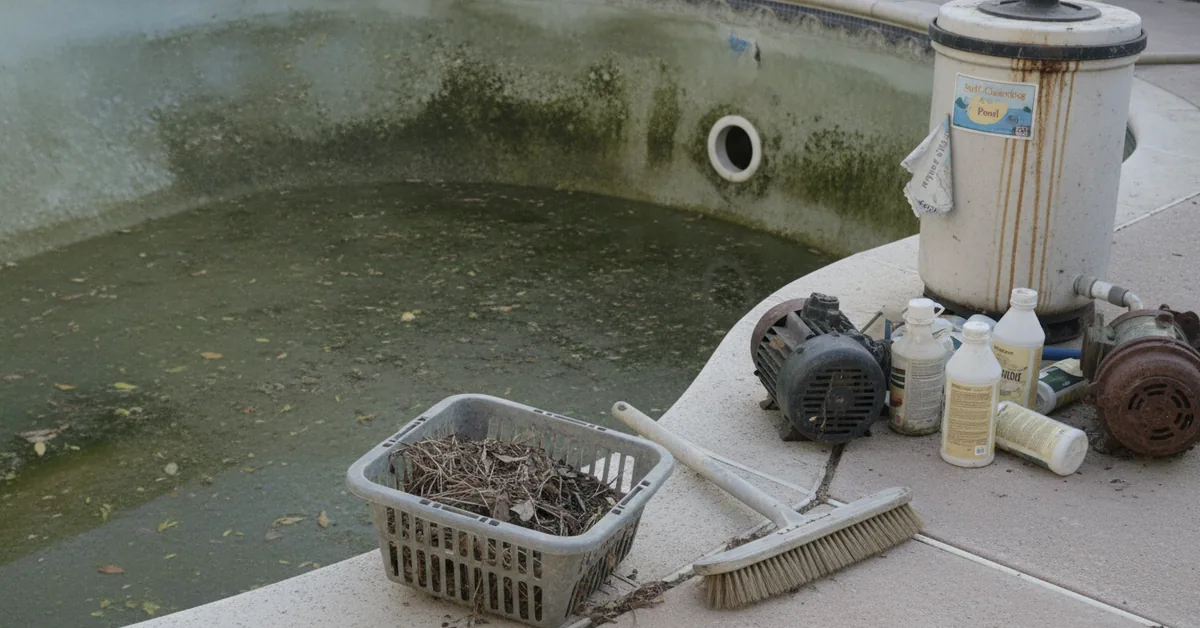
A client called me last July with panic in her voice because her six-figure custom gunite pool had transformed into a soup of cloudy green sludge just three hours before a major party. She was bewildered—her builder had assured her that between the $8,000 in-floor pop-up system, the automated salt chlorinator, and the top-tier robotic vacuum, the pool was virtually self-cleaning. When I stepped onto the equipment pad and opened the pump basket, I found a cracked strainer pot choked with disintegrated palm fronds, while the salt cell was completely bridged solid with white calcium scale. The automated system had been grinding blindly without flow for weeks, driving water temperatures up, sterilizing zero bacteria, and triggering an algae bloom that ultimately required a $3,200 drain, acid wash, and equipment rebuild.
In my 15 years servicing commercial and residential vessel hydraulics, I have seen marketing terms like fully automated or self-cleaning lull thousands of pool owners into expensive neglect. The reality on the ground is simple: mechanical gadgets can shift debris and circulate water, but they possess zero technical judgment. Relying entirely on automated hardware without manual intervention is the fastest way to turn a high-end aquatic investment into an operational nightmare.
Executive Summary: The Reality of Automated Pool Care
Automated pool cleaning systems excel at moving solid debris and circulating water, but they are completely incapable
Automated pool cleaning systems excel at moving solid debris and circulating water, but they are completely incapable of maintaining water balance or diagnosing mechanical strain. Believing a pool can manage itself inevitably leads to silent equipment destruction, premature surface deterioration, and inflated repair bills.
- Pop-up heads and robotic cleaners remove visible dirt but miss 100% of chemical imbalances and microscopic biofilm.
- Salt chlorinators generate chlorine continuously but cannot regulate cyanuric acid, pH spikes, or total alkalinity.
- Unattended low-flow issues cause gear module lockups in pop-up systems, costing $400 to $800 per replacement.
- A weekly 15-minute manual inspection prevents severe plaster etching, scale deposition, and heater core failures.
Deconstructing In-Floor Cleaners and Robots: Mechanical Limits Exposed
In-floor pop-up cleaning systems rely on a central water distribution valve that sequentially directs high-pressure water to nozzle clusters embedded across the pool floor. While these systems push heavy particulate toward the main drain, they depend entirely on precise hydraulic pressure to function. When filter pressure increases by just 8 PSI due to dirt loading, the rotation speed of the water distribution valve slows dramatically, leaving pop-up heads stuck in the raised position where swimmer feet or heavy debris can snap the internal stem gears.
Automated cleaners lack spatial awareness and chemical intuition; they blindly push water across surfaces without addressing the stagnant microscopic boundary layer where black algae roots take hold. Robotic pool cleaners face similar physical constraints. While micro-fiber filter bags in modern units catch fine silt down to 2 microns, their drive tracks, drive belts, and impellers wear rapidly when operating in unbalanced water chemistry. Furthermore, leaving a robotic cleaner submerged in a pool all week exposes its electronic seals to constant chemical degradation. Mechanical helpers are circulation assistants, not autonomous technicians.
Why Water Chemistry Destroys "Self-Cleaning" Dreams
The most dangerous assumption a homeowner can make is that a salt chlorine generator or automated chemical dosing pump eliminates the need for manual water testing. A salt cell generates sodium hypochlorite through electrolysis, but it also produces sodium hydroxide as a byproduct, inherently driving the pool's pH upward every single day. Left unchecked, a pH level exceeding 7.8 causes dissolved calcium to drop out of solution, coating the internal electrolytic plates of the salt cell and clogging heat exchangers.
Furthermore, cyanuric acid (CYA) acts as a sunblock protecting chlorine from UV degradation, but excess CYA creates a severe condition known as chlorine lock. If your CYA climbs past 90 PPM due to stabilized chlorine tablets or lack of fresh water dilution, a free chlorine reading of 3.0 PPM becomes functionally useless against pathogens and algae. High cyanuric acid strips chlorine of its sanitizing power regardless of how many hours your salt generator runs. I regularly test pools where the owner believed their automated system was working perfectly, only to find a Total Dissolved Solids (TDS) level exceeding 3,500 PPM and Calcium Hardness over 600 PPM—conditions that actively strip plaster finishes and destroy heat exchangers. Balanced water parameters demand human testing and manual adjustment.
Field Case Study: The $5,200 Cost of Unchecked Automation
Two years ago, I took over a service call for a homeowner in Dallas who had relied entirely on an automated salt cell, a pH acid dosing pump, and an in-floor pop-up cleaner for 18 months without opening his equipment hatch. He called me because his gas heater stopped heating and water flow from the return jets had dropped to a trickle.
Upon inspection, the peristaltic tube on the automated acid feeder had ruptured internally due to age-related embrittlement, spraying concentrated muriatic acid over the system's electronic control board. Meanwhile, the suction-side basket was collapsed from excessive leaf suction, forcing the pump into severe cavitation. The reduced flow rate caused the salt cell to overheat, triggering thermal sensor failures and dropping raw calcium flakes directly into the distributor valve, which seized the internal acrylic gear assembly.
| Automated System | Promised Capability | Unseen Mechanical Failure Risk | Required Human Intervention |
|---|---|---|---|
| In-Floor Pop-Up Cleaners | Cleans floor and steps automatically | Debris jams distribution gears; heads freeze mid-cycle | Weekly clearance of auxiliary leaf canisters and valve pressure inspection |
| Salt Chlorine Generators | Continuous sanitization without manual chlorination | High pH drift causes rapid calcium scaling on titanium plates | Weekly pH testing, acid balancing, and quarterly cell acid washing |
| Robotic Pool Cleaners | Autonomous vacuuming and wall scrubbing | Impeller jams from pine needles; tracks deteriorate in low pH | Emptying filter bag after every cycle; removing unit from water |
| Automated Acid Feeders | Regulates pool pH without handling chemicals | Peristaltic tube rupture sprays acid; probe calibration drift | Monthly tube inspection and quarterly probe re-calibration in buffer solutions |
The total restoration required replacing the heater exchanger core ($1,800), installing a new water distribution module ($650), replacing the destroyed salt cell ($1,100), repairing acid feed lines and control board components ($950), and chemical rebalancing ($700). Total bill: $5,200. Had the owner spent five minutes a week inspecting the equipment pad, every single one of these mechanical failures would have been caught early.
Hydraulic Balance: The Silent Killer of Variable Speed Efficiency
Variable speed pumps (VSPs) are engineering marvels, reducing electricity consumption by up to 80% when running at low RPMs (1,200–1,500 RPM). However, high-efficiency low-flow settings directly conflict with the physical operation of automated cleaning hardware. An in-floor pop-up system generally requires a minimum operating pressure of 20 to 25 PSI at the distribution valve to force the heads out of their recessed housings and rotate them 18 degrees per cycle.
If a VSP is programmed to run at low energy-saving speeds all day, water pressure drops below 10 PSI. The pop-up heads push up halfway, fail to rotate, and allow heavy grit to settle directly into the head casing, permanently locking the return spring. Operating variable speed pumps at inadequate flow rates destroys automated cleaners. You must schedule high-RPM speed blocks (2,800–3,200 RPM) specifically dedicated to driving hydraulic cleaning gear, balancing energy efficiency against mechanical lifespan. Ignoring flow requirements creates costly system bottlenecks.
The 5-Minute Equipment Pad Checklist: Weekly Reality Check
Walk out to your pool pad once every seven days and perform this critical inspection sequence to keep your automated hardware running smoothly:
- Check the filter pressure gauge reading against your baseline clean pressure; if the pressure has risen by 8 to 10 PSI, perform a filter backwash or cartridge teardown immediately.
- Turn off the pump, open the suction strainer lid, and inspect the basket for hairline fractures or compacted debris that restricts water flow to the impeller.
- Examine the transparent cell housing of your salt chlorine generator for visible white, chalky calcium scale spanning across the internal titanium plates.
- Perform a liquid reagent drop test (DPD method) for Free Chlorine (target 2.0–4.0 PPM) and pH (target 7.4–7.6), ignoring automated panel displays which can drift over time.
- Inspect the pressure reading on your in-floor distribution valve and confirm that the pop-up heads on the pool floor are fully retracting flush with the plaster surface.
Advanced Technical FAQs
- Why does my salt chlorine generator report normal salt levels and active generation while my pool is actively turning green?
- This discrepancy usually stems from cyanuric acid (CYA) lock or severe salt cell plate degradation. When CYA levels rise above 80–100 PPM, the chemical bond holding free chlorine reserve becomes too strong, drastically reducing the active hypochlorous acid available to kill pathogens. Additionally, salt cells generate false conductivity readings when coated in scale or when water temperatures drop below 60°F, indicating high salt concentrations on the controller display while producing virtually no actual chlorine gas.
- Will running my Variable Speed Pump at low energy-saving speeds void the warranty or damage my gas heater?
- It will not void the heater warranty directly, but insufficient flow rates cause the internal water pressure switch in the heater to cycle repeatedly or refuse to close. This leads to severe thermal stacking inside the heat exchanger, where stagnant water boils instantly upon ignition, causing rapid copper erosion and heavy scale accumulation inside the header assemblies. Always ensure your low-speed pump schedule satisfies the heater's minimum flow rate (typically 30–40 GPM).
- How does high calcium hardness accelerate mechanical failure in automated pop-up heads and gear modules?
- When Calcium Hardness exceeds 400 PPM alongside elevated pH levels (above 7.8), calcium carbonate precipitates directly out of solution inside high-friction areas. Inside in-floor pop-up heads, micro-crystallization forms on the internal return spring and acrylic rotation pawls. This microscopic scale acts like fine sandpaper, wearing down drive teeth, binding the head stem inside the nozzle body, and eventually causing the gear teeth in the main distribution valve to strip under hydraulic load.