

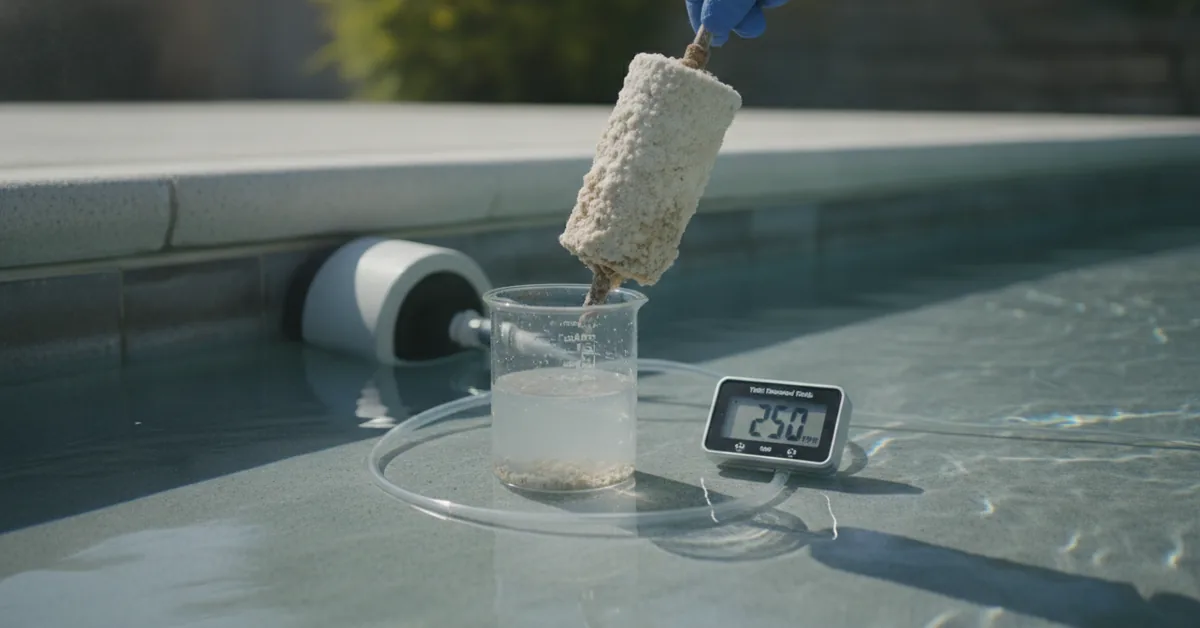
The most expensive mistake you can make when a gas pool heater or heat pump stops warming your water efficiently is assuming that the thermostat or control board has failed. In my 15 years on pool pads across the country, I have seen thousands of dollars wasted on unnecessary component replacements when the true culprit was invisible: saturated, tired water carrying a massive burden of Total Dissolved Solids (TDS). Water that appears crystal clear can silently act like liquid sandpaper and an thermal insulator all at once, destroying high-end heating units from the inside out.
Every chemical drop, swimmer waste, dust particle, and tap water mineral that enters your pool leaves a permanent residue behind. As evaporation removes pure H2O, these solids stay behind, continuously raising the water density and electrical conductivity. When this chemically overloaded water passes through the narrow tubes of a burner assembly or titanium exchanger, heat transfer efficiency collapses, setting off a chain reaction of scaling, localized boiling, and catastrophic metal failure.
Executive Briefing: The Hidden Impact of Total Dissolved Solids on Heater Longevity
Total Dissolved Solids measure the sum of all organic and inorganic materials dissolved in your pool water, serving as a critical indicator of water age and chemical saturation. Ignoring rising TDS levels directly compromises thermal transfer, accelerates galvanic corrosion, and destroys heat exchangers long before their expected service lifespan.
- High TDS acts as a micro-thermal insulator, causing internal heat exchangers to overheat, crack, or soot up.
- Elevated TDS distorts balance formulas, leading to aggressive scaling inside heater headers even when pH appears correct.
- Saltwater pools require distinct TDS accounting, separating functional sodium chloride from corrosive byproduct accumulation.
- Water replacement is the only true physical remedy; chemical additives cannot destroy or neutralize dissolved heavy ions.
The Physics of Thermal Transfer: How Saturated Water Starves Your Heater
To understand why TDS ruins heating equipment, you have to look at how a heater transfers energy. In a gas heater combustion chamber, combustion flame temperatures exceed 1,500°F. The heat exchanger tubes—typically crafted from copper or a cupro-nickel alloy—are designed to rapidly transfer that extreme heat into the moving body of pool water passing over their internal surfaces. For this process to work efficiently, fresh water must make direct, unbroken fluid contact with the internal tube walls.
When pool water reaches high TDS levels (typically exceeding 1,500 ppm over baseline fill water), its physical properties shift. Saturated water holds less dissolved oxygen, exhibits higher electrical conductivity, and rapidly drops minerals out of solution when heated. As water temperature spikes inside the narrow heat exchanger channels—often reaching localized boundary temperatures of 180°F—the dissolved minerals precipitate out instantly. They form a micro-thin, ceramic-like scale matrix directly on the metal boundary layer, drastically reducing heat absorption.
This mineral layer acts as an effective thermal insulator. Instead of heat absorbing cleanly into the water column, it bounces back into the metal wall of the exchanger. The heat exchanger metal overheats, leading to localized thermal expansion stress, metal fatigue, and eventually, pinhole leaks that flood the combustion tray.
The $4,200 Heat Exchanger Autopsy: A Lesson From My Phoenix Route
I recall a specific service call in Phoenix, Arizona, that perfectly illustrates this phenomenon. A residential client called me out because his 400,000 BTU low-NOx gas heater was whistling like a jet engine whenever it fired up, taking nearly six hours to bump a spa by ten degrees. The pool water was sparkling clean, the cartridge filters were brand new, and the local pool store had told him his pH and chlorine were spot on.
I pulled the header off the heater and pulled out the heat exchanger bundle. The internal copper tubes were severely choked with a dark, crystalline crust, and the external fins were covered in heavy soot caused by incomplete combustion due to thermal backing. When I tested the pool water chemistry with a calibrated digital meter, the pH was 7.5 and total alkalinity was 90 ppm—seemingly perfect. However, the TDS reading spiked at 5,800 ppm, with calcium hardness sitting at 950 ppm. The water was simply so full of dissolved salts, cyanuric acid, and legacy minerals that it was throwing calcification onto the heat exchanger every time the burners ignited. The client had to replace the entire burner assembly and exchanger manifold for $4,200—a loss that a simple partial drain and refill six months earlier would have completely prevented.
| Water Quality Parameter | Target Operating Range | High TDS Threshold | Direct Mechanism of Heater Failure |
|---|---|---|---|
| Total Dissolved Solids (Freshwater) | 500 – 1,500 ppm | > 2,500 ppm | Causes micro-boiling, thermal insulation scaling, and severe efficiency drop. |
| Total Dissolved Solids (Saltwater) | 3,000 – 4,500 ppm | > 6,000 ppm | Accelerates galvanic corrosion on copper header plates and erodes titanium welds. |
| Calcium Hardness | 200 – 400 ppm | > 800 ppm | Rapidly precipitates out in high-heat zones, choking exchanger tube diameter. |
| Langelier Saturation Index (LSI) | -0.3 to +0.3 | > +0.5 (Scale-Forming) | Forces calcification on metal heating surfaces, restricting water velocity. |
Salt Chlorination vs. Standard Sanitizers: The TDS Confusion Matrix
One of the biggest points of confusion I encounter among homeowners involves salt chlorine generators. Saltwater pools intentionally operate at high TDS levels—typically between 3,000 and 4,000 ppm of sodium chloride (NaCl)—because the electrolytic cell requires those dissolved ions to produce free chlorine. However, many pool owners assume this means high TDS is harmless for their heating equipment.
This is a dangerous misconception. There is a critical difference between functional salt TDS and non-functional byproduct TDS. The sodium chloride added to a salt pool is a clean, simple salt. The danger arises when non-salt solids—such as calcium chloride hardeners, cyanuric acid stabilizer, sulfates from dry acid, and heavy bather waste—accumulate on top of that baseline salt level. When your total dissolved load pushes past 6,000 ppm in a salt system, the elevated electrical conductivity accelerates galvanic corrosion. If your heater lacks a sacrificial zinc anode or an insulated grounding loop, the stray electrical currents traveling through the dense water will eat away at the heat exchanger metal, pitting cupro-nickel tubes within a single season.
Diagnostic Pad Walk: 5 Mechanical Checks to Save Your Heater Core Today
You do not need an engineering degree to evaluate whether high TDS is threatening your pool heater. I recommend every pool owner perform this simple pad inspection at the start of each heating season:
- Measure baseline vs. current TDS: Test your tap water fill source with a digital TDS meter, then test your pool water. If your pool water is more than 1,500 ppm higher than your tap water baseline (excluding added sodium chloride for salt systems), your water is aged and requires dilution.
- Inspect the exhaust pressure and flame color: Fire up your gas heater and look through the sight glass. A healthy burner displays a crisp blue flame. If you see lazy yellow flames or soot building up on the internal heat tray, heat is failing to transfer into scaled internal tubes.
- Listen for thermal boiling noises: Stand next to the heater while it operates under full load. A knocking, popping, or high-pitched whistling sound (termed "kettling") indicates localized boiling caused by insulating scale internal build-up.
- Verify continuous flow rate: Ensure your variable speed pump is pushing sufficient gallons per minute (GPM) through the pad. Low flow combined with elevated TDS dramatically increases the speed of thermal calcification.
- Check the sacrificial zinc anode: Inspect the inline sacrificial anode installed on your equipment plumbing pipe. If the zinc disc is depleted by more than 50%, high TDS water is actively seeking metal components to erode.
Master Technician FAQ: Advanced TDS and Pool Heater Diagnostics
- How does high TDS distort the Langelier Saturation Index (LSI) inside a heater?
- The LSI formula relies on total dissolved solids to calculate ionic strength. As TDS climbs above 2,000 ppm, it alters the solubility product of calcium carbonate. Water that tests chemically balanced at room temperature (78°F) in a test kit shifts into severe, aggressive scale-forming territory when exposed to the high boundary temperatures (140°F+) inside the heater core.
- Can I use anti-scale chemical sequestering agents instead of draining pool water?
- Sequestering agents only temporarily bind to heavy metals and calcium ions to keep them suspended in solution; they do not remove or lower total dissolved solids. Furthermore, these chemical agents break down rapidly under the intense heat and UV exposure within gas heater combustion loops, rendering them ineffective at high TDS levels.
- Will high TDS void my manufacturer heater warranty?
- Yes. Virtually all major equipment manufacturers (including Hayward, Pentair, and Jandy) explicitly state in their warranty documentation that damage caused by chemical imbalance, scale accumulation, or elevated TDS/calcium levels constitutes chemical corrosion or improper water maintenance, which is not covered under standard manufacturer warranties.