

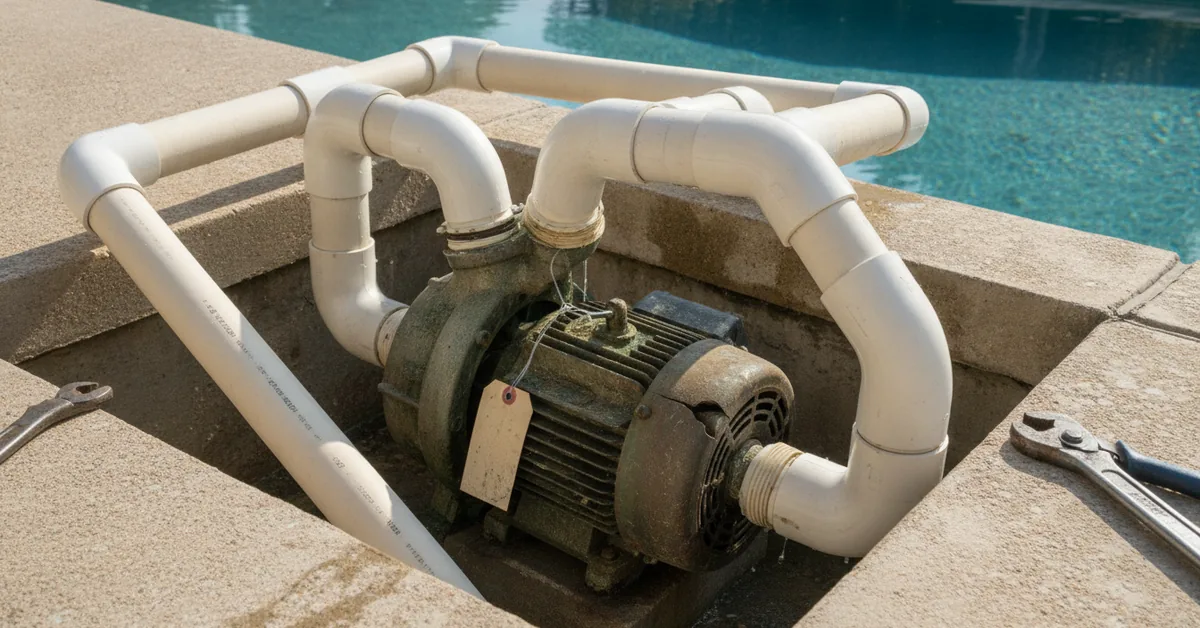
Why do pool supply retailers and aggressive contractors keep telling homeowners that a larger pump is always better? It is one of the most expensive and persistent myths on the pool deck, and I see the structural damage weekly across my service route. Homeowners drop a massive 3-horsepower pump onto a 1.5-inch suction line believing they are buying superior filtration, only to cook the motor within two seasons. The reality is that putting an oversized pump on undersized plumbing does not keep your water clearer; it creates extreme hydraulic friction that destroys mechanical seals, pits impellers, and cooks motor windings from the inside out.
Executive Summary: The Physics of Sizing and Motor Longevity
Matching your pump's flow rate in gallons per minute to your plumbing system's total dynamic head is the single most
Matching your pump's flow rate in gallons per minute to your plumbing system's total dynamic head is the single most important decision for equipment survival. When a motor is mismatched to the pipe diameter, hydraulic resistance forces the pump to work against extreme pressure gradients, leading to destructive vacuum states and thermal stress.
- Pipe velocity must remain at or below 6 feet per second on suction lines to prevent pump starvation and hydraulic drag.
- Oversized pumps operating on restrictive plumbing suffer from cavitation, where vapor bubbles implode and destroy the impeller face.
- Variable speed pumps do not automatically solve sizing problems if their default schedules exceed the maximum flow rate of the filter or plumbing.
- Correctly engineered flow dynamics extend pump motor life from an average of 3 years to well over 10 years while drastically reducing monthly power expenditures.
Hydraulics on the Pad: Friction Loss and Total Dynamic Head
When I step onto an equipment pad to diagnose a prematurely dead pump, the first thing I measure is not electrical voltage; it is hydraulic resistance. Every foot of PVC pipe, every 90-degree elbow, every heater header, and every valve body creates drag against flowing water. In the trade, we aggregate this friction into a single metric called Total Dynamic Head (TDH), measured in feet of head resistance. If your pump produces more volumetric flow than your suction and return lines can hydraulically carry, that energy does not disappear. It translates directly into backpressure, extreme suction vacuum, and wasted heat within the pump housing.
Standard residential plumbing relies heavily on standard schedule 40 PVC pipe. A 1.5-inch suction pipe is hydraulically capped at roughly 42 to 48 gallons per minute before water velocity exceeds the safe 6 feet per second standard set by the National Spa and Pool Institute. Forcing 80 or 90 gallons per minute through that same 1.5-inch pipe requires tremendous energy and creates a high vacuum environment inside the pump's strainer pot. The pump is essentially trying to pull liquid through a coffee straw, causing excessive hydraulic shear that strains every moving component inside the wet end.
| Pipe Diameter (Sch 40) | Max Safe Flow Rate (6 FPS Limit) | Maximum Recommended Horsepower (Single Speed) | Common Failure Mode from Over-Pumping |
|---|---|---|---|
| 1.5 Inches | 42 - 48 GPM | 0.75 HP - 1.0 HP | Thermal overload, warped pot lids, cavitation, blown shaft seals |
| 2.0 Inches | 73 - 80 GPM | 1.5 HP - 2.0 HP (or 2.7 HP VS tuned down) | High filter tank pressure, crushed cartridge cores, bypass valve fatigue |
| 2.5 Inches | 110 - 120 GPM | 3.0 HP (Full Rated) | Rare equipment failure; optimal low-friction dynamic flow |
The Mechanics of Cavitation: How Vacuum Bubbles Destroy Impellers
The most silent killer of an oversized pool pump is a phenomenon called cavitation. When a high-horsepower motor attempts to pull more water than the suction line can physically supply, the fluid pressure inside the impeller eye drops below the vapor pressure of water. Microscopic vapor bubbles form instantly within the liquid stream. As these bubbles travel from the low-pressure center of the impeller to the higher-pressure outer edges of the diffuser, they collapse violently.
These are not simple air pockets; they are violent micro-implosions that hit the impeller face with local pressures exceeding tens of thousands of pounds per square inch. Over weeks of operation, these implosions erode the plastic face of the impeller, giving it a pitted, chewed-up appearance that looks like termites ate through solid Noryl resin. On top of the physical erosion, cavitation creates intense vibration. That vibration transfers directly down the stainless steel motor shaft, overheating the double-lip mechanical seal and destroying the front motor bearing. If your pump sounds like it is circulating rocks or coarse gravel, you are listening to cavitation actively chewing up your investment.
Field Case Study: The $2,200 Variable Speed Pump That Melted in Scottsdale
Last summer, I took a service call for a client in Scottsdale who had self-installed a top-of-the-line 3.0-horsepower variable speed pump. He had replaced an old 1.0-horsepower single-speed unit, operating under the assumption that a bigger motor running at full output would scrub his 25,000-gallon pool in two hours. When I arrived, the brand-new pump was screaming with a high-pitched bearing whine, the clear strainer lid was visibly dished and warped, and the motor kept shutting down on internal thermal overload errors.
His pool pad was plumbed entirely with 1.5-inch PVC suction lines, featuring three hard 90-degree street elbows packed tightly right before the pump intake. He had set his pump to run at max speed (3,450 RPM) for six hours a day. The pump was trying to push nearly 90 GPM through a plumbing manifold that choked out at 45 GPM. The extreme vacuum had heated the water in the volute chamber to over 140 degrees Fahrenheit during priming cycles, softening the PVC connections and causing air leaks at the threaded male adapters. The fix was not replacing the pump again; it was re-engineering the suction manifold to 2-inch pipe where possible, installing a sweep elbow intake, and programming the variable speed drive to cap maximum operational speed at 2,250 RPM. His daily energy consumption dropped by 65%, the water went crystal clear, and the hydraulic noise vanished immediately.
The Pad Diagnostics Protocol: Auditing Your System Sizing
- Measure Your Pipe Diameters: Walk out to your equipment pad and check the suction line running from the ground into the front of your pump. Read the stamped text on the PVC or measure the outside diameter (a 1.5-inch pipe has an outside diameter of roughly 1.9 inches; a 2.0-inch pipe measures 2.375 inches).
- Check Your Operational Filter Pressure: Look at the pressure gauge on top of your pool filter while the pump is running at high speed. A baseline clean pressure above 22 to 25 PSI often indicates severe downstream hydraulic restriction caused by an oversized pump forcing too much water through a small filter grid or narrow return lines.
- Inspect the Strainer Pot Water Line: Observe the clear lid on your pump basket chamber. If you see violent churning, massive trapped air pockets that never clear, or constant stream cavitation despite perfect O-ring lubrication, your pump is likely starved for water on the suction side.
- Calculate Your Turnover Requirements: Determine your pool's total volume in gallons (Length x Width x Average Depth x 7.5). Divide that number by 480 (minutes in an 8-hour window) to establish your minimum target GPM. If your pump is pushing twice that required GPM through undersized pipes, your speed schedule needs immediate recalibration.
- Examine the Shaft Seal Housing: Look underneath the metal motor housing where it connects to the plastic wet end pump body. Rust stains, white chemical crust, or dripping water indicate that high backpressure or cavitation heat has degraded the mechanical shaft seal, opening a pathway for water to enter the front motor bearings.
Advanced Field Diagnostics: Operational Sizing FAQs
- Can I safely put a 3.0-horsepower variable speed pump on old 1.5-inch plumbing?
- Yes, but only if you explicitly restrict the maximum RPM within the digital control menu. A variable speed pump running at lower RPMs (such as 1,400 to 2,000 RPM) moves water with exceptional hydraulic efficiency and minimal friction loss through 1.5-inch pipe. However, if you allow the pump to ramp up to its 3,450 RPM maximum during automated priming or high-speed filter cycles, you will cause immediate cavitation, high filter backpressure, and premature seal wear.
- How does high hydraulic backpressure cause thermal overload in a pump motor?
- When a pump motor encounters excessive resistance against its impeller, the electrical draw in amps rises as the motor tries to maintain its synchronous magnetic speed. This additional electrical current generates intense heat within the copper stator windings. If the internal motor fan cannot dissipate this heat fast enough—often exacerbated by ambient summer temperatures on an open pad—the internal thermal breaker trips to prevent the insulation from melting.
- Why does an oversized pump cause my filter media to fail early?
- Every pool filter—whether sand, cartridge, or diatomaceous earth (DE)—has a rigid maximum flow rating measured in GPM per square foot of filter area. Forcing water through cartridge elements at a higher rate than designed causes structural buckling of the inner core and tearing of the media pleats. In sand filters, excessive flow velocity creates channels through the sand bed, blowing unfiltered dirt straight back into the pool and blowing lateral fingers off the internal hub assemblies.