

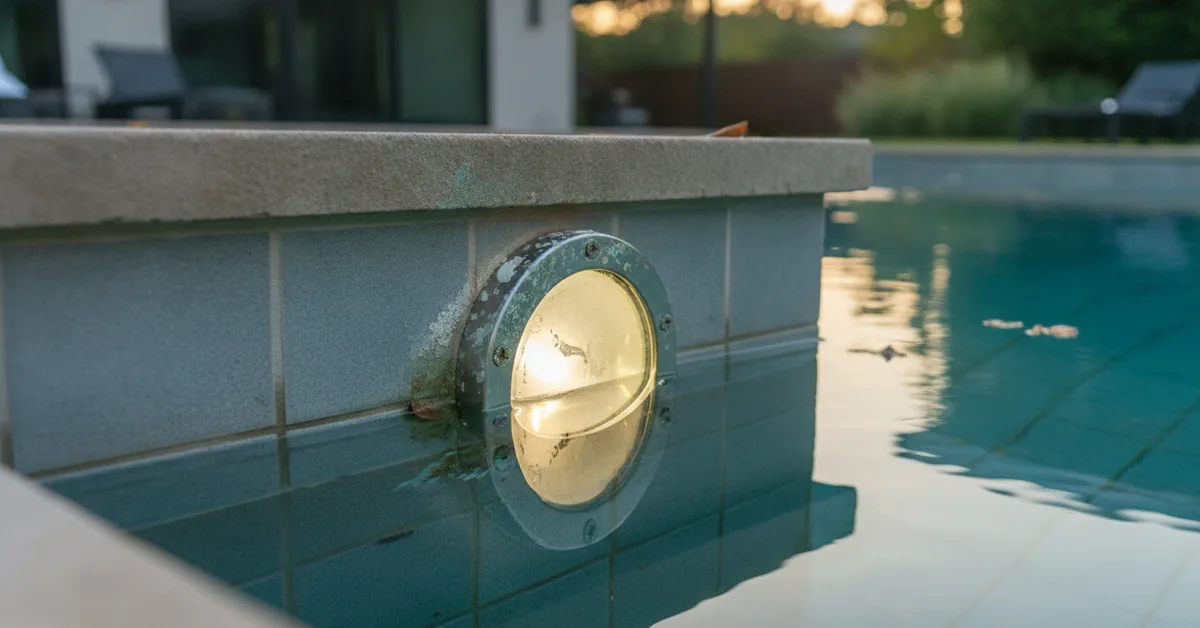
It was 8:30 PM on a hot Saturday evening when a backyard dinner party in Scottsdale came to an abrupt halt. The vibrant teal luminescence of the underwater pool light blinked twice, flickered violently, and vanished into total darkness, leaving behind a faint smell of burnt epoxy near the equipment pad. When I arrived on-site Monday morning, I pulled the $1,200 light fixture out of its wet niche only to find the rubber face-plate gasket eroded into a gummy, black sludge and two cups of chlorinated water trapped inside the supposedly sealed LED housing. The homeowner assumed a power surge killed the unit, but my chemical test kit revealed the true culprit: months of unbuffered, acidic water lingering at a pH of 6.5.
The Direct Link Between Water Chemistry and Underwater Light Longevity
Underwater pool lights are high-precision electronic units submerged in a dynamic chemical solution, making them deeply vulnerable to subtle shifts in water balance. Maintaining a balanced Langelier Saturation Index (LSI) prevents premature seal rot, housing pitting, and expensive internal diode failure.
- Low pH (below 7.2) rapidly attacks nitrile gaskets, silicone sealants, and brass niche screws through acidic oxidation.
- High pH (above 7.8) precipitates calcium onto glass lenses, creating an insulating scale blanket that traps heat and cooks LED drivers.
- Galvanic corrosion accelerates around underwater light niches when aggressive water breaks down protective metal oxides.
- Consistent water balancing around a target pH of 7.4 to 7.6 can double the operational lifespan of modern light engines.
The Chemical Cascade: How Acidic and Alkaline Water Target Light Assemblies
When pool owners think about aggressive water, they usually worry about etched plaster or burning eyes. In my weekly service routes across hundreds of residential pads, the most costly victims of pH imbalance are actually underwater light assemblies. Water is a natural solvent; when its pH drops below 7.2, it aggressively seeks minerals and compounds to neutralize itself. It attacks the softest materials first—specifically the elastomeric seals and silicone gaskets that keep hundreds of gallons of pool water away from high-voltage electrical connections.
Conversely, when pool water drifts above 7.8, it becomes scale-forming. Dissolved calcium carbonate drops out of solution and deposits onto the warmest surfaces available. Because underwater lights—even modern low-voltage LEDs—generate concentrated heat during operation, calcium forms a hard layer over the exterior lens. This scale layer prevents proper thermal transfer into the water, causing internal circuit boards to operate far above their rated temperature thresholds and causing catastrophic thermal throttling or total board burnout long before the manufacturer's expected lifespan.
A $1,400 Lesson: The Case of the Dissolved Brass Screw in Paradise Valley
A few seasons ago, I took over a pool in Paradise Valley where the homeowner relied entirely on floating Trichlor tablet dispensers. Trichlor has an extremely low pH (around 2.8), and without regular buffering from sodium bicarbonate, the pool water dropped to 6.6 and stayed there for four months. The water looked crystal clear, leading the owner to believe everything was working perfectly. However, during a routine evening lighting check, the primary 500-watt equivalent LED fixture went dead.
When I stepped onto the deck to extract the fixture, the bronze pilot screw securing the light ring to the niche disintegrated the moment my screwdriver applied torque. The low pH water had systematically stripped the zinc out of the alloy and turned the rubber cord sleeve into brittle paste. Water had slowly wicked through the power cord jacket straight into the sealed light engine. The entire fixture was ruined, along with the potted transformer secondary coil, leading to a $1,400 repair bill that a $15 bucket of pH increaser would have completely prevented.
| Fixture Component | Acidic Water Impact (pH < 7.2) | Alkaline Water Impact (pH > 7.8) | Typical Replacement / Repair Cost |
|---|---|---|---|
| Gaskets & O-Rings | Softening, leaching, elastomer breakdown, moisture leaks | Hardening, cracking, loss of elasticity over time | $35 – $90 (plus labor) |
| Stainless Steel Niche / Ring | Pitting, surface rust, localized galvanic breakdown | Thick calcium scale accumulation, rust staining underneath scale | $250 – $600 |
| Tempered Glass Lens | Etching, permanent micro-pitting, reduced clarity | Severe calcium carbonate scaling, reduced light transmission | $65 – $150 |
| Internal LED Driver / Board | Short-circuiting due to moisture ingress past degraded seals | Overheating due to thermal blanket effect from lens scale | $700 – $1,500 (full unit) |
| Brass Mounting Hardware | De-zincification, thread stripping, snapping during service | Seizure due to scale buildup in niche threads | $15 – $40 |
Thermal Dynamics and Lens Scaling: Why High pH Kills Modern LED Engines
Modern nicheless and standard LED pool lights rely entirely on the surrounding pool water for heat dissipation. Traditional 300W or 500W incandescent bulbs radiated immense heat, but modern micro-LED chips concentrate heat into small aluminum heat sinks packed inside tight polycarbonate housings. Water flowing over the exterior lens absorbs this heat continuously. When high pH causes a thin layer of scale to form over the glass or polymer lens, that scale acts as an thermal insulator.
Without efficient heat transfer into the pool water, internal junction temperatures on the LED board can easily exceed 185°F (85°C). At these elevated temperatures, solder joints crack, color-changing microcontrollers freeze, and output lumens drop rapidly. You might notice your light shifting to an improper color code or turning off automatically after 20 minutes of operation; this internal thermal shutdown is directly triggered by calcification on the lens surface driven by elevated pH and Total Alkalinity.
Step-by-Step Field Audit: Inspecting Your Lighting Assembly Today
- Test Raw pH and Calculate LSI: Before touching any hardware, pull a water sample from elbow-depth away from skimmers. Ensure your pH is strictly between 7.4 and 7.6, and your Langelier Saturation Index falls within -0.3 to +0.3.
- Perform a Visual Lens Inspection: Turn off the light circuit breaker at the main equipment pad. Looking into the pool with a mask or clear surface view, check the lens for white, rough calcification patches or localized fogging inside the glass.
- Inspect the Pilot Screw and Niche Rim: Check the top screw securing the light ring to the pool wall. If you see brown rust trails bleeding down the plaster below the light, aggressive chemical conditions are eating the metal hardware or niche bucket.
- Check the GFCI Outlet and Junction Box: Open your high/low voltage junction box at the pad. Inspect terminal connections for green copper oxide corrosion, which indicates moisture wicking up the cord jacket due to damaged light seals.
- Observe Thermal Behavior After 30 Minutes: Turn the lights on after dark and let them run for half an hour. If the fixture turns off unexpectedly or flickers through color cycles independently, check for thermal buildup caused by outer lens scaling.
Advanced Technical Troubleshooting: Frequently Asked Questions
- How does an unstable pH cause my GFCI breaker to trip repeatedly even when the light switch is turned off?
- When low pH degrades the outer silicone cord seal, acidic water creeps into the niche cord channel. Even with the wall switch in the "off" position, neutral or ground wires connected to the sub-panel carry low-level micro-amp leakages. The moisture bridge inside the niche creates a path to pool ground, causing sensitive GFCI breakers to detect a current imbalance and trip continuously.
- Can low pH cause chemical intrusion through the light cord jacket itself, away from the lens gasket?
- Yes. Most high-end pool light cords use specialized PVC or neoprene jacketing designed for continuous immersion. However, sustained exposure to water with a pH below 7.0 strips plasticizers from the cord material, causing the outer jacket to harden, shrink, and form micro-fissures—especially near the tight bend where the cord enters the back of the fixture housing.
- Why did my new LED pool light lens turn cloudy and brown within six months of installation?
- A brown or clouded lens on a relatively new fixture is typically caused by a combination of high pH and localized iron or manganese oxidation. High pH drives metals out of solution, and the ambient heat emitted through the light lens accelerates metal precipitation directly onto the glass surface, burning dark mineral stains permanently into the lens body.