

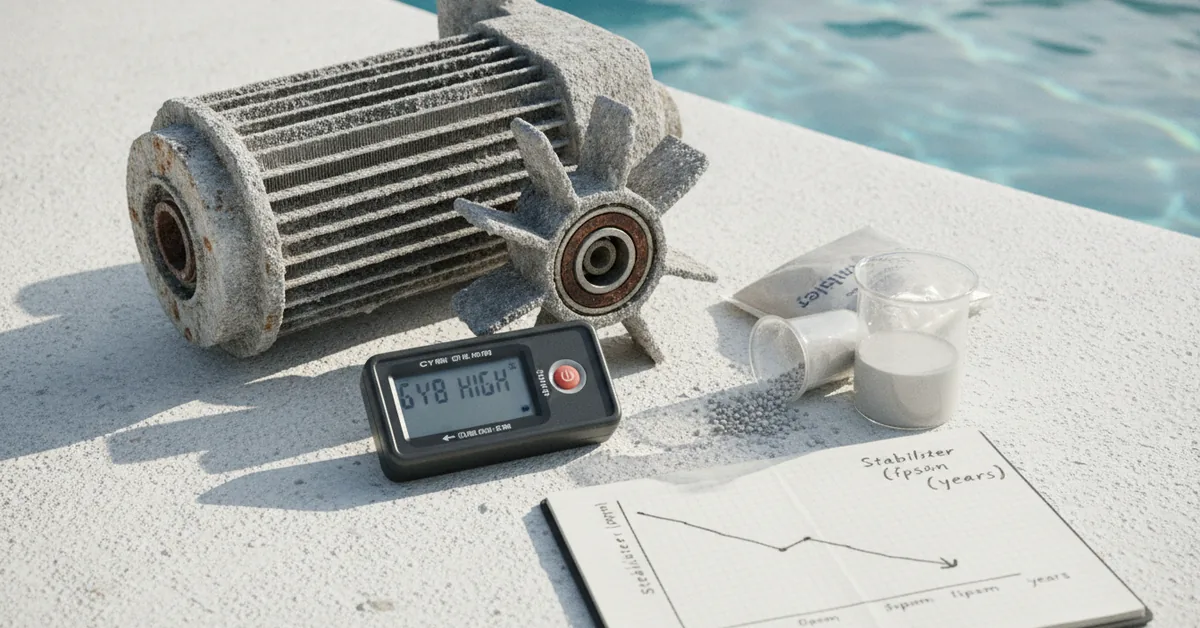
The mid-July sun was baking a 95-degree afternoon when I pulled up to a backyard in Scottsdale. The homeowner stood by his crystal-clear pool, hands on his hips, completely baffled. He had thrown twelve pounds of calcium hypochlorite shock into the water over seventy-two hours, yet by noon every single day, his free chlorine reading plummeted back to absolute zero. Meanwhile, his three-year-old salt chlorine generator was buzzing continuously at 100% output, straining under the heat while the heat exchanger on his gas heater was silently pitting from localized acidic corrosion. What he thought was a simple summer algae battle was actually a hidden financial catastrophe caused by runaway cyanuric acid (CYA)—an invisible chemical driver that drains bank accounts far faster than standard wear and tear ever could.
Executive Summary: The Financial Reality of Cyanuric Acid Imbalance
Maintaining proper cyanuric acid levels is not just about keeping water clear; it directly dictates the operational lifespan of your mechanical equipment and chemical burn rate. When stabilizer levels climb beyond recommended boundaries, pool owners face exponential chemical costs and premature hardware failures.
- Stabilizer levels exceeding 80 PPM trigger severe chemical lock, requiring up to four times more free chlorine to achieve adequate sanitization.
- Overworked salt chlorination cells operating at continuous maximum duty cycles suffer a reduced lifespan, often failing 2 to 3 years early at a replacement cost of $1,000 to $1,800.
- High CYA distorts total alkalinity calculations, leading to unbuffered pH drops that dissolve copper heat exchangers in gas heaters.
- Controlled dilution remains the most cost-effective remedy compared to continuous chemical overdosing and premature pad equipment replacement.
The Hidden Mechanics of Chlorine Lock and Mechanical Overload
Cyanuric acid acts as a solar shield for liquid and free chlorine, protecting hypochlorous acid (HOCl) from degradation by ultraviolet light. In ideal conditions—between 30 and 50 PPM for standard chlorine pools, and 60 to 80 PPM for salt systems—CYA forms a weak, reversible bond with chlorine. However, every time you use stabilized chlorine tablets (trichlor) or shock (dichlor), you permanently add CYA to your pool. It does not evaporate. It only concentrates.
When CYA creeps above 100 PPM, the chemical dynamics shift drastically. Cyanuric acid binds so tightly to the hypochlorous acid that the chlorine becomes inactive. To achieve the same oxidation potential as a pool with 40 PPM CYA, a pool with 120 PPM CYA requires an absurdly high free chlorine baseline. I routinely inspect equipment pads where homeowners think their salt generator is failing. In reality, the cell is producing pure chlorine continuously, but the over-stabilized water locks it up instantly, forcing the owner to turn pump run-times to 24 hours a day at high RPMs, accelerating mechanical seal wear and driving up monthly electrical bills.
A Technician's Field Case Study: The $3,200 Over-Stabilization Mistake
Two seasons ago, I received a service call from a home in suburban Dallas. The client, Arthur, complained that his electronic salt system was defective because his pool kept turning dull yellow every five days. He had spent over $600 on store-bought shock over two months before calling me. When I dipped my liquid reagent test kit and performed a 1:1 dilution test, his CYA read 160 PPM—off the standard chart.
Arthur had been using trichlor pucks in a floating feeder alongside his salt system during intense summer heat spikes. Because the water couldn't sanitize properly, his salt cell had been running at 100% output for 18 hours a day for two consecutive summers. Upon unthreading the cell unions, I saw that the ruthenium oxide coating on the titanium plates was completely exhausted and flaking off. Worse yet, because high CYA skews the true Carbonate Alkalinity test, his water had been aggressively balanced under a false pH assumption, causing invisible pitting inside his copper heat exchanger until it corroded through and filled his filter grid with blue-green copper scale. The total repair bill—a new salt cell, heater core replacement, and partial drain—exceeded $3,200. All of it was entirely preventable with a $35 liquid drop test kit.
Financial Impact Matrix: Stabilizer Levels vs. Equipment Lifespan
To put the financial impact into perspective, consider how varying stabilizer concentrations affect equipment efficiency, chemical consumption, and hardware longevity across a typical 20,000-gallon residential pool.
| CYA Level (PPM) | Required Free Chlorine (FC) | Salt Cell / Pump Strain | Heater Corrosion Risk | Estimated Annual Cost Impact |
|---|---|---|---|---|
| 0 - 20 (Deficient) | 1 - 2 PPM | Low strain, but UV destroys FC in 2 hours. | Low | $400 - $600 (Wasted chlorine due to UV burnoff) |
| 30 - 50 (Ideal Fresh) | 2 - 4 PPM | Optimal duty cycle (20% - 40% run time). | Minimal | Baseline Operating Cost |
| 60 - 80 (Ideal Salt) | 3 - 5 PPM | Efficient cell generation rate. | Minimal | Baseline Operating Cost |
| 100 - 120 (Elevated) | 8 - 10 PPM | High cell load (80%+ duty cycle), pump runs longer. | Moderate (False Alkalinity readings) | $700 - $1,100 (Excess chemical & power draw) |
| 150+ (Severe Lock) | 15+ PPM | Maximum cell burnout, high wear on mechanical seals. | High (Aggressive heat exchanger etching) | $2,500+ (Premature hardware replacement) |
Step-by-Step Field Audit to Protect Your Pool Investment Today
You do not need an engineering degree to evaluate your pool pad for stabilizer-induced stress. Walk out to your equipment area today and perform this simple tactical inspection to safeguard your cash flow:
- Perform a Dilution CYA Test: Standard test strips often cap out at 100 PPM and give false security. Use a reagent-based turbidity test (cyanuric acid reagent). If the dot disappears before the liquid reaches the 90 mark, mix 50% pool water with 50% tap water, re-test, and multiply the result by two to find your true number.
- Audit Your Salt Generator Output: Check your salt cell control panel. If your cell is set above 70% output for more than 8 hours a day on water under 85°F, inspect your stabilizer levels immediately. Running cells at maximum output drastically shortens their 10,000-hour operational life.
- Inspect Filter Operating Pressure: High CYA creates conditions ripe for repeated micro-algae blooms that clog cartridge elements or DE grids. Check if your filter tank pressure rises 8 to 10 PSI above clean starting pressure in fewer than 14 days.
- Calculate Carbonate Alkalinity: Subtract one-third of your total CYA reading from your measured Total Alkalinity. If your measured TA is 90 PPM and your CYA is 120 PPM, your actual Carbonate Alkalinity is only 50 PPM—meaning your water is acidic and actively eating copper components in your heater.
Advanced Equipment and Chemistry Troubleshooting FAQ
- How does high cyanuric acid specifically distort ORP sensor readings in automated chemistry controllers?
- Automated chemical feeders use Oxidation-Reduction Potential (ORP) sensors measured in millivolts (mV) to assess water sanitizing power. Cyanuric acid dampens the electronic response of ORP electrodes by slowing down electron transfer at the platinum probe surface. Even if total free chlorine is adequate, high CYA depresses the mV reading below the standard 650–750 mV threshold. This tricks the automated system into continuously feeding liquid chlorine or running a salt cell nonstop, over-saturating the pool with unnecessary chemicals while wearing out mechanical feed pumps and salt plates.
- Why can't I use chemical CYA reducers instead of draining my water to protect equipment?
- Biological CYA reducers utilize specialized bacterial enzymes to convert cyanuric acid into ammonia and nitrogen gas. While attractive in theory, these treatments require very strict water conditions—such as zero free chlorine, specific temperature ranges, and minimal flow—to work. If any residual chlorine exists, it neutralizes the active enzymes instantly. In real-world field conditions, enzyme treatments yield inconsistent results, often leaving behind high ammonia levels that demand massive doses of expensive shock to correct. Partial water replacement remains the only mathematically predictable and cost-effective method to lower high CYA levels.
- Does running a variable speed pump at lower speeds offset the damage caused by high stabilizer levels?
- Running a variable speed pump at low RPMs reduces electrical consumption, but it does not mitigate the chemical damage of incorrect CYA. Lower flow rates extend the contact time of aggressive, low-pH water inside the heater core when chemical balance is distorted by high stabilizer. Furthermore, if your salt generator is forced to run for prolonged periods to overcome chlorine lock, low flow rates can lead to localized gas buildup inside the electrolytic cell housing if flow switches fail, causing heat stress on the plastic cell body and sensor housing.