

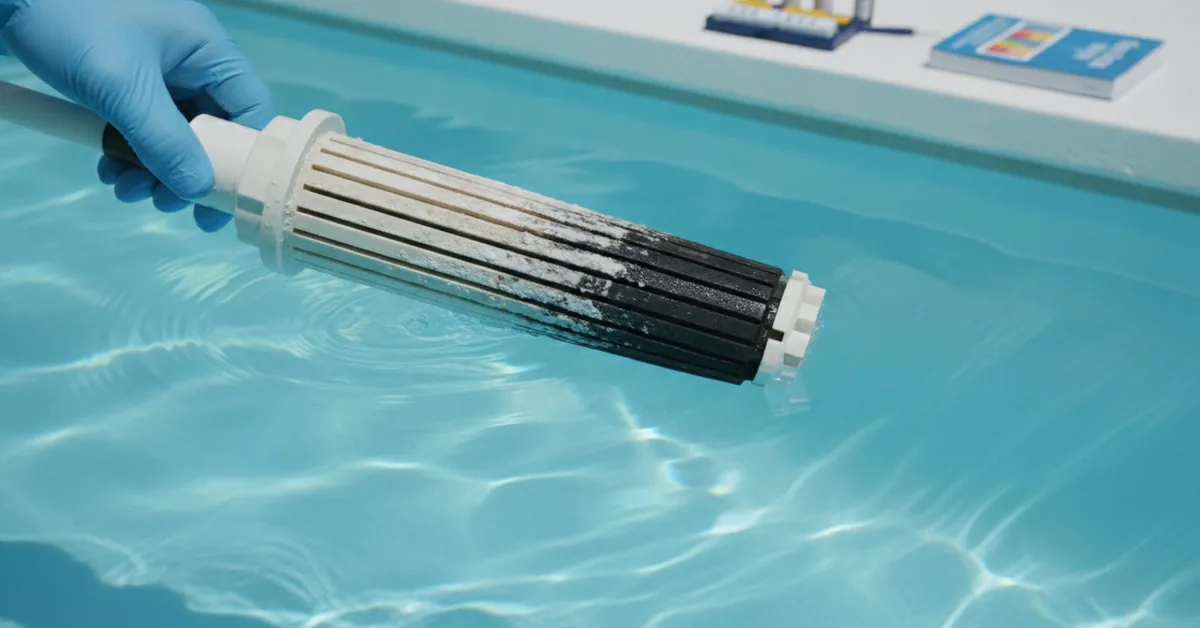
Running your saltwater chlorine generator at 100% output to keep up with intense summer heat is actually the fastest way to burn through a $1,200 electrolytic cell. Most pool owners believe that when a saltwater pool fails to maintain a chlorine residual, the cell is either scaled with calcium, failing electronically, or lacking sufficient salt in the water. In reality, cranking up your output percentage to compensate for chronic chlorine loss is usually a sign of incorrect cyanuric acid levels destroying your equipment behind the scenes. An electrolytic salt cell has a finite lifespan measured in operational hours, and mismanaging your stabilizer forces the system to consume its precious ruthenium plate coating years ahead of schedule.
Executive Summary: Protecting Your Salt Generator Investment
Maintaining the proper cyanuric acid concentration is the single most critical factor in determining whether your salt
Maintaining the proper cyanuric acid concentration is the single most critical factor in determining whether your salt cell lasts three years or seven years. When stabilizer levels fall out of the ideal range, the salt chlorinator must run at elevated duty cycles to offset rapid chlorine loss, accelerating mechanical wear and chemical erosion.
By treating stabilizer as a protective shield for your cell rather than just a water balance chemical, you dramatically lower operational costs and prevent premature equipment failure.
- Ideal Range Alignment: Saltwater pools require higher cyanuric acid levels (60–80 ppm) than traditional liquid chlorine pools (30–50 ppm) to protect localized chlorine production.
- Duty Cycle Mitigation: Proper stabilizer levels reduce the required output percentage of your chlorinator, cutting operating hours and preserving plate coatings.
- Chlorine Efficiency: Insufficient CYA allows up to 90% of free chlorine generated by the cell to degrade under direct sunlight within two hours.
- Cost Prevention: Optimizing water chemistry prevents unnecessary equipment replacements and extends electrolytic plate lifespan by up to four additional seasons.
The Electrolysis Mechanics: How Low Stabilizer Destroys Cell Plates
To understand why stabilizer dictates cell longevity, you have to look at what happens inside the cell housing. As saltwater passes over the micro-charged titanium plates, electrolysis converts sodium chloride and water into hypochlorous acid and sodium hypochlorite. This process produces pure, unstabilized chlorine directly at the cell outlet. Unlike trichlor pucks or stabilized granules, the chlorine generated by your salt cell contains zero cyanuric acid.
When this unstabilized chlorine exits the return jets into a pool with low stabilizer (under 30 ppm), raw ultraviolet radiation breaks down the chlorine molecules in less than 45 minutes. The pool owner sees a zero chlorine reading on their test kit and naturally turns the chlorinator knob up to 100% output while extending pump runtimes to 14 hours a day.
An electrolytic cell rated for 10,000 operational hours will burn out in under two years if forced to run continuously at maximum capacity. By raising cyanuric acid to the salt pool sweet spot of 70 ppm, the produced chlorine is immediately shielded from solar destruction. This simple adjustment allows you to drop the chlorinator output setting down to 30% or 40% while maintaining a bulletproof free chlorine level, effectively doubling or tripling the calendar lifespan of your equipment.
High CYA and Chlorine Lock: The Under-Reported Danger to Salt Systems
While low stabilizer burns through cell life via overwork, excessively high cyanuric acid (above 90 to 100 ppm) creates a completely different failure mode. High stabilizer levels bind tightly with free chlorine, reducing its chemical reactivity and sanitizing efficacy. This phenomenon requires a significantly higher total free chlorine concentration just to achieve the same level of sanitation, forcing the pool owner back into the trap of running the chlorinator at elevated percentages.
When stabilizer climbs too high—often from years of adding cyanuric acid without measuring drain dilution—the active disinfectant ratio drops. To keep algae at bay, you need a free chlorine level that represents roughly 7.5% of your total CYA reading. If your CYA sits at 120 ppm, you need to maintain 9 ppm of free chlorine continuously, putting an unsustainable burden on your chlorinator.
| Stabilizer Level (CYA) | Target Free Chlorine | Required Cell Duty Cycle | System Stress Factor | Expected Cell Lifespan |
|---|---|---|---|---|
| 0 - 20 ppm (Extremely Low) | 1.0 - 3.0 ppm | 90% - 100% | High physical wear, rapid coating erosion | 1.5 - 2.5 Years |
| 30 - 50 ppm (Standard Pool) | 2.0 - 4.0 ppm | 60% - 80% | Moderate wear, elevated thermal stress | 3.0 - 4.0 Years |
| 60 - 80 ppm (Salt Pool Sweet Spot) | 3.0 - 5.0 ppm | 30% - 50% | Optimal performance, low thermal stress | 5.0 - 7.0 Years |
| 100+ ppm (Over-Stabilized) | 7.5+ ppm | 70% - 100% | Chlorine lock risk, elevated duty cycle | 3.0 - 4.5 Years |
From the Service Route: The $1,400 Cell Replacement That Didn't Need to Happen
On a service call in Dallas during a scorching August heatwave, I inspected a client's pad where they were about to buy their third salt cell in five years. The homeowner was convinced their variable speed pump wasn't moving enough water or that the power center transformer was dying. The salt level was verified at 3,400 ppm, yet the cell was running at 100% for 16 hours a day and struggling to maintain even 0.5 ppm of free chlorine.
I pulled out my turbidity tube testing kit and measured the cyanuric acid. It read barely 15 ppm. Years of winter rains, backwashing, and water displacement had diluted the stabilizer, but no one had tested for CYA since the original salt system installation. The cell plates were physically stripped of their dark ruthenium oxide coating, displaying exposed bare titanium beneath.
We replaced the destroyed cell, but before turning the system back on, I added granular cyanuric acid through a skimmer sock to bring the pool up to 75 ppm. Within 24 hours, the new cell was maintaining a crisp 4.0 ppm chlorine residual while operating at just 35% capacity. Correcting the stabilizer chemistry first saved the homeowner thousands of dollars in recurring hardware failures and dramatically reduced energy usage on their pump pad.
Pad Inspection Protocol: Step-by-Step Salt System Calibration
- Perform a manual reagent turbidity test for Cyanuric Acid using a sight-tube tester rather than standard test strips, which frequently misread high CYA levels by up to 30 ppm.
- Inspect the physical electrolytic cell plates for calcium carbonate scale or flaking metal coating before adjusting output settings.
- Dose the pool with dry cyanuric acid via the skimmer or liquid stabilizer through the deep end to target 70 ppm, adding chemical in stages to avoid overshooting.
- Recalibrate the chlorinator power center output setting down to 30%–50% once stabilizer levels equilibrate over 48 hours.
- Check real-time salinity readings against an independent hand-held digital meter to ensure the control board isn't compensating for false salt readings by overdriving current to the cell.
Advanced Troubleshooting: Salt Cells and Water Chemistry FAQs
- How does high calcium hardness interact with improper stabilizer levels inside a salt cell chamber?
- When stabilizer is low and the system is forced to run at 100% output, the electrolytic chamber operates at a higher internal temperature and localized high pH (often exceeding 10.0 at the cathode plate). If calcium hardness is also elevated (above 400 ppm), this intense micro-environment causes rapid calcium carbonate precipitation directly onto the titanium plates, suffocating electric current and forcing the power center to push maximum amperage through remaining clear plate areas.
- Why do manufacturers recommend higher CYA levels for salt chlorine generators compared to traditional liquid chlorine pools?
- Traditional pools receiving liquid chlorine or bleach get large batch doses of sanitizer all at once, whereas salt pools produce chlorine slowly, grain by grain, over hours of filtration. Higher CYA (60–80 ppm) acts as an immediate structural dynamic reservoir, capturing these micro-doses of hypochlorous acid the moment they leave the return jet before sunlight can burn them off.
- Can running a salt cell at 100% output trigger false system error codes like "Low Salt" or "Cell Clean"?
- Yes. Continuous high-output operation accelerates plate surface depletion and elevates internal heat within the cell housing. As the ruthenium oxide coating wears thin or scales over from thermal stress, electrical resistance across the plates rises. The control board interprets this resistance drop as low salinity or reduced connectivity, firing "Low Salt" or "Inspect Cell" warning lights even when actual water salinity is perfectly balanced.