

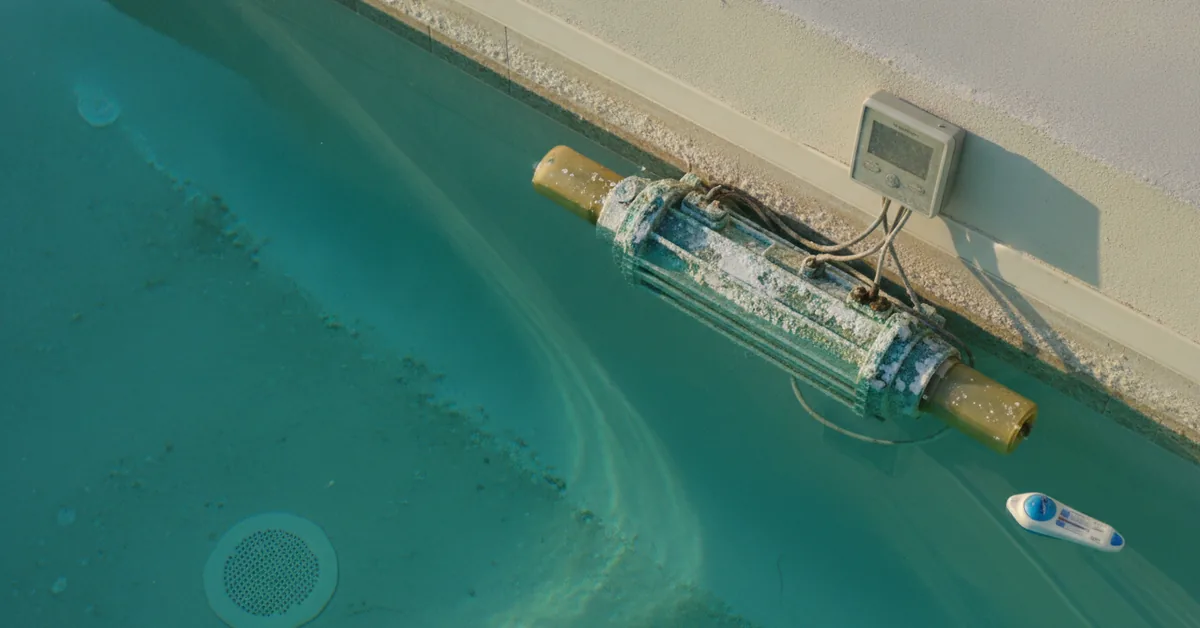
Running your saltwater chlorinator at 100% output to fight off hazy summer water is often the quickest way to burn through a $1,200 electrolytic cell before its time. Most homeowners assume that if their free chlorine drops, the saltwater system simply needs to push harder, but the actual villain sitting on the equipment pad is usually invisible chemical neglect: incorrect Cyanuric Acid (CYA) levels. Over the past 15 years servicing pools across scorching summers, I have condemned hundreds of premature salt cell deaths that were completely preventable with a single bottle of stabilizer and a basic understanding of water chemistry dynamics.
The Chemical Shield: Why Cyanuric Acid Dictates Salt Cell Lifespan
Maintaining precise Cyanuric Acid (CYA) levels is the single most critical factor in preventing premature failure of
Maintaining precise Cyanuric Acid (CYA) levels is the single most critical factor in preventing premature failure of saltwater chlorine generator (SWCG) cells. Without proper stabilization, ultra-violet radiation destroys generated free chlorine almost instantly, forcing the system's titanium plates to work constantly under extreme electrical stress.
- Optimal Saltwater Target: Saltwater pools demand 60–80 PPM of stabilizer—significantly higher than traditional liquid chlorine pools—to adequately buffer micro-dosed chlorine against intense UV loss.
- Reduced Duty Cycles: Proper stabilizer levels allow salt cells to run at lower percentage outputs (e.g., 20–40%), directly preserving the expensive ruthenium oxide coating on the electrolytic plates.
- Low CYA Strain: When stabilizer drops below 30 PPM, solar destruction forces chlorinators to run 24/7, wearing down titanium plates in 2 to 3 seasons instead of their expected 5 to 7 year lifecycle.
- High CYA Lockup: CYA levels exceeding 100 PPM induce chemical lock, requiring unrealistically high chlorine residuals to sanitize, which prompts homeowners to over-acidify and ruin cell housing during desperate cleaning cycles.
How UV Burn-Off Forces Electrolytic Cell Overwork
To understand why stabilizer directly dictates hardware lifespan, you have to look at what happens inside the salt cell union. Saltwater chlorinators convert dissolved sodium chloride into hypochlorous acid (free chlorine) via electrolysis. As water passes across titanium plates coated with a razor-thin layer of ruthenium dioxide, electrical current splits the salt and water molecules. This generates pure chlorine gas right at the plate surface. It is a brilliant, self-sustaining process, but it produces chlorine in micro-doses compared to dumping a gallon of liquid bleach into the skimmer.
Without Cyanuric Acid acting as a sunscreen, up to 90% of that freshly generated free chlorine is destroyed by solar ultraviolet rays within two hours. When a homeowner notices the pool water going hazy, their immediate reaction is to head to the control panel and crank the system from 30% up to 80% or 100% output, while extending the variable speed pump runtime to 24 hours a day. Every percentage increase in cell output directly consumes the finite micro-layer of ruthenium oxide, rapidly shortening the component's total operational lifespan.
When you force a salt chlorinator to run at maximum output day after day just to fight off sunlight, you are effectively running a car engine at redline during every commute. The titanium core remains intact, but once that catalytic coating is eroded by sheer chemical production hours, the cell becomes a useless plastic tube that can no longer conduct electrolysis.
Field Story & The Stabilizer Spectrum Matrix
A few seasons back, I took over a service call for a client named Dave in Scottsdale. He had installed a premium 40,000-gallon capacity saltwater system on a 22,000-gallon pool—a setup that should have cruised effortlessly for seven years. Yet, after just 18 months, his system flashed a red "Inspect Cell / Low Salt" error, despite the salt content measuring a perfect 3,400 PPM. When I pulled the cell, the titanium plates weren't scaled up with calcium; they were completely dull, smooth, and exhausted.
I ran a full chemical balance test on his water. His CYA was sitting at a bottom-dwelling 12 PPM. Dave had been backwashing his sand filter weekly, topping off with city water, and completely ignoring his stabilizer level. To keep his water clear in the Arizona heat, he had set his chlorinator to 100% output for 14 hours a day. He burned through five years of cell life in a year and a half simply because he didn't realize that maintaining 70 PPM CYA reduces cell operating hours by over 50% compared to standard un-stabilized water.
| CYA Level (PPM) | Chlorinator Efficiency | Avg. Output Needed | Projected Cell Lifespan | Primary System Risk |
|---|---|---|---|---|
| 0 - 30 PPM | Extremely Poor | 80% - 100% | 1.5 - 3 Years | Rapid UV chlorine destruction; extreme plate wear |
| 30 - 50 PPM | Moderate | 50% - 70% | 3 - 4 Years | Standard target for traditional pools; suboptimal for SWG |
| 60 - 80 PPM | Maximum (Ideal) | 20% - 40% | 5 - 7+ Years | Optimal UV protection; minimal electrical duty cycle |
| 100+ PPM | Severe Lockout | N/A (Compromised) | Varies (Damage via cleaning) | Chlorine lock; excessive acid washing requirement |
High CYA, Acid Washing, and the Silent Scale Trap
While low CYA destroys salt cells through forced overwork, excessively high CYA (above 100 PPM) creates a completely different mechanism of failure: accelerated plate degradation from over-maintenance and scale formation. High CYA alters the Langelier Saturation Index (LSI) by masking true carbonate alkalinity. When pool owners test total alkalinity without adjusting for cyanurate ions, they frequently miscalculate water balance, leading to aggressive scale formation inside the cell.
During normal electrolysis, the localized pH inside the cell chamber spikes to 13 or higher around the cathode plates. If the bulk water chemistry is even slightly scale-forming due to miscalculated LSI, calcium carbonate immediately precipitates out of solution and coats the plates in heavy white crust. The cell's self-cleaning reverse polarity feature struggles to shed this heavy build-up, prompting the homeowner to pull the cell and wash it in a muriatic acid bath.
Herein lies the silent trap: every time you pour a diluent mixture of muriatic acid through an electrolytic cell to strip away calcium scale, the acid slightly eats away at the precious metal coating. If high stabilizer levels are causing rapid scaling and forcing you to acid-wash your salt cell every few weeks, you are chemically stripping the life off those plates far faster than normal electrolysis ever could.
Step-by-Step Equipment Pad Protocol for Stabilizer Management
To maximize the operational life of your saltwater cell and prevent chemical lock, follow this step-by-step procedure on your equipment pad at least once every spring and mid-summer:
- Inspect the Cell Chamber First: Shut down power at the breaker, unscrew the salt cell unions, and look down the barrel between the titanium plates. If you see bridging calcium scale, perform a mild wash using a diluted 10:1 water-to-muriatic-acid ratio. If it is clear, leave it alone—never acid-wash a clean cell.
- Perform a Turbidity CYA Test: Avoid using cheap test strips, which can easily be off by 30–40 PPM. Use a reagent-based sight-tube test (like the Taylor K-2006). Take your water sample 18 inches below the surface away from return jets, and ensure the sample is at room temperature (around 70°F–75°F) for accurate light refraction.
- Dose Cyanuric Acid via the Sock Method: If your CYA is below 60 PPM, calculate the dosage needed to reach 70 PPM. Pour dry granular stabilizer into a white tube sock, tie off the top, and suspend it directly in front of a pool skimmer or suction line. Never dump dry CYA directly into the skimmer skim-basket uncontained, as it can settle in the filter and slow down water circulation.
- Recalibrate Pump Schedule and Cell Percentage: Once stabilizer reaches the 60–80 PPM target range, drop your saltwater generator output back down to 20%–40%. Adjust your variable speed pump to run at a low energy-efficient speed (e.g., 1,600–1,800 RPM) for an extended filtration cycle. This delivers a steady, low-stress trickle of chlorine that maintains a perfect 3–5 PPM free chlorine residual effortlessly. Directly monitor your cell's operational hours and salt display every 30 days to confirm that no low-flow or high-voltage fault codes are triggering.
Operational Troubleshooting for Saltwater Systems
- Why do saltwater chlorinator manufacturers recommend higher CYA levels (60-80 PPM) than traditional liquid chlorine pools (30-50 PPM)?
- Saltwater chlorinators generate chlorine slowly and continuously over long filtration cycles. Unlike traditional pools where liquid bleach or trichlor tabs are added in large batch doses, SWCGs maintain a steady micro-dose. Higher stabilizer levels (60–80 PPM) act as a necessary protective buffer to prevent sunlight from destroying this low-level generation as fast as the cell produces it, allowing the equipment to run at lower, stress-free power settings.
- How does incorrect CYA affect the Langelier Saturation Index (LSI) inside the high-pH environment of an operating salt cell?
- Cyanuric acid contributes to Total Alkalinity (TA) in the form of cyanurate ions. To calculate true Carbonate Alkalinity for LSI, you must subtract roughly one-third of your CYA reading from your TA reading. High CYA levels disguise low carbonate alkalinity, causing pool owners to add balance chemicals incorrectly. Inside the salt cell—where local pH naturally spikes above 13 during electrolysis—this imbalance accelerates hard calcium scaling directly on the electrolytic plates.
- If my pool is over-stabilized above 100 PPM CYA, can I use a chemical reducer, or is draining the only practical fix?
- While biological CYA reducers exist on the market, they are notoriously finicky, requiring exact water temperatures, zero free chlorine residual, and days of slow reaction time with mixed success rates. In commercial and residential pool service reality, partial draining and refilling with fresh tap water remains the most reliable, cost-effective, and immediate method to lower high cyanuric acid levels and protect your equipment from chemical lock.