

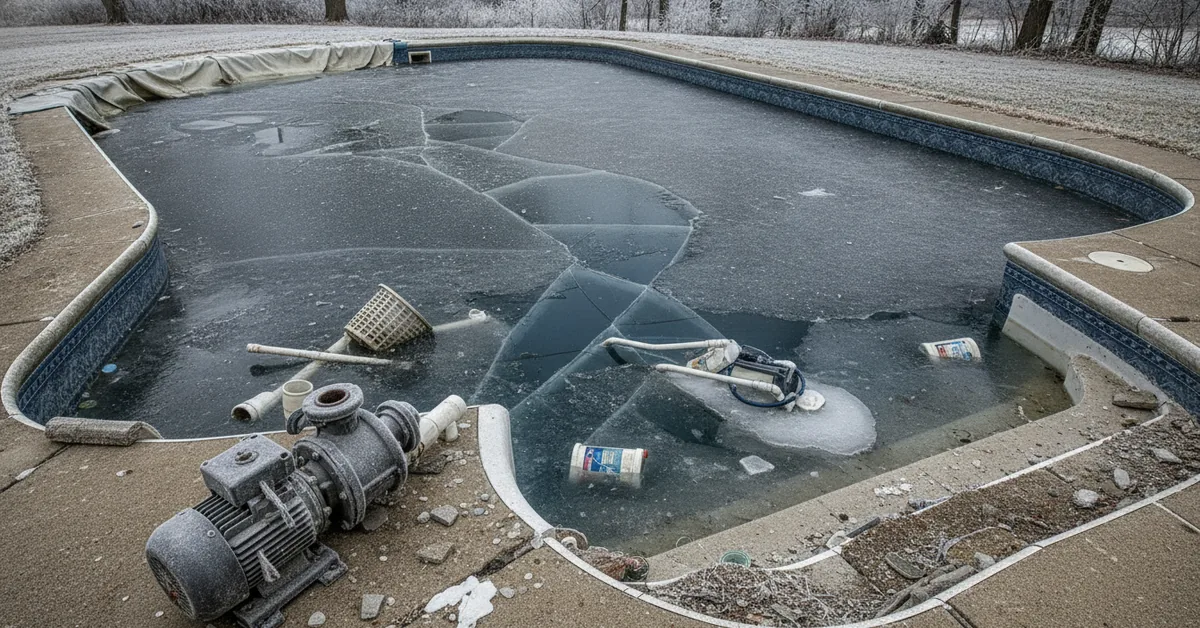
Slapping a solid safety cover over a pool filled with improperly balanced chemistry and air-locked plumbing is actually more destructive than leaving it open to the elements all winter. Most homeowners assume that as long as the water isn't circulating, chemical reactions slow down to zero and trapped residual water in underground lines will harmlessly expand into open spaces. In reality, stagnant water under a dark cover undergoes violent Langelier Saturation Index (LSI) swings while expanding ice exerts up to 30,000 PSI of mechanical force against unvented PVC lines, brass valves, and heat exchangers. Over my 15 years servicing commercial and residential pools across unpredictable freeze zones, I have written more repair quotes for closed pools than for those caught off guard by early autumn cold snaps.
Critical Overview: Structural and Mechanical Realities of Winter Pool Closing
Proper winterization is not merely a seasonal chore; it is an engineered preservation process designed to withstand subsurface expansion and corrosive stagnant chemistry. Failing to clear lines, balance LSI, and properly isolate equipment leads directly to subterranean pipe ruptures and cracked cast-iron or thermoplastic housings.
- Water expands by approximately 9% upon freezing, generating localized hydraulic pressure exceeding 30,000 PSI inside closed PVC pipes.
- Residual water in gas heater cores forms ice pockets that shear internal copper/cupro-nickel headers, averaging $1,800 to $3,500 in replacement costs.
- LSI drops below -0.3 in cold water strip calcium straight out of plaster finishes, leaving permanent etching and rough aggregate surfaces.
- Non-toxic propylene glycol antifreeze must be used exclusively; ethylene glycol breaks down elastomer seals and contaminates pool ecosystems.
Hydraulic Thermodynamics: Why Underground Lines Shear Under Ice Expansion
Pipes do not burst at the point where ice forms; they burst at the point where an air lock traps expanding water against an immovable obstruction. When water inside an underground Schedule 40 PVC pipe freezes, it expands laterally until it meets an air pocket or a closed valve. If you leave a half-drained skimmer line sealed at the pad without blowing it clear with a high-volume commercial blower, that water has nowhere to migrate as ice forms.
Back in 2018, I pulled up to a client's property in Bucks County where the homeowner used a standard shop vac to clear his return lines. He assumed five peak horsepower on a wet/dry vac was enough to clear an 80-foot underground run buried below the frost line. Come April, when we fired up his system, the pressure gauge pegged at 35 PSI and water began bubbling through his lawn. The shop vac had only cleared the vertical risers, leaving a 12-foot belly in the underground pipe full of water. It cost him $4,200 in jackhammering and trenching to replace a split suction line that a proper high-volume air blowout would have prevented.
The $3,000 Heat Exchanger Collapse: Heat Cores and Pump Volutes
Gas heaters and variable speed pumps are the most expensive items on your equipment pad, and they are notoriously unforgiving during winter. A gas heater's heat exchanger consists of thin-walled copper or cupro-nickel tubes designed for high heat transfer, not structural pressure resistance. Even if you pull the front drain plug on a Hayward or Raypak unit, water remains trapped in the rear header unless you physically blow low-pressure air through the internal bypass loop.
When ice forms in a heater header, it splits the internal bypass assembly or shears the bundle tubes right at the header plate. You won't know it happened until spring, when you turn the pump on and watch a steady torrent of pool water pour out of the heater exhaust stack. Replacing a heat exchanger core runs between $1,500 and $2,800 for parts alone, making it one of the most common total-loss mechanical failures I diagnose after bad winters. Variable speed pumps face similar fates when water freezes inside the strainer basket volute, cracking the outer composite housing—a mistake that costs $600 to $1,100 for a replacement wet end.
Comparative Freeze Risk & Chemical Stability Matrix
Understanding where failures occur allows you to allocate winterization effort where mechanical risk is highest. The following matrix outlines common failure mechanisms across key pool assets and the field standards required to protect them:
| Equipment / Surface | Primary Winter Hazard | Failure Mechanism | Pre-Winter Target Standard |
|---|---|---|---|
| Schedule 40 PVC Plumbing | Trapped water expansion | Longitudinal pipe splitting along subterranean runs | Air blowout at 50+ CFM; lines sealed with expanded rubber/threaded plugs |
| Gas Heater Heat Exchanger | Low-point water accumulation | Copper tube cracking and cast-iron/plastic header fracture | Drain plugs removed; internal bypass cleared; non-toxic PG added if required |
| Plaster / Quartz Finish | Aggressive cold-water LSI drop | Calcium leaching leading to deep surface etching and rough spots | LSI adjusted to +0.2 to +0.4 prior to closing (Calcium: 300-400 PPM) |
| Variable Speed Pump Volute | Water retention in strainer basket housing | Cracked thermoplastic pot housing and shaft seal failure | Drain plugs removed, housing coated with silicone lubricant on o-rings |
| Skimmer Assemblies | Surface ice pressure crushing plastic walls | Inward collapse of skimmer throat and wall separation | Gizzmo or expansion bottle installed to absorb ice displacement force |
Cold Water LSI Swings: How Unbalanced Chemistry Eats Plaster Under Cover
Many pool owners balance their water in September, throw on the cover, and forget about it until May. The critical flaw here is ignoring how temperature drops radically alter the Langelier Saturation Index (LSI). Water becomes significantly more aggressive as it cools down. Water with a perfectly balanced LSI of 0.0 at 80°F will plummet to an aggressive -0.45 LSI when the water drops to 40°F, even if pH, alkalinity, and hardness remain identical.
When water becomes LSI-negative (corrosive), it searches for calcium to satisfy its chemical equilibrium. In plaster, quartz, or pebble pools, the water actively leaches calcium carbonate directly out of the cement matrix. By spring, when you pull the cover back, your smooth plaster feels like 40-grit sandpaper, and white calcium scale coats your tile line. To prevent this, I always boost Calcium Hardness to 300 to 400 PPM and set Total Alkalinity between 100 to 120 PPM before closing, driving the warm-water LSI slightly positive (+0.2 to +0.3) so that as the water freezes, it settles into perfect equilibrium rather than turning acidic.
Field Protocol: Step-by-Step Pre-Winterization Audit
Before you store your maintenance kit for the winter, walk out to your pad and perform this field-tested execution sequence:
- Balance Water for Temperature Drift: Test water 7 days prior to closing. Adjust pH to 7.4 - 7.6, Total Alkalinity to 100 - 120 PPM, and Calcium Hardness to 300 - 400 PPM to cushion the winter cold LSI shift.
- Shock with Non-Stabilized Chlorine: Bring Free Chlorine to 5 - 10 PPM using liquid sodium hypochlorite rather than dichlor or trichlor to avoid spiking Cyanuric Acid (CYA) levels above 50 PPM.
- Lower Water Level Below Tile Line: Drain water 4 to 6 inches below the skimmer mouth for mesh covers, or 2 to 3 inches below for solid safety covers, preventing freeze-thaw tile line popping.
- Execute High-Volume Pipe Blowout: Connect a commercial blowout rig to the pad piping. Blow main drains until they bubble furiously, then isolate valves to air-lock the pipe under pressure before closing the valve.
- Protect Skimmers with Expansion Devices: Insert a threaded Gizzmo or closed-cell foam expansion log into every skimmer housing to absorb ice compression.
- Pull All Mechanical Drain Plugs: Remove drain plugs from the pump strainers, filter tank, heater header, and chlorinator. Store plugs inside the pump basket for spring access.
Advanced Winterization FAQs: Field Diagnostics and Troubleshooting
- Why does my pool lose water under a sealed safety cover during dead winter?
- Water loss under a winter cover typically stems from one of two issues: hydrostatic relief valve failure at the bottom of the pool or an undetected siphon effect through an improperly air-locked main drain line. If a main drain valve leaks air at the pad, hydrostatic pressure pushes pool water back up through the pipe, breaking the air lock and slowly draining the pool until equilibrium is reached.
- Can I use standard RV non-toxic antifreeze in pool plumbing, or does it require specialized pool antifreeze?
- While both often contain propylene glycol, pool-specific antifreeze is formulated without additives or ethanol blenders found in low-grade RV fluids. RV antifreeze containing ethanol can degrade rubber O-rings inside multiport valves and Jandy diverters, and it can foster localized organic growth inside lines, leading to stubborn spring blooms. Always verify the label specifies 100% Virgin Propylene Glycol with freeze protection down to -50°F or lower.
- How does high CYA affect winter water chemistry and potential cover staining?
- Cyanuric Acid (CYA) above 70 PPM locks up available chlorine, but more importantly, high CYA depresses effective alkalinity. In cold water, high CYA shifts the LSI sharply into corrosive territory even if Total Alkalinity appears normal on standard test kits. Furthermore, during long stagnant months, excessive CYA can convert into ammonia through anaerobic bacterial degradation under the cover, requiring immense amounts of chlorine shock to clear in spring.