

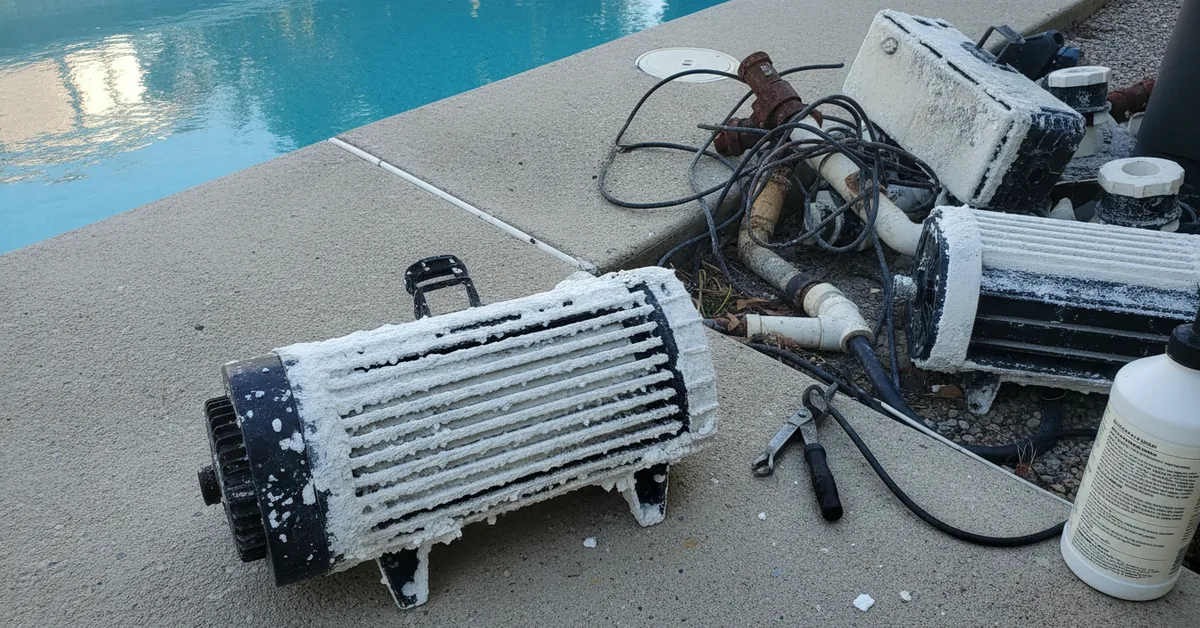
Running a salt chlorine generator at 100% output when chlorine levels drop is often the fastest way to destroy a $1,100 electrolytic cell while doing zero to sanitize your pool. Most homeowners assume that if their water is turning cloudy or the control panel flashes a warning, cranking up the sanitize percentage is the logical fix. In reality, when scale forms over internal ruthenium-coated titanium plates, pushing more electrical current through the system generates severe localized heat, accelerates plate degradation, and spikes your monthly utility bill without producing a single gram of free available chlorine.
Over my 15 years servicing salt water systems across hard-water regions in the Sunbelt, I have seen thousands of dollars wasted on cell replacements that were completely preventable. Scaling is not just an aesthetic annoyance on your pool plaster; it is an active mechanical and chemical barrier that alters how your equipment pad functions. Understanding the silent chemistry occurring inside that clear plastic housing is the difference between a chlorinator that lasts seven years and one that dies in eighteen months.
Executive Summary: The Silent Financial Drain of Electrolytic Scaling
Calcium carbonate scale formation inside a salt water chlorinator creates an insulating barrier that chokes off chlorine production while dramatically increasing electrical resistance. Left unaddressed, scaling causes premature cell failure, incorrect salt readings, and unnecessary chemical over-correction that ruins pool plaster and equipment.
- Scale accumulation inside the cell matrix acts as an electrical insulator, forcing the power center to draw maximum amperage while output plummets.
- Localized pH spikes inside the cell during electrolysis create micro-environments where calcium precipitates out of water faster than standard pool surface water.
- Over-cleaning with concentrated acid strips the catalytic noble metal coating from titanium plates, permanently ruining cell capacity.
- Maintaining a negative or neutral Langelier Saturation Index (LSI) prevents scaling without sacrificing plaster longevity or equipment integrity.
The Electrolytic Micro-Environment: Why Scale Forms Faster Inside the Cell
To understand why scaling happens, you have to look beyond the general body of pool water. Inside an active salt chlorinator cell, continuous electrolysis breaks down dissolved sodium chloride and water into sodium hydroxide and hydrogen gas at the cathode plate. This reaction causes a massive localized pH surge—often exceeding 10.0 pH right at the plate surface—even if your main pool water tests at a perfect 7.4 pH.
When localized pH skyrockets alongside thermal energy generated by electrical current, dissolved calcium carbonate loses solubility and instantly precipitates onto the titanium plates. If your pool water maintains a Calcium Hardness above 400 ppm or your total alkalinity hovers near 120 ppm, this micro-chemical reaction speeds up exponentially. Over time, these white crusty deposits bridged across adjacent plates alter electrical conductivity and trick the main circuit board into throwing false diagnostic error codes.
Field Case Study: The $1,400 'Faulty Cell' That Was Just a Chemical Trap
Last summer in Scottsdale, Arizona, I was called out to inspect a 40,000-gallon plaster pool where the homeowner had already replaced two salt cells in under three years. The control panel was displaying a persistent 'Low Salt' light, despite the owner dumping eight 40-pound bags of pool salt into the water over two weeks. The cell was operating at 100% capacity, yet the water was turning pale green and chlorine levels were sitting at absolute zero.
When I pulled the cell off the union couplings, the internal plates were so clogged with dense, rock-hard calcium scale that you couldn't see daylight through the grid. The owner assumed the board was failing. In truth, the scale was insulating the sensor plates, making the system calculate salinity based on distorted electrical resistance. We performed a mild diluted acid flush, lowered his Calcium Hardness from 650 ppm down to 300 ppm via a partial drain, and reset his water chemistry. The original cell fired right back up, producing 3.2 ppm of free chlorine within 24 hours. He had burned through $1,400 in replacement cells simply because no one explained how extreme hardness breaks salt systems.
Diagnostic Matrix: Scale Symptoms vs. Chemistry Root Causes
Distinguishing between actual cell degradation and simple calcium scaling requires comparing system error messages against real drop-test water chemistry metrics.
| Control Board Symptom | Physical Cell Condition | Root Water Chemistry Cause | Corrective Action Required |
|---|---|---|---|
| 'Low Salt' error despite proper salt test | White crust bridging plates completely | High pH (>7.8) & High LSI (>+0.5) | Soak in 10:1 diluted muriatic acid solution |
| 'Check Cell' or Low Current flashing | Light flaky debris near plate edges | Elevated Calcium Hardness (>450 ppm) | Lower Calcium via partial drain; adjust acid levels |
| Zero chlorine output at 100% setpoint | Severe scale & pitted dark titanium plates | Acid damage from previous improper cleanings | Replace cell; titanium coating stripped away |
| High cell voltage / low amperage draw | Hardened white scale blockages in center slots | High Total Alkalinity (>140 ppm) driving pH up | Burn off alkalinity using targeted acid additions |
The Invisible Financial Drain: Variable Speed Pumps and Equipment Fatigue
When scale bridges the 1/8th inch gap between titanium plates inside a salt cell, water flow restriction becomes an immediate issue. For pool owners utilizing variable speed pumps, restricted flow forces the system to operate at higher RPM settings to clear safety flow switches, driving up daily watt consumption. A pump forced to ramp from 1,750 RPM to 2,800 RPM simply to push water through a scaled chlorinator can cost an additional $40 to $70 per month on electricity alone.
Furthermore, scaled cells generate extreme internal heat. When water cannot flow smoothly over the plates, localized liquid temperatures inside the cell housing can exceed 115 degrees Fahrenheit. This excessive thermal stress degrades the plastic cell housing, damages the main power center's transformer, and rapidly strips the ruthenium dioxide coating off the titanium substrate. A cell designed to last 5 to 7 years can easily fail in under 18 months under these conditions.
Step-by-Step Troubleshooting: Cleaning and Protecting Your Salt Cell
If your chlorinator displays scaling or false salt readings, follow this operational protocol at your pool pad before buying new hardware or dumping raw chemicals into the pool.
- Turn off all power to the pool equipment pad at the main circuit breaker panel to prevent automatic pump start-ups or electrical shock.
- Close operational valves to isolate the salt cell line, then unscrew the quick-disconnect unions at both ends of the cell housing.
- Perform a visual inspection using a bright flashlight, looking through the barrel of the cell for white, chalky bridges between the metal plates.
- Test your pool water independently using a FAS-DPD drop test kit to verify actual salinity (target 3,000 to 3,500 ppm) and LSI balance, rather than trusting the control panel display.
- If heavy scale is present, screw the cell onto a cleaning stand and fill it with a diluted solution of 10 parts water to 1 part muriatic acid (ALWAYS add acid to water, never water to acid).
- Allow the solution to foam for 8 to 10 minutes until bubbling stops, then pour the mixture into a chemical-safe container and rinse thoroughly with clean hose pressure. Never use metal tools or screwdrivers to scrape the plates.
- Reinstall the cell, open isolated valves, restore power at the breaker, and re-test chlorine production output over a 48-hour period.
Advanced Salt Chlorinator Troubleshooting FAQs
- How does localized electrolytic heat inside the salt cell accelerate calcium scaling even when overall pool water appears balanced?
- During electrolysis, electricity passing through salt water splits molecules into chlorine gas, hydrogen gas, and sodium hydroxide. Sodium hydroxide creates an extreme micro-zone of ultra-high pH (above 10.0) right along the titanium plate surfaces. Because calcium carbonate becomes significantly less soluble at higher pH levels and elevated temperatures, calcium drops out of solution and attaches to the plates even if your main pool water tests at a perfectly balanced 7.4 pH.
- Why does cleaning a salt cell with concentrated muriatic acid permanently damage chlorination capacity?
- Titanium plates inside a salt cell are coated with a microscopically thin layer of ruthenium dioxide or iridium oxide, which acts as the precious metal catalyst for chlorine generation. Using high-concentration acid baths (such as 50% acid or straight acid) dissolves this catalytic coating right off the metal substrate. Once this coating is stripped away, the raw titanium cannot perform electrolysis, rendering the cell useless regardless of how clean the plates appear.
- Can high calcium hardness cause a false 'Low Salt' reading on my chlorinator control board?
- Yes. Salt chlorinators do not directly count salt molecules in water; they calculate salinity by measuring electrical conductivity across the plates. Calcium scale acts as a physical electrical insulator. When scale builds up between the plates, current flow drops, causing the control board's microcomputer to interpret the reduced electrical conductivity as a drop in salt levels, triggering a false 'Low Salt' warning.