

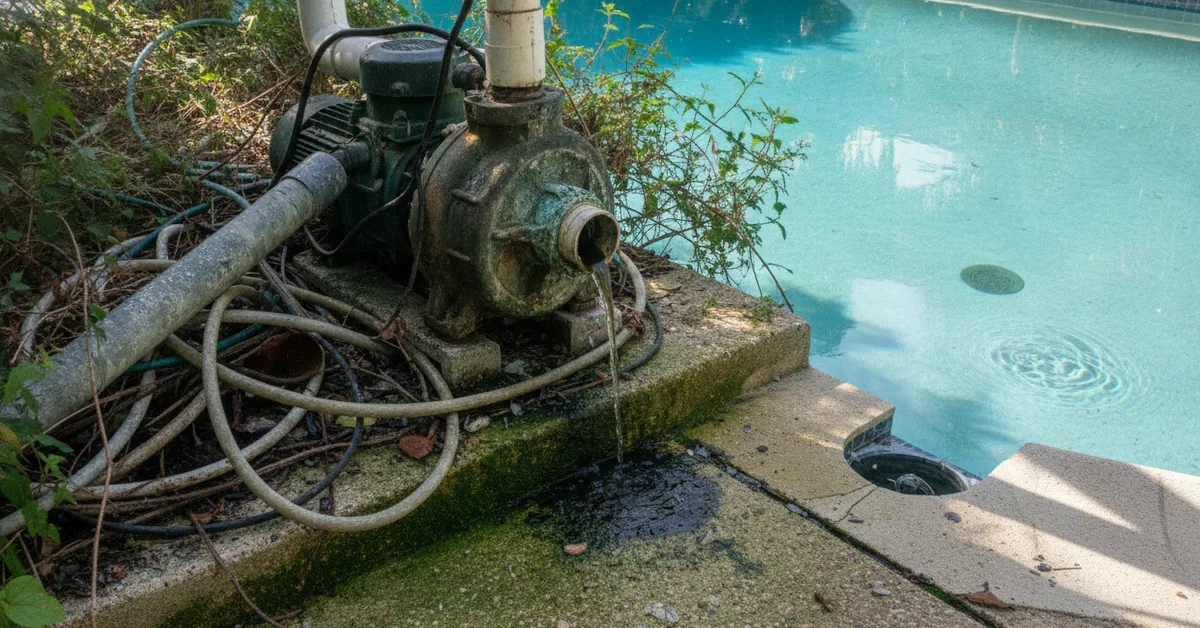
Assuming that a humming pool pump moving water is automatically healthy is the most expensive mistake a homeowner can make on the pool pad. Most pool motors do not die of old age; they are slowly tortured to death by invisible hydraulic bottlenecks, micro-cavitation, and subtle chemical imbalances. When a pump seizes prematurely, the $1,200 to $2,500 replacement tag for a modern variable speed unit is often just the tip of the iceberg. The true financial bleed happens quietly in burned-out heat exchangers, fried salt cells, and skyrocketing utility bills months before the motor finally throws a thermal overload switch.
Executive Summary: The Real Balance Sheet of Equipment Decay
Premature pump failure is rarely an isolated mechanical fault; it is almost always the symptom of systemic equipment
Premature pump failure is rarely an isolated mechanical fault; it is almost always the symptom of systemic equipment pad distress. Unaddressed hydraulic restrictions and minor air leaks shorten equipment life while compounding operational costs across your entire pool system.
- Hydraulic Stress: Cavitation and starved suction double motor operating temperatures, degrading internal bearings and mechanical seals in less than 24 months.
- Downstream Damage: Inadequate flow rate triggers short-cycling in gas heaters and accelerates scale buildup inside salt chlorine generator cells.
- Thermal Distortion: Suction-side air leaks create air pockets that cause pump wet ends to overheat, melting PVC threaded unions and warping suction ports.
- Preventative Efficiency: Correcting hydraulic restrictions and matching pump speed curves to system dynamics saves up to $1,100 annually in power while extending pad lifespan to 10+ years.
The Downstream Nightmare: How a Dying Pump Wrecks Your Entire Pad
In my 15 years on service routes across the Sunbelt, I have watched hundreds of pool owners focus entirely on whether their water looks clear, completely ignoring the mechanical strain occurring on the pad. A pool pump is the circulation pump for your entire chemical and filtration system. When flow drops from a nominal 60 Gallons Per Minute (GPM) down to 25 GPM due to an obstructed impeller or a clogged diffuser, the ripple effects hit every other component immediately.
Gas heaters rely on a specific differential pressure switch to verify adequate water circulation before ignition. When flow drops near that critical operational margin (typically around 20 to 30 GPM depending on BTU capacity), the switch flutters. This causes rapid short-cycling, which cooks condensation into soot inside the combustion chamber and corrodes the copper heat exchanger. A starved pump creates localized chemical stagnation inside salt chlorinator cells, causing localized pH spikes above 9.0 that rapidly bake calcium scale onto expensive titanium plates.
Furthermore, running a pump under severe hydraulic strain dramatically increases motor amperage draw. Instead of operating smoothly within its service factor rating, the motor runs hot, baking the internal winding insulation. Hydraulic friction and continuous dry-running shrink mechanical seal life from a standard seven-year operational lifespan down to under eighteen months, inviting water directly into the front drive bearing.
Field Notes: The $3,400 Suction Leak That Fooled Three Techs
Last summer, I was called out to diagnose a residential pad in suburban Dallas where the homeowner had gone through two replacement pump motors in under three years. The previous technicians had simply swapped the burnt-out drive ends and collected their labor fees, chalking the failures up to bad luck or poor factory quality control. I knew that lightning rarely strikes the same shaft twice without help.
I attached a vacuum testing rig to the pump strainer basket inlet and performed a isolation pressure decay test on the suction line. The issue was not on the electrical side at all: a degraded stem O-ring on an aging 2-inch three-port diverter valve was letting micro-bubbles of air slip into the line under high vacuum. Water never leaked out onto the pad because the leak was strictly on the negative pressure side. However, that continuous stream of entrained air created a persistent air pocket at the top of the pump basket lid.
The impeller was operating in a perpetual state of partial air-binding. The reduced water volume failed to adequately cool the mechanical seal plate. Heat conducted down the motor shaft, turning grease inside the front ball bearing into carbonized powder. The bearing eventually seized, causing the shaft to bind and thermal breakdown of the motor windings. A $4 valve O-ring replacement had devoured over $3,400 in replacement motors and emergency service calls.
| Silent Killer | Primary Physical Mechanism | Early Warning Sign | Downstream Financial Impact |
|---|---|---|---|
| Suction-Side Air Leak | Negative pressure draws atmospheric air through loose valve stems or drain plugs. | Micro-bubbles returning through floor jets; churning air under clear basket lid. | Melted pump unions, thermal motor burnout ($500–$2,000+). |
| Cavitation (Hydraulic Starvation) | Water vapor bubbles collapse violently under pressure due to undersized plumbing. | Loud gravel-like rattling sound coming directly from the pump wet end. | Pitted impellers, destroyed mechanical seals, fractured diffusers ($250–$800). |
| Chemical Back-Siphonage | High-concentration acid or chlorine flows backward from off-line feeders during shutdown. | Rusted motor shaft, continuous seal plate weep hole dripping. | Corroded stainless steel hardware, seized bearings, shorted windings ($600–$1,800). |
| Over-Curving / Oversizing | Pump horsepower exceeds pipe diameter flow limits (e.g., 3 HP on 1.5-inch pipe). | High operating PSI on filter, excessive motor heat, high amp draw. | Excess electricity consumption (+$40–$80/mo), cracked filter tanks ($1,000–$3,000). |
Unmasking the Four Silent Killers of Pool Motors
Understanding how a pump dies requires looking beyond standard wear-and-tear. In field diagnostics, I categorize pump destruction into four distinct hydraulic and chemical failure modes.
1. Micro-Cavitation and Hydraulic Imbalance
Cavitation occurs when fluid velocity increases to a point where absolute pressure drops below the vapor pressure of water. Tiny vapor pockets form instantly and then implode violently as they enter higher-pressure zones inside the impeller channels. Micro-explosions on the impeller face pit the plastic, unbalancing the shaft assembly and sending destructive harmonic vibrations down the motor bearings.
2. Chronic Suction-Side Air Encasement
When air enters through a dry skimmer, degraded pump lid O-ring, or leaking quick-disconnect union, it displaces fluid inside the housing. Water is the primary coolant for the rubber boot of the shaft seal assembly. Without a steady, solid column of liquid, friction heat spikes the seal temperature beyond 250°F in minutes, blistering the carbon ring and melting the surrounding plastic diffuser.
3. Chemical Backflow and Acid Migration
If you run an erosion feeder (tab chlorinator) installed downstream of your filter without an automated chemical-resistant check valve (featuring a Hastelloy or Viton spring), concentrated trichlor solution (pH ~2.8) migrates backward through the plumbing when the pump turns off. Concentrated acid rapidly corrodes stainless steel impeller screws and crystallizes on carbon-ceramic seal faces, causing instant fluid leaks directly into the motor front end upon the next startup.
4. Thermal Traps and Plumbing Resistance
Plumbing a 2.7 Total Horsepower (THP) variable speed pump into an old 1.5-inch PVC suction loop creates massive dynamic head loss (TDH). Forcing high volumes of water through restrictive plumbing increases backpressure dramatically. The motor works twice as hard to overcome hydraulic resistance, converting unused electrical current directly into excess heat that degrades the motor insulation resin.
The Pad Walkthrough: Your Step-by-Step Diagnostic Check
You do not need an engineering degree to perform a primary health check on your pump. Walk out to your equipment pad while the system is operating under normal filter conditions and execute this 5-step evaluation sequence:
- Inspect the Lid Glass: Look directly through the clear pump lid. The basket housing should be completely full of solid water without churning air pockets, white foam, or constant air bubble rings at the top.
- Listen for Cavitation Noise: Place your ear near the pump intake. A smooth fluid hum is normal; a sound resembling marbles, gravel, or loud metal rattling indicates active cavitation due to flow starvation.
- Check the Weep Hole: Feel underneath the motor flange where the metal motor connects to the plastic pump housing (the seal plate weep hole). If your finger comes back wet, soapy, or encrusted with white chemical salt, your shaft seal has breached and water is invading the front bearing.
- Execute the Thermal Hand Test: Carefully touch the top of the rear motor casing and the PVC threaded fittings entering the suction port. The motor casing will be warm, but if the PVC unions are hot to the touch or show visible thread distortion, the unit is running in a severe thermal condition.
- Cross-Reference Filter PSI: Note your baseline clean filter pressure. If the PSI drops drastically while the pump speed remains unchanged, look for an inlet suction clog. If PSI spikes rapidly without algae present, inspect for plumbing restrictions or stuck return valves downstream.
Advanced Technical FAQs: Diagnostics and Troubleshooting
- How does a partial suction-side air leak directly cause mechanical seal failure without dripping water on the pad?
- A suction-side air leak exists on the negative pressure side of the hydraulic circuit (between the skimmer/main drain and the pump impeller). Because pressure inside this line is lower than atmospheric pressure during operation, air is pulled into the pipe rather than water pushing out. This entrained air collects inside the pump basket housing, creating a continuous air pocket around the mechanical seal. Without total water immersion, the carbon and ceramic faces of the seal overheat from friction, warping the rubber bellows and cracking the ceramic ring long before water ever has the chance to leak out during pump shutdown.
- Why does operating a variable speed pump at low RPMs sometimes trigger low-flow errors on gas heaters, and how do you calibrate it properly?
- Variable Speed Pumps (VSPs) save power by running at low speeds (e.g., 1,150–1,750 RPM), but lower speeds exponentially cut flow rate (GPM) and dynamic head pressure. Gas heaters utilize an internal water pressure switch designed to prevent the burner from firing without sufficient flow to carry heat away from the exchanger (typically requiring 30+ GPM). If the pump runs too slow, pressure drops below the switch threshold, causing the heater to shut down or fault out. To resolve this, calibrate your VSP speed schedule using a flow meter or digital drive controller to step up the RPM (e.g., to 2,450–2,800 RPM) specifically during timed heating cycles.
- What specific chemical conditions cause premature carbon-ceramic seal degradation in saltwater pools?
- Saltwater pools maintain high Total Dissolved Solids (TDS), typically between 3,000 and 4,000 PPM of sodium chloride. Standard carbon-ceramic mechanical seals rely on a thin microscopic film of water to lubricate the rotating seal faces. In saltwater setups, when the pump stops, tiny amounts of salt water trapped between the seal faces evaporate, leaving behind sharp, abrasive microscopic salt crystals. Upon the next start, these hard salt crystals scratch the polished carbon face. For saltwater pools, standard carbon-ceramic seals should always be upgraded to specialized Viton elastomer seals with Silicon Carbide faces, which resist chemical abrasion and localized heat breakdown.