

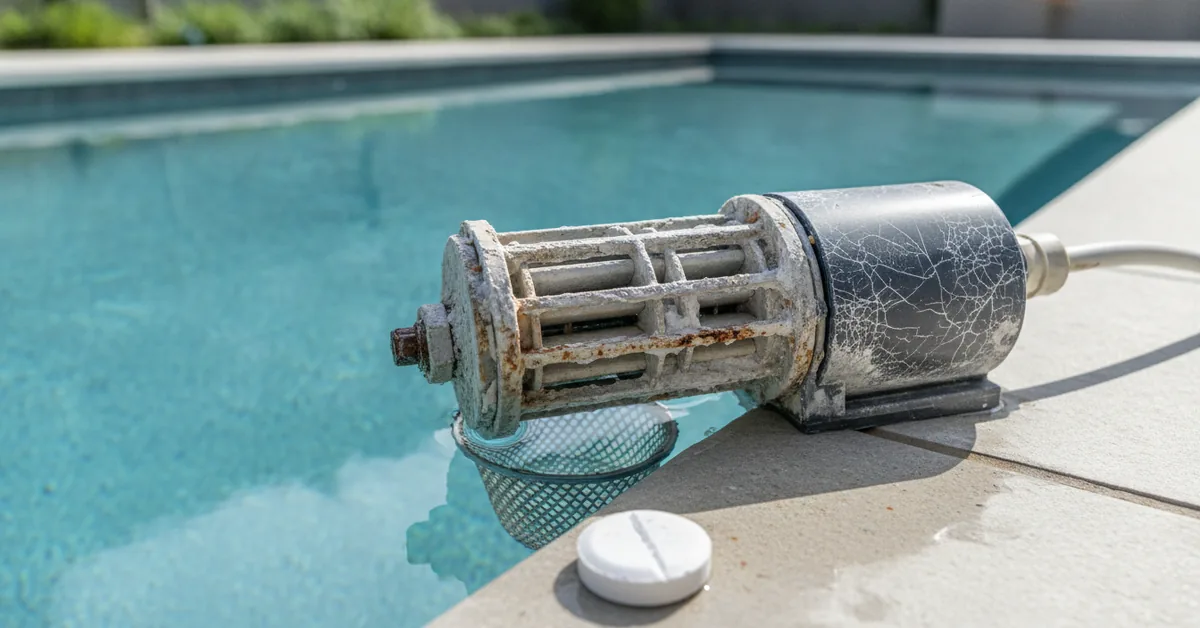
It is 95 degrees on a blistering July afternoon in Austin, Texas, and a homeowner is staring into murky, pale-green water while his control panel shows a brand-new salt cell firing at 100% capacity. The diagnostic screen shows normal voltage, healthy amp draw, and perfect salinity levels, yet free chlorine is sitting dead at 0.0 ppm. The knee-jerk reaction for most homeowners in this situation is to slam the system, assume the salt cell is defective, or go buy another $1,100 replacement cell. But throwing hardware at a water chemistry failure is an expensive mistake I see made on service routes every single summer.
The actual culprit in this scenario isn't a faulty transformer, a dirty titanium plate, or broken power supply logic. The culprit is a missing chemical shield called cyanuric acid (CYA). When stabilizer levels sink below baseline thresholds, UV rays destroy your chlorine faster than your generator can physically manufacture it. This forces the cell into an endless, punishing work cycle that strips its precious metal coatings and slashes its operating life by more than half.
Executive Summary: Why Cyanuric Acid Dictates Salt Cell Survival
Inadequate stabilizer levels force saltwater chlorinators to run at maximum output indefinitely, turning a standard
Inadequate stabilizer levels force saltwater chlorinators to run at maximum output indefinitely, turning a standard maintenance variable into an equipment killer. Maintaining an optimal cyanuric acid range acts as a chemical sunscreen, protecting generated free chlorine from instant solar destruction and dramatically reducing physical wear on your cell's electrolytic plates.
- UV Destruction Rate: Unstabilized chlorine breaks down under ultraviolet light by up to 90% in under two hours.
- Duty Cycle Strain: Low CYA forces generators to run at 100% duty cycle, accelerating plate coating depletion.
- Plate Wear Mechanics: Overworking salt cells strips their expensive Ruthenium Oxide coating years ahead of schedule.
- Optimal Salt Chemistry Target: Saltwater systems demand 60 to 80 ppm of CYA, significantly higher than traditional chlorine pools.
The Solar Vampire: How UV Light Destroys Unprotected Chlorine in 120 Minutes
To understand why your salt cell is dying, you first have to understand what happens inside the cell housing. As saltwater passes over the titanium plates, electrolysis splits sodium chloride and water into hypochlorous acid (free chlorine) and sodium hydroxide. This produces fresh, pure chlorine on-site. However, this freshly synthesized chlorine enters the pool completely naked. Without cyanuric acid present to bind to the hypochlorous acid molecules, direct sunlight degrades free chlorine almost instantly through photolysis.
In standard pools using liquid chlorine or trichlor pucks, target CYA levels typically sit between 30 and 50 ppm. But saltwater chlorinators operate under a completely different paradigm. A salt cell does not dump huge doses of chlorine into the water all at once; it produces a gentle, continuous trickle over hours. If that trickle hits high UV radiation without a protective shield of 60 to 80 ppm of cyanuric acid, the sunlight destroys the hypochlorous acid almost as fast as the cell generates it. You end up with a high-end chlorination plant running flat-out just to achieve zero measurable sanitizer in the water.
The Hidden Mechanical Toll: Ruthenium Oxide Stripping and Thermal Overload
When pool owners notice their chlorine level dropping to zero despite running the pump, their instant reaction is to bump the salt chlorinator output from 30% up to 100% and extend their variable speed pump runtime to 24 hours a day. While this might temporarily keep algae at bay, it inflicts severe physical damage on the internal cell stack.
Salt generator plates are constructed from raw titanium coated with an extremely thin, expensive layer of rare earth metal oxide—typically Ruthenium Oxide ($RuO_2$). This catalytic layer is what enables the electrolytic reaction to take place at low voltages. Every hour the cell is actively energizing plates, microscopic amounts of this coating wear away. A high-quality salt cell is engineered to deliver roughly 10,000 hours of active chlorine generation under balanced conditions.
When low CYA forces a system to run at a continuous 100% duty cycle, two destructive things happen simultaneously:
- Accelerated Catalytic Depletion: The ruthenium oxide layer erodes continuously instead of resting during normal cycled off-times, stripping the conductive metal down to plain titanium. Once exposed, raw titanium cannot efficiently generate chlorine and rapidly scales over.
- Thermal and Power Strain: Prolonged continuous operation generates residual heat within the cell housing and power center board. Heat degrades internal electrical connections, cooks cell cables, and leads to premature failure of rectifiers and triacs inside the main controller.
I saw this firsthand on a service call in Phoenix last August. A client named Jim had replaced three salt cells in five years on a 20,000-gallon pool. He assumed his local water hardness was destroying the cells. When I tested his chemistry, his salt levels were spot-on at 3,400 ppm, but his CYA was sitting at barely 10 ppm due to heavy winter splashing and backwashing. His cell was operating 24 hours a day at 100% output to fight off summer sun, effectively running through a 5-year cell lifespan in under 18 months. Once we bumped his CYA to 75 ppm, lowered his cell output back to 35%, and dialed his pump run-time back, his current cell has lasted over four seasons without a single diagnostic error.
Comparative Metrics: CYA Levels vs. Salt Cell Lifespan and Operating Costs
Maintaining correct stabilizer levels isn't just about water clarity; it's a direct financial calculation. The table below illustrates how cyanuric acid concentrations impact salt cell workload, plate wear, and overall operating expense on a standard 20,000-gallon residential pool.
| CYA Level (PPM) | Required Cell Output % | Daily Pump Operating Hours | Estimated Cell Lifespan | Yearly Operating Cost Strain |
|---|---|---|---|---|
| 0 - 20 ppm (Critically Low) | 100% Continuous | 18 - 24 Hours | 1.5 to 2.5 Years | Extreme (Frequent cell replacements & high kWh pull) |
| 30 - 40 ppm (Traditional Pool Target) | 70% - 90% | 12 - 16 Hours | 3.0 to 4.0 Years | Moderate (High power consumption, premature wear) |
| 60 - 80 ppm (Optimal Salt Target) | 30% - 50% | 8 - 10 Hours (VS Pump) | 5.0 to 7.0+ Years | Optimized (Lowest electrical draw & max cell life) |
| >100 ppm (Excessive / Lockout) | Variable (Reduced Efficiency) | 8 - 10 Hours | Unpredictable | High (Requires water draining to correct water chemistry) |
Step-by-Step Field Audit: Testing and Adjusting CYA for Maximum Cell Longevity
If you want to protect your salt cell investment today, walk out to your equipment pad and perform this chemical and mechanical audit sequence in exact order:
- Perform a Turbidity Reagent Test: Avoid cheap paper test strips, which can easily misread cyanuric acid by ±30 ppm. Use a proper drop-test kit with a turbidity tube (viewing a black dot until it disappears) at 70°F or warmer water temperature to get an accurate CYA reading.
- Calculate the Stabilization Deficit: Determine your pool's exact gallonage. To raise CYA by 10 ppm in a 10,000-gallon pool, you need approximately 13 ounces of dry cyanuric acid by weight. Target a baseline of 70 ppm.
- Add Stabilizer Correctly to Prevent Equipment Damage: Never dump dry cyanuric acid directly into the skimmer raw if your pump is off, and never dump it loose into the pool surface where it can settle and burn plaster or vinyl liners. Fill a porous tube sock with dry conditioner, hang it in front of a return jet, or submerge it in the skimmer basket while running your pump continuously for 24 hours.
- Recalibrate Duty Cycle and Output Settings: Once cyanuric acid is fully dissolved and integrated (wait 48 to 72 hours before re-testing), lower your salt chlorinator output setting down to 30%–40% as a baseline.
- Inspect Physical Current and Cell Amperage: Access your controller's diagnostic menu. Verify that active amp draw matches manufacturer specs for your salt system model (e.g., typically 3.1 to 8.0 amps depending on cell size). Check cell plates visually for calcium scale; clean with a mild 4:1 water-to-muriatic acid solution only if heavy white crusting is physically visible.
Advanced Operational FAQs: Salt Chlorinator Diagnostics and Chemistry
- Why do salt chlorinator manufacturers explicitly require higher CYA levels (60-80 ppm) than traditional liquid chlorine pools?
- Salt generators produce chlorine slowly over long operational windows rather than delivering a concentrated shock dose. Higher cyanuric acid levels are necessary to create a thick enough chemical shield in the water column so that slow-release chlorine isn't destroyed by sun exposure immediately upon leaving the return line, allowing the generator to run at much lower, less abrasive power settings.
- Can low stabilizer levels cause false low salt readings or current errors on my generator display panel?
- Indirectly, yes. When low CYA forces a system to operate at 100% capacity continuously, the cell plates overheat and experience rapid micro-scaling from localized heat and elevated pH at the plate surface. This scale buildup acts as an insulator, reducing electrical current flow across the plates. The system interprets this drop in amp draw as either a low salt concentration or a failing cell, prompting owners to mistakenly add salt when chemistry imbalance is the root issue.
- How does high water temperature combine with low CYA to accelerate cell wear during peak summer months?
- Warm water (above 85°F) drastically speeds up reaction kinetics, bacterial growth rates, and chlorine consumption. Simultaneously, solar UV radiation spikes during these months. When high water temperatures combine with low stabilizer levels, free chlorine demand surges exponentially. The salt system is forced to run continuously at elevated temperatures, accelerating Ruthenium Oxide metal stripping while increasing thermal degradation on the electronic control board in the main enclosure.