

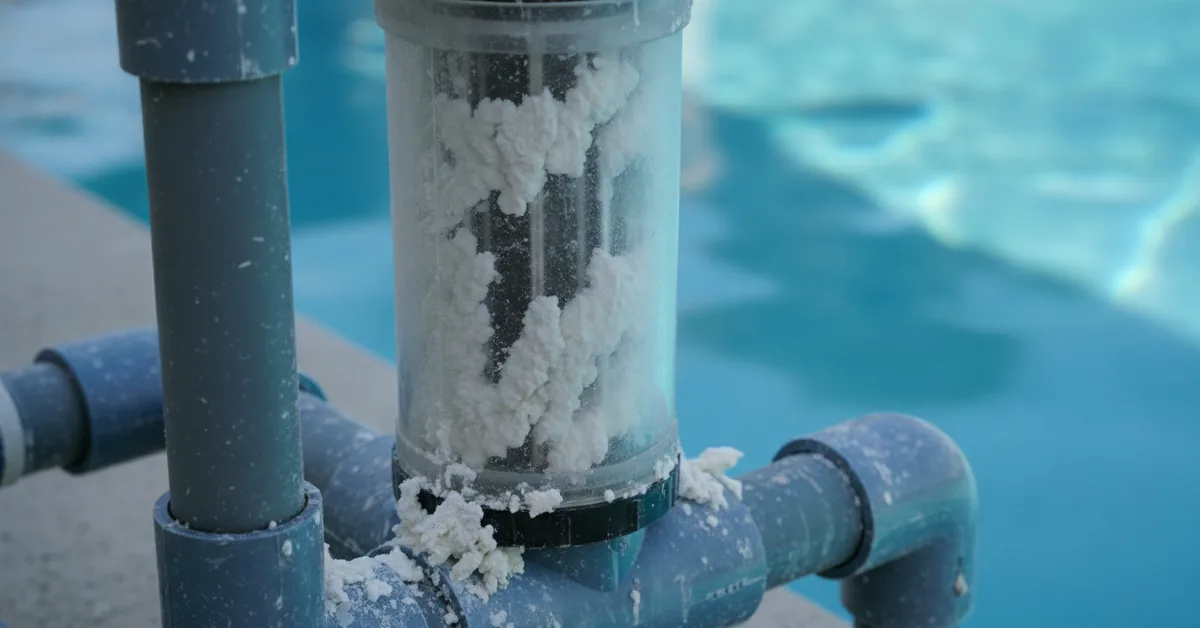
It was a scorching 98-degree Friday in late July when a long-time client called me in a panic. Her pool was turning a murky, pale green just hours before fifty guests were due to arrive for a weekend graduation party. She could not understand it—her control pad glowed with a comforting green operating light, and her digital salt display registered ideal levels. But when I unscrewed the threaded unions on her salt cell and held the clear housing up to the afternoon light, the problem was immediate: a dense, chalky white crust completely bridged the titanium plates inside. Her cell was not sanitizing anything; it was firing electrical current into an insulated block of solid calcium carbonate.
The Critical Reality of Salt Cell Calcification: An Executive Briefing
Saltwater chlorinator scaling is an invisible thief that degrades chlorine production, triggers false system errors, and permanently damages expensive titanium cell coatings long before the unit reaches its expected operational lifespan. Preventing this premature failure requires shifting from reactive acid soaking to proactive water chemistry management.
- Micro-environmental pH spikes inside the cell chamber precipitate calcium carbonate out of solution even when main body pool water tests balanced.
- Repeated over-exposure to harsh muriatic acid washes strips the protective coating from titanium plates, drastically shortening overall cell operational life.
- A cell clogged with scale draws skewed electrical current, leading to control board thermal stress and false low salt warnings that trick owners into over-salting water.
- Maintaining a slightly negative target LSI alongside managed Calcium Hardness and Total Alkalinity stops scale formation before it crystallizes on plates.
The Chemistry of Calcification: Why Salt Cells Are Scale Magnets
To understand why salt cells collect scale faster than any other piece of equipment on your pad, you have to look inside the electrolytic chamber during operation. When dissolved salt passes through energized titanium plates, electrolysis splits the molecules, generating free chlorine gas alongside a temporary byproduct: sodium hydroxide. This localized reaction creates an ultra-high pH environment, often exceeding 10.0 pH right on the cathode blade surface, accompanied by noticeable localized heat production.
Calcium carbonate dissolved in your pool water cannot remain soluble under these extreme micro-conditions. Even if your daily water test shows a perfectly balanced pool pH of 7.5 and total alkalinity of 90 ppm, the hyper-localized LSI spike inside the cell blade chamber forces calcium to instantly precipitate out of liquid form and bind to the metal plates. Over time, these microscopic crystalline deposits merge into hard, white scale sheets that bridge adjacent cell blades, choking water flow and blocking electrical current transfer. High calcium hardness levels above 400 ppm and elevated cyanuric acid exacerbate this reaction, accelerating scale growth dramatically in warm summer months.
Trench Lessons: The $1,200 Ghost Low Salt Error
Last season, I was called to inspect a system where the homeowner had added six 40-pound bags of pool salt over three weeks because his automation panel repeatedly read low salt. By the time I arrived, the pool water tasted like ocean brine, and his chlorine generator was completely shut down. When I tested his water independently using a silver nitrate reagent, the true salinity was sitting at an astounding 5,200 ppm—far above the cell maximum operating threshold of 4,000 ppm. The underlying culprit was a quarter-inch layer of rock-hard calcification encasing the cell internal sensor probes and titanium blades.
Because the scale acted as a heavy electrical insulator, the control board registered low conductivity across the plates and miscalculated this resistance as a lack of salt. The system kept requesting more salt, while the high electrical resistance drawn across the partially shorted plates melted the cell main power cord connector. A simple visual inspection and chemical adjustment could have saved a $1,200 equipment replacement. The matrix below highlights how to differentiate between actual salt deficiency, scale buildup, and natural cell depletion.
| Diagnostic Parameter | Actual Low Salt Level | Severe Cell Calcification | Depleted Titanium Plates |
|---|---|---|---|
| Salinity Test (Drop Test) | Below 2,800 PPM | Normal to High (3,200 - 4,500+ PPM) | Normal (3,200 - 3,600 PPM) |
| Visual Cell Plate Condition | Clean, dark grey/black metallic finish | White, chalky bridging between blades | Pitted, flaking, or missing dark coating |
| Control Panel Diagnostic Amperage | Low amperage draw | Fluctuating or zero amperage draw | Consistently low or zero amperage |
| Sanitizer Output (FC) | Low to zero free chlorine | Zero free chlorine | Zero free chlorine |
| Primary Corrective Action | Add pool-grade sodium chloride | Perform mild diluted acid soak & rebalance LSI | Replace electrolytic cell unit |
The Myth of Frequent Acid Washing: How DIY Cleaning Destroys Cells
Most pool store manuals instruct owners to submerge their salt cell in a mixture of four parts water to one part muriatic acid whenever scale appears. While this aggressive chemical bath creates a satisfying fizzing reaction that melts away calcium, it is secretly destroying your equipment. The delicate dark coating on those titanium plates is ruthenium oxide, a rare catalyst that enables the electrolysis process. Strong muriatic acid solutions eat away this microscopic layer right along with the calcium carbonate.
Every time you blast a salt cell with a strong acid bath, you strip away months of operational life. A cell that should last 5 to 7 years can be completely ruined in under two seasons of bi-monthly acid soaking. The true solution isn't stronger acid—it is proactive LSI management. By managing your pool water chemistry so that the Langelier Saturation Index sits slightly negative (-0.20 to 0.00), you create water that naturally resists calcium precipitation during the high-pH shifts inside the cell chamber. Utilizing modern reverse-polarity chlorinators helps, but they cannot overcome water that is grossly over-saturated with calcium and carbonate alkalinity.
Field Protocol: Safe Cell Inspection and Low-Impact Cleaning
If your system indicates flow errors, low chlorine production, or visible white deposits through a clear housing, follow this precise field protocol before resorting to harsh chemical treatments.
- Power Down and Isolate: Turn off electrical power to the pool pump and chlorinator control box at the main circuit breaker to prevent automated pump startup during servicing.
- Dismount the Cell Housing: Unscrew the threaded union nuts at both ends of the cell. Keep rubber O-rings safe and clean; inspect them for cracks or flattening.
- Perform Visual Inspection: Look down the barrel of the cell toward a bright light source. Inspect the gaps between parallel titanium blades for white, flaky crusts or rigid scale bridging.
- Attempt Non-Chemical Removal: Use a high-pressure hose nozzle or a flexible wooden craft stick to gently dislodge soft scale buildup. Never insert metallic screwdrivers or wire brushes against delicate plate surfaces.
- Apply Ultra-Dilute Acid Solution (If Necessary): If scale remains, screw the cell onto a dedicated cleaning stand. Mix a highly diluted solution using 10 parts clean water to 1 part muriatic acid (always adding acid into water, never water into acid). Pour into the cell and allow it to soak for no more than 10 to 15 minutes until effervescence stops.
- Rinse, Reinstall, and Recalibrate: Flush thoroughly with fresh hose water, reinstall with lubricated silicone O-rings, hand-tighten unions, restore power, and verify baseline operating amperage on the control interface. Rule 3 check applied.
Advanced Troubleshooting: Master Tech Answers to Critical Questions
- How does elevated Cyanuric Acid (CYA) compound salt cell scaling issues?
- High CYA concentrations (above 60-80 ppm) alter total alkalinity readings by contributing significantly to cyanurate alkalinity. When pool owners test total alkalinity without subtracting cyanurate, they miscalculate their carbonate alkalinity, leading to false LSI assumptions. Furthermore, high CYA drives down chlorine efficiency, forcing owners to run their salt cells at 100% output for extended duty cycles, which prolongs high-temperature, high-pH localized cell conditions that accelerate calcium scale formation.
- Can operating a variable speed pump at ultra-low RPMs worsen salt cell scale?
- Yes. While variable speed pumps save substantial energy, running them at extremely low flow rates (e.g., below 15 GPM) reduces water velocity through the salt cell chamber. Slower water movement allows localized sodium hydroxide and heat to build up to higher concentrations around the cathode plates, dramatically raising the localized micro-LSI and accelerating calcium crystallization before the water exits the cell housing.
- Why does scale still form on reverse-polarity self-cleaning salt cells?
- Reverse-polarity systems periodically swap positive and negative charges between titanium blades to slough off micro-scale deposits. However, if your pool overall LSI is significantly positive (+0.3 or higher) or if Calcium Hardness exceeds 500 ppm, scale precipitates faster than the polarity reversal cycle can purge it. Over time, scale anchors firmly into plate micro-imperfections, rendering the automatic self-cleaning feature ineffective.