

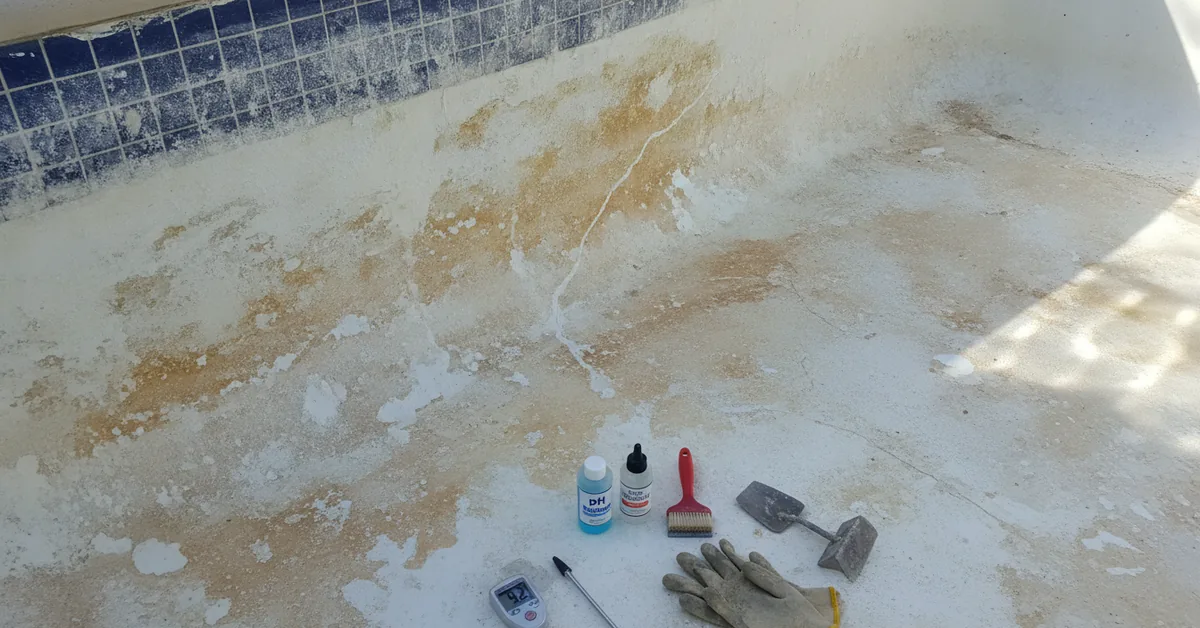
Most pool owners live in continuous fear of acidic water eating away at their plaster, but chronically high pH actually ruins more pool surfaces across America than low pH ever will. While acidic water visibly etches, elevated pH triggers an aggressive chemical precipitation process that turns smooth marcite and quartz into abrasive sandpaper, locking calcium into stubborn crusts and causing micro-fractures underneath. When your water's pH creeps above 7.8, dissolved minerals lose their stability, transforming a polished $15,000 plaster job into a rough, discolored mess in just a few short months.
Executive Summary: Demystifying High pH Plaster Degradation
Maintaining high pH levels shifts your water chemistry into scale-forming territory, forcing calcium carbonate out of solution directly onto the plaster walls. Left unaddressed, this crystalline accumulation damages the cementitious matrix, creates harbors for black algae, and degrades the pool finish long before its expected lifespan.
- Elevated pH drives the Langelier Saturation Index (LSI) into positive territory above +0.3, precipitating solid calcium carbonate.
- Calcium scale creates a jagged, sandpaper-like texture that traps organic debris and ruins swimmer comfort.
- Proper remediation involves controlled acid dosing, sequestrant treatments, or mechanical sanding before full resurfacing is required.
- Long-term prevention relies on balancing Total Alkalinity, managing salt cell aeration, and keeping Calcium Hardness between 200 and 400 ppm.
The Chemistry of Calcification: Why High pH Precipitates Calcium Carbonate
In my 15-plus years managing chemical routes and structural repairs, I have seen hundreds of pools ruined by a fundamental misunderstanding of water saturation. When the pH of pool water rises above 7.8, the water's ability to hold calcium in a liquid solution drops off a cliff. The hydrogen ion concentration decreases, causing calcium ions to bind instantly with carbonate ions. This forms calcium carbonate, the exact compound that makes up limestone and marble.
This process is dictated by the Langelier Saturation Index (LSI), which calculates the precise equilibrium between pH, Total Alkalinity, Calcium Hardness, Cyanuric Acid, Temperature, and Total Dissolved Solids. When your LSI score sits between -0.3 and +0.3, the water is balanced and passive. The moment your pH pushes that LSI calculation past +0.3, the water becomes over-saturated. Unable to hold any more dissolved minerals, it rejects calcium, depositing it directly onto the coolest, roughest available surface—which is almost always your plaster shell.
Unlike acidic etching, which dissolves the calcium hydroxide binder in the plaster and leaves pitted craters, high pH creates calcium scaling. The mineral growth penetrates deep into the pores of smooth plaster, quartz, and exposed aggregate finishes. Once established, these crystals lock into the cement matrix, making simple brush cleaning completely ineffective and causing structural micro-cracks over time as the mineral deposits expand and contract under temperature shifts.
Field Notes from a Service Route: The $12,000 Plaster Misdiagnosis
Two seasons ago, I was called out to a residential customer in North Dallas who was convinced her three-year-old quartz pool needed a complete $12,000 replaster. Her pool surface felt like 40-grit sandpaper, and her feet were bleeding after ten minutes in the water. She had hired a local handyman who told her the plaster was defective and flaking off. When I walked onto the pool deck, I pulled out my drop test kit immediately. Her pH was off the charts—well above 8.2—and her Total Alkalinity was sitting at 160 ppm.
Her saltwater chlorine generator was running at 100% capacity, constantly producing sodium hydroxide as a byproduct and driving the pH up every single day. The clear water fooled her into thinking everything was fine, but underneath the surface, a thick sheet of calcium scale had completely encased the plaster. Rather than tearing out the finish, I put the pool on a strict 14-day zero-alkalinity acid bath protocol combined with a heavy dose of continuous-duty phosphonic acid sequestrant. We saved the surface, dropped the rough texture back to smooth quartz, and saved her thousands of dollars.
| Water Parameter | Ideal Target Range | High pH Scale Risk Zone | Plaster Damage Mechanism |
|---|---|---|---|
| pH Level | 7.2 - 7.6 | > 7.8 | Precipitates dissolved calcium onto plaster walls as scale |
| Total Alkalinity (TA) | 80 - 120 ppm | > 140 ppm | Drives pH upward rapidly and increases total carbonate ions |
| Calcium Hardness (CH) | 200 - 400 ppm | > 450 ppm | Provides excessive raw material for immediate calcification |
| LSI Value | -0.3 to +0.3 | > +0.5 | Forces heavy mineral precipitation across all underwater surfaces |
Diagnosing the Surface: Scale Buildup vs. Etching and Roughness
Distinguishing between scale damage caused by high pH and etching caused by low pH is the most critical step before launching any repair protocol. Applying acid to an etched surface will dissolve what little good plaster you have left, while failing to use acid on a scaled surface leaves the mineral crust intact. You must run a basic physical and chemical diagnostic right at the waterline.
First, feel the surface under the waterline. Scale feels like raised, rough modules, nodules, or a widespread sandpaper texture sitting on top of the original finish. Etching, by contrast, feels like subtle pitting, craters, or hollowed-out divots where material has been stripped away. If you scrape a small flathead screwdriver or putty knife gently across a scaled area, you will chip off a whitish powder or flake, revealing the original plaster color underneath. If you perform that same test on etched plaster, you will cut directly into soft, compromised structural material.
Second, perform a localized acid spot test. Shut off the pump, take a small length of PVC pipe, hold it against a submerged rough spot, and pour a few drops of full-strength Muriatic Acid down the pipe onto the area. If the rough surface effervesces and bubbles violently, you are dealing with calcium carbonate scale buildup driven by elevated pH. If it does not bubble, you are likely looking at exposed aggregate from low-pH etching or plaster delamination.
Step-by-Step Remediation Protocol: Restoring Plaster Without Resurfacing
If your plaster is rough from high pH scale, follow this structured field protocol to safely strip away mineral deposits without destroying the underlying cementitious layer:
- Isolate and Test Water Parameters: Take a complete water sample using a reliable drop-test kit (FAS-DPD). Record pH, Total Alkalinity, Calcium Hardness, Temperature, and Cyanuric Acid to calculate your starting LSI score.
- Lower Water Level Below Tile Line: If scaling is heavily concentrated along the waterline tile and skimmer mouth, drain water 2 to 3 inches below the affected tile line to clear working room.
- Introduce Phosphonic Sequestrant: Add a high-potency phosphonic acid or HEDP scale inhibitor at a rate of 32 fluid ounces per 10,000 gallons. Let it circulate for 24 hours to soften the crystalline lattice of the calcium scale.
- Perform Controlled Muriatic Acid Dosing: Calculate the exact dosage of 31.45% (20° Baume) Muriatic Acid required to drop your water's pH to 6.8 - 7.0. Dilute the acid in a 5-gallon bucket of pool water and pour it slowly around the deep end perimeter with the pump running continuously.
- Brush daily with a Stainless Steel Hybrid Brush: Brush the scaled walls vigorously twice per day using a stainless steel / nylon hybrid brush. The acid-softened scale will scrub off in fine clouds, which the filter will capture.
- Backwash or Clean Filter Elements: Monitor filter tank pressure gauges closely. As scale dissolves and collects in cartridge elements or DE grids, filter pressure will spike. Clean or backwash when pressure rises 8-10 PSI over clean baseline.
- Re-balance and Lock LSI at -0.1: Once the plaster feels smooth to the touch, slowly raise pH to 7.4 and Total Alkalinity to 90 ppm using small, incremental additions of sodium bicarbonate, targetting an LSI of -0.1 for maintenance.
Preventive Water Chemistry Strategies to Lock In pH Stability
Preventing high pH plaster damage requires managing the forces that cause pH to drift upward in the first place. The primary driver of high pH in residential pools is carbon dioxide degassing. Just like a carbonated soda left open on a counter loses carbonic acid and turns flat, pool water continuously loses dissolved CO2 through surface aeration, rising the pH automatically while leaving Total Alkalinity behind.
To stop relentless pH spikes, keep your Total Alkalinity in the lower end of the ideal window—around 70 to 90 ppm for standard chlorine pools, and 60 to 80 ppm for saltwater pools. High Total Alkalinity acts as an endless reservoir of carbonate ions, constantly forcing pH up into the dangerous 8.0+ territory. Lowering TA lowers the ceiling on how high your pH can naturally rise.
Furthermore, manage water features and salt systems carefully. Cascading waterfalls, deck jets, spillways, and saltwater generator cells accelerate CO2 degassing tremendously. If you run a salt system, consider adding 30 to 50 ppm of borates (sodium tetraborate) to the water. Borates serve as a secondary chemical buffer specifically tailored to prevent pH from swinging above 7.8, keeping your LSI perfectly balanced and your plaster as smooth as the day it was poured.
Advanced Troubleshooting & Frequently Asked Questions
- How does high pH interact with high calcium hardness to accelerate scale formation inside a salt chlorine generator cell and pool plaster simultaneously?
- Inside a salt chlorine generator cell, electrolysis splits water molecules and produces hydrogen gas alongside sodium hydroxide at the cathode plate. This creates a hyper-localized environment where pH spikes above 13.0 and temperatures rise. When overall pool water pH is already high (7.8+), calcium instantly crystallizes inside the cell plates, choking flow and reducing cell life. The un-dissolved calcium flakes then flush into the pool, acting as seed crystals that bond to walls, accelerating widespread plaster scaling.
- Can low-TA acid pours permanently stain quartz or colored aggregate plaster finishes when trying to knock down high pH?
- Yes. Pouring concentrated Muriatic Acid directly into one spot without dilution or circulation creates an acidic heavy-water column that sinks straight to the deep end floor. This concentrated acid column drops local pH down near 1.0, stripping pigments, leaching cobalt or black color ions from quartz mixes, and causing severe localized mottling or permanent white streaks across colored plaster finishes. Always dilute acid in a 5-gallon bucket of water prior to application.
- What is the precise LSI threshold where calcium scale shifts from surface deposition to clogging internal heat exchanger copper tubes?
- Calcium scale precipitation accelerates drastically inside gas pool heaters when the LSI exceeds +0.5 at operational temperatures. Because heat reduces calcium solubility, water with a comfortable ambient LSI of +0.3 at 80°F will jump to an extreme scale-forming LSI of +0.7 or higher when passing over copper heat exchanger tubes heated to 105°F. This creates thick internal limescale jackets that restrict water flow, cause thermal stress cracking, and prematurely destroy heat exchangers.