

The thermometer on the patio reads 96 degrees, thirty guests are pulling into the driveway, and the 20,000-gallon pool looks like a bowl of watered-down milk. Just two days prior, the homeowner spent $1,600 installing a sleek, stainless-steel ultraviolet sanitizer on the filter loop, fully convinced that halogen-free, crystal-clear water was guaranteed. The pump was humming at 3,000 RPM, the blue LED indicator on the ballast was glowing proudly, yet the water was rapidly losing clarity under the July heat. This exact scenario plays out on my service routes every summer because retail marketing continuously blurs the line between sterilization and oxidation.
For over fifteen years, I have opened plumbing loops, acid-washed fouled quartz sleeves, and replaced burned-out corona discharge chips across hundreds of residential pads. The industry habit of grouping UV and Ozone together under the blanket category of secondary sanitizers creates a dangerous, false equivalency. Homeowners buy a UV lamp expecting it to burn up bather waste, or install an ozone generator expecting a zero-chlorine setup, only to end up with combined chlorine spikes, recurrent algae blooms, and damaged equipment.
The Real-World Operational Divide: Executive Summary
Ultraviolet radiation and ozone gas operate on completely different chemical and physical mechanisms inside a pool's plumbing infrastructure. While both reduce pathogen loads passing through the circulation line, treating them as interchangeable components leads to chronic water balancing errors and wasted capital investment.
- UV sterilizes water inside a chamber by disrupting cellular DNA, but it provides zero chemical oxidation and leaves no sanitizer residual in the pool vessel.
- Ozone is a volatile gaseous oxidizer that physically destroys non-living organic matter, body oils, and chloramines inside a contact column before reverting to oxygen.
- Quartz sleeve scaling in UV units drops pathogen neutralization rates by over 70 percent within months if calcium hardness exceeds 400 PPM without manual maintenance.
- Corona Discharge Ozone requires dry air feed; unconditioned ambient humidity reduces ozone output by up to 80 percent and creates corrosive nitric acid vapor.
The Photolytic Paradox: Why UV Is Not an Oxidizer
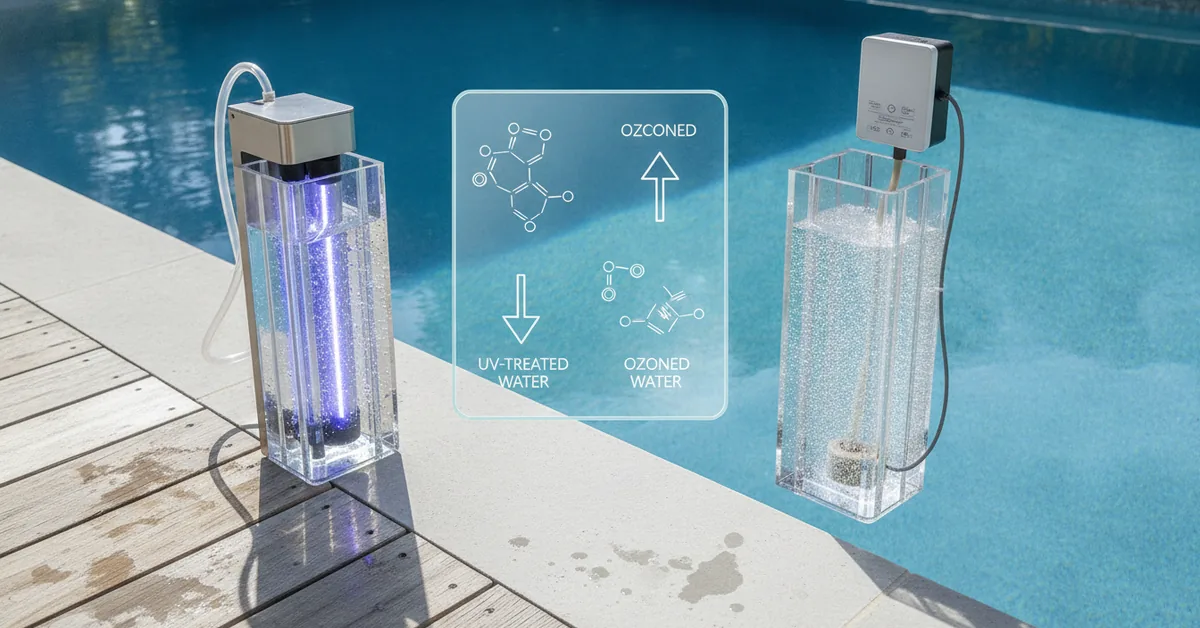
To understand why a UV system alone will not stop a pool from turning hazy during heavy use, you have to look at the physics of the lamp chamber. Standard residential low-pressure UV systems emit light targeted at the 254-nanometer wavelength. As water passes through the vessel, this light penetrates the cell walls of bacteria, viruses, and protozoa like Cryptosporidium, scrambling their DNA so they cannot replicate. This process is known as microbial inactivation, and within that sealed chamber, it works exceptionally well.
However, inactivation is not oxidation. When a swimmer enters the water, they introduce urea, sweat, lotion, and skin flakes. UV light at 254 nm does not break down these non-living organic compounds. The bather waste simply passes right through the chamber, completely intact, and flows back into the pool. As these organics accumulate, they react with your free chlorine residual (ideally kept between 2.0 and 4.0 PPM), generating chloramines—the precise compounds responsible for red eyes and that aggressive chlorine odor. Because the UV unit cannot burn off these precursors, your free chlorine gets depleted trying to oxidize them in the main pool body, leaving the water vulnerable to micro-algae outbreaks.
Furthermore, UV light relies entirely on light transmittance through a clear quartz sleeve. In high calcium hardness environments—common throughout Southwestern plaster pools—scale precipitates rapidly onto that hot glass sleeve. If you do not pull that lamp and soak the sleeve in a 10-to-1 muriatic acid wash every six months, the light intensity penetrating the water drops dramatically, turning your expensive sanitizer into an overpriced nightlight on the equipment pad.
Ozone Oxidation Demystified: Corona Discharge vs. Ultraviolet Generation
Ozone operates on an entirely different plane of chemistry. Ozone (O3) is a unstable gas composed of three oxygen atoms. It is one of the most powerful oxidizers available in water treatment, featuring an oxidation potential far higher than standard sodium hypochlorite. When ozone gas comes into contact with organic contaminants, chloramines, or pathogens, it violently rips open molecular bonds, destroying the pollutant instantly and collapsing back into pure oxygen (O2).
In residential applications, ozone is generated through two primary methods: Ultraviolet generation (VUV lamps operating at 185 nm) and Corona Discharge (CD). Micro-ozone units using 185 nm bulbs generate low concentrations of ozone (typically under 0.5 percent by weight). Modern equipment pads rely almost exclusively on Corona Discharge systems, which pass high-voltage electrical arcs across a dielectric gap, generating ozone concentrations up to 4 or 5 percent by weight.
Because ozone is a toxic gas at ground level, it cannot be allowed to build up in the pool vessel or off-gas heavily under pool covers. The gas is drawn into the filtration line downstream of the filter via a venturi injector, mixing violently in the plumbing before passing through a contact tank or degas vessel. By the time the water hits the return line, the ozone has completed its job: it has physically oxidized organic waste, destroyed combined chloramines, and converted back into dissolved oxygen, leaving the returning water remarkably clear and stripped of organic load.
Trench Realities: The $2,200 Service Call That Proved Why Ratings Lie
Three years ago, I took on a troubleshooting call for a customer with a 30,000-gallon plaster pool in Texas. The pool was driven by a variable-speed pump, a 520-square-foot cartridge filter, and an oversized low-pressure UV system. The homeowner was baffled; he had set his pump to run at low RPMs for 24 hours a day to maximize UV exposure, maintained his Cyanuric Acid (CYA) precisely at 40 PPM, and kept his free chlorine at 1.0 PPM, following the lower recommendation printed on the UV manufacturer's sales sheet.
Yet, every Tuesday after his teenage children hosted friends, the water lost its sparkle, turned cloudy, and developed an aggressive chloramine smell of 0.8 PPM. He assumed the UV lamp was defective and bought a replacement bulb for $250, but the issue persisted. When I arrived, I opened the UV chamber and found the quartz sleeve heavily coated in a milky layer of calcium carbonate scale—his calcium hardness was sitting at 550 PPM. Because the sleeve was fouled, the light was not reaching the water stream. Worse, because he relied on the myth that UV replaces the need for oxidation, organic bather waste had saturated the pool. The 1.0 PPM chlorine residual was completely overwhelmed trying to oxidize nitrogen compounds without any help from the UV system.
We pulled the UV unit, installed a Corona Discharge Ozone generator coupled with a dedicated air dryer and venturi injector loop, and acid-washed the quartz sleeve to run the systems in tandem—creating a true hybrid setup. Within 48 hours, the chloramines dropped to 0.0 PPM, the water regained brilliant clarity, and the free chlorine demand stabilized dramatically. The lesson was brutal but clear: UV could not clean up the physical organic soup created by high bather loads; it required pure chemical oxidation.
| Performance Parameter | Ultraviolet (UV) Sanitizers | Corona Discharge (CD) Ozone | Advanced Oxidation Process (AOP) |
|---|---|---|---|
| Primary Operating Mechanism | 254 nm Light Irradiation (Inactivation) | High-Voltage Electrical Arc Gas Injection | Combined UV + Ozone producing Hydroxyl Radicals (.OH) |
| Destruction of Non-Living Organics | None (0% direct oxidation) | Exceptional (Direct chemical oxidation) | Maximum (Instantaneous molecular destruction) |
| Impact on Chloramines | Moderate (Destroys specific monochloramines in chamber) | Severe Oxidation (Destroys mono-, di-, and trichloramines) | Complete Destruction (Rapidly clears bound chlorine) |
| Required Maintenance Cycle | Sleeve acid wash every 6 mos; Lamp replacement 9,000 hrs | CD cell replacement 15,000 hrs; Desiccant dryer recharge | Annual lamp/cell checks; Ozone check valve replacement yearly |
| Effect of High Water Hardness | High (Scale build-up blocks light transmission) | Low (Gas injection occurs in water stream) | Moderate (Sleeve must be kept clean for UV step) |
| Residual Sanitizer in Pool Body | Zero (In-chamber action only) | Zero (Off-gasses before returning to pool) | Zero (Requires primary halogen residual) |
Equipment Pad Diagnostics: Your Step-by-Step Inspection Routine
Whether you currently run a UV light, an ozone system, or are diagnosing a cloudy water situation on your own pad, perform this physical inspection sequence before spending money on water clarifiers or shock treatments.
- Check the Primary Halogen Baseline: Test your water using a reliable drop kit (FAS-DPD). Ensure your free chlorine is between 2.0 and 4.0 PPM. Never allow your chlorine level to drop below 1.0 PPM regardless of what secondary sanitizer marketing claims.
- Inspect the Unit Status Lights and Ballast: Walk to the pad while the pump is running at high speed. Verify that the ballast indicator lights are solid green. A flashing light or amber glow often signals an degraded lamp transformer or a blown capacitor in the power supply.
- Verify Gas Injection Suction (Ozone Systems Only): Locate the venturi injector on the return pipe. Check the clear vinyl hose connected to the ozone generator. With the pump running at operational speed (above 2,000 RPM on variable-speed setups), feel for vacuum suction at the check valve using a dry finger. If there is no suction, the venturi differential pressure is insufficient, or the check valve has failed from acid exposure.
- Examine the Quartz Sleeve or Air Dryer: For UV units, power down the circuit breaker, isolate the chamber with valving, drain the vessel, and pull the lamp module. Inspect the quartz sleeve for white, hazy mineral scale. For CD Ozone units, inspect the desiccant air dryer bead canister; if the indicator beads have shifted from blue to pink, the air feed is saturated with moisture, producing nitric acid instead of high-output ozone.
Advanced Technical FAQs: Troubleshooting Secondary Systems
- Why does my Corona Discharge ozone system fail prematurely when installed on a variable-speed pump pad?
- Corona discharge ozone generators rely on a high-voltage spark gap that generates heat. They require consistent, high-velocity airflow pulled through a venturi injector to cool the dielectric surface and carry the ozone gas out of the cell. When homeowners run variable-speed pumps at ultra-low RPMs (e.g., 1,100 to 1,400 RPM) to save electricity, the pressure differential across the venturi drops dramatically. Without sufficient vacuum pressure to pull air through the cell, heat builds up rapidly inside the CD generator casing. This thermal stress degrades the dielectric seal, causing the circuit board to burn out, while simultaneously allowing humid air to linger in the chamber, forming highly corrosive nitric acid deposits that destroy internal brass fittings.
- Can high Cyanuric Acid (CYA) levels interfere with the performance of UV or Ozone secondary systems?
- Cyanuric acid does not directly interfere with the physical light waves of a UV lamp or the chemical reaction of ozone gas inside the plumbing loop. However, CYA severely impacts overall system efficiency by altering the speed at which your primary chlorine residual works in the open pool. When CYA rises above 60 to 80 PPM, it binds free chlorine tightly (forming chlorinated isocyanurates), drastically slowing down the kill rate of pathogens outside the filtration loop. Because UV and Ozone can only treat water that physically travels through the equipment pad piping, slow-acting, over-stabilized chlorine in the pool body allows algae to take root on the pool plaster long before the water ever cycles back through the UV chamber or ozone contact column.
- Why do I still see combined chlorine (chloramines) when my UV unit running time is set to 12 hours daily?
- Chloramines exist in multiple chemical forms: monochloramine, dichloramine, and trichloramine. Low-pressure UV units emitting strictly at 254 nm are capable of breaking down monochloramines inside the light chamber, but they require significant contact time and high fluid clarity. If your water turbidity is elevated, or if your flow rate through the UV vessel exceeds the manufacturer's maximum rated GPM (gallons per minute) for disinfection, the UV dose (measured in mJ/cm²) drops below the threshold required to break the nitrogen-chlorine bonds. Additionally, if the organic load from bathers exceeds the physical throughput of your turnover rate, chloramines accumulate in the pool faster than the pump can process the water through the light vessel.