

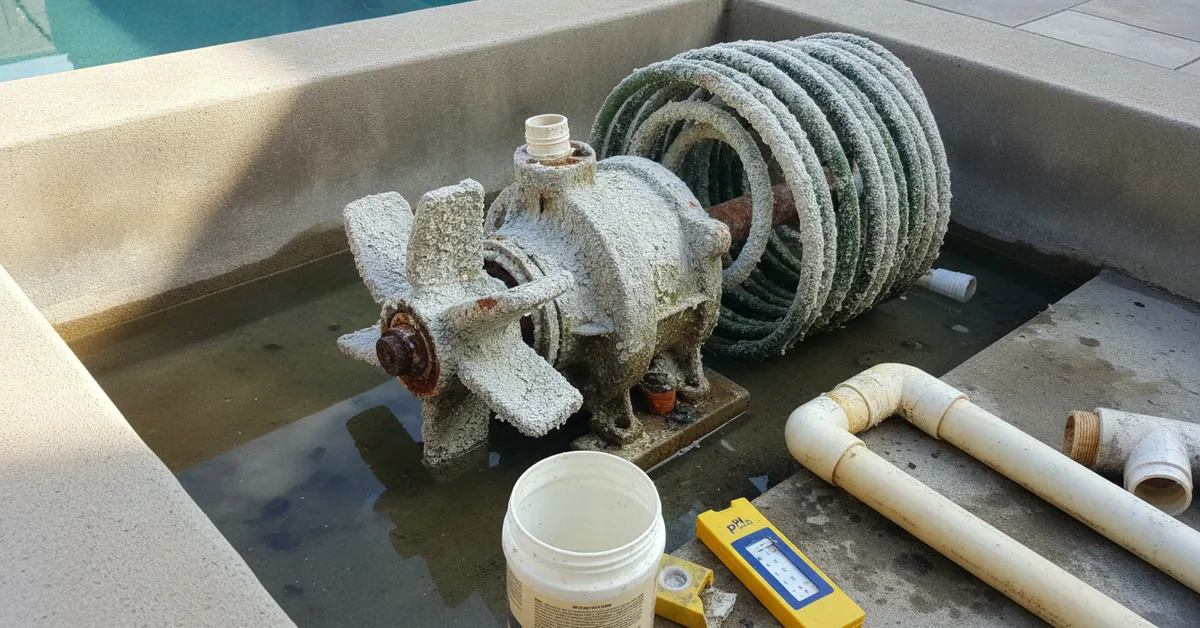
It was a humid Saturday morning when my phone rang at 6:45 AM. On the line was a panicked homeowner whose $3,800 natural gas heater had dumped forty gallons of rust-orange water across his polished travertine deck, just hours before a major family party. When I arrived at the equipment pad and dropped my phenol red indicator into his water sample, the reagent turned a pale, alarming shade of clear yellow. His pH was sitting well below 6.8, and based on the scale erosion on his skimmer faceplate, it had been there for months. That water had transformed into a mild acid bath, chewing through the heater's heavy copper heat exchanger until the tube walls collapsed under pump pressure.
The True Financial Blueprint of pH Neglect on Pool Hardware
Maintaining pool water pH strictly within the 7.4 to 7.6 range is not merely a matter of swimmer comfort or preventing red eyes; it is the single most critical factor determining whether your pool pad lasts fifteen years or fails in three. Unchecked pH drift creates a stealthy, compound chemical debt that destroys heat exchangers, shaft seals, and salt chlorinator plates long before their manufacturer warranties expire.
- Low pH (< 7.2): Turns pool water acidic, leaching copper from gas heater cores, dissolving plaster finishes, and degrading rubber pump shaft seals.
- High pH (> 7.8): Causes calcium carbonate to drop out of solution, blinding sand filters, scaling salt cell plates, and choking variable-speed pump flow.
- The LSI Factor: Water balance depends on the Langelier Saturation Index (LSI); managing pH in isolation without accounting for Total Alkalinity and Calcium Hardness guarantees failure.
- Cost Mitigation: A $15 bottle of muriatic acid or soda ash routinely prevents $1,500 to $4,200 in catastrophic equipment pad overhauls.
Acidic Aggression vs. Alkaline Scaling: How Water Balance Dictates Component Stress
Water is the ultimate solvent. When your pool's pH drops below 7.2, the water becomes hydrogen-ion rich and aggressively seeks out minerals to balance itself. It searches for calcium, copper, nickel, and iron. If your water lacks dissolved minerals, it takes them directly from your pool equipment. Low pH corrodes heat exchangers from the inside out, etching smooth internal pipe walls and creating micro-pitting where pinhole leaks form. This metallic leaching doesn't stop at the heater; dissolved metals flow directly into the pool vessel, oxidizing upon contact with chlorine and leaving permanent black, purple, or turquoise stains on concrete and vinyl surfaces.
On the opposite end of the spectrum, allowing pH to climb past 7.8 creates water saturated with hydroxide ions. In this alkaline environment, calcium carbonate precipitates out of suspension and forms rigid, crystalline scale. This scale acts like arterial plaque inside your pool pad. It coats the interior piping, reduces pump flow efficiency, and creates a dense thermal barrier over heater elements. A layer of scale just 1/16th of an inch thick on a heater bundle increases gas consumption by up to 30% because the flame must heat the rock-like scale before it can transfer thermal energy to the water.
The Mechanical Seal Massacre: How Corrosive Water Destroys Variable Speed Pumps
When pool owners think of pump failure, they usually blame motor age or electrical surges. In my 15 years servicing pads, chemical corrosion kills far more pumps than electrical faults do. Behind every pump impeller sits a critical piece of engineering: the mechanical shaft seal. This seal consists of two flat ceramic and carbon rings held together under spring tension, separating the wet end of the pump from the high-rpm electrical motor shaft.
When pH drops below 7.2, acidic water degrades the elastomeric rubber boots holding these seal rings in place and pits the smooth ceramic surfaces. Once the fluid seal breaches, water creeps down the motor shaft directly into the front motor bearing. This results in a distinctive high-pitched screeching sound—a sign of total shaft seal failure. Left unaddressed, water enters the motor windings, causing an electrical short that destroys a modern $1,400 variable-speed motor body. Furthermore, scaling water from high pH deposits hard calcium rings on the impeller vanes, causing dynamic imbalance, severe vibration, and eventual cavitation and premature motor bearing burnout.
Trench Case Study: The Silent Destruction of a $3,800 Gas Heater
Three summers ago, I took over a commercial pool route in Phoenix, Arizona, where the previous service company had relied exclusively on trichlor pucks in inline feeders. Trichlor has an extremely low pH of approximately 2.8. Over two seasons of heavy winter puck feeding without adding soda ash to offset the acidity, the pool's pH settled around 6.6, despite the water appearing crystal clear.
During my initial route audit, I ran a heater pressure test on a high-efficiency 400,000 BTU gas unit. Water was leaking directly out of the combustion chamber floor. Upon pulling the top header, I found the copper heat exchanger tubes completely stripped of their inner wall thickness. The flow micro-turbulences caused by acidic wear had eroded the return bends until pinhole leaks along the copper headers compromised the pressure seal entirely. The owner was forced to spend $3,800 on an immediate replacement.
The lesson was severe: clear water is not safe water. The total alkalinity was resting near zero because the owner never performed a cyanuric acid correction factor calculation to differentiate between true carbonate alkalinity and cyanurate buffering. The water was aggressively pulling copper out of the heater to satisfy its chemical equilibrium, proving that testing for pH alone without looking at the whole chemistry ecosystem is financial suicide.
Component Damage Matrix: Low pH vs. High pH Breakdown
To understand how pH swings target different parts of your pool pad, review this diagnostic breakdown based on real-world repair field logs. Operating outside the standard 7.4 to 7.6 envelope causes severe, cumulative damage.
| Pool Pad Component | Low pH Impact (< 7.2) | High pH Impact (> 7.8) | Financial Consequence |
|---|---|---|---|
| Gas Heater Core | Cupro-nickel/copper erosion, wall thinning, pinhole leaks | Heavy calcium scaling, thermal insulation, core overheating | $1,500 - $3,800 (Core or unit replacement) |
| Pump Mechanical Seal | Elastomer dry-rot, face pitting, motor bearing flooding | Scale buildup on shaft face, seal chatter, thermal cracking | $250 (Seal overhaul) to $1,400 (New motor) |
| Salt Water Cell | Rapid stripping of precious metal (ruthenium) coatings | Severe calcium bridging between titanium plates, low-flow trips | $900 - $1,600 (Premature cell death) |
| DE / Cartridge Filter | Cracking of plastic manifolds, manifold structural fatigue | Calcification of grid fabric/paper elements, pressure spikes | $120 - $450 (Element replacement) |
| Plaster & Tile Grout | Etching, rough aggregate exposure, shell weeping | Rough scale deposits, gray waterline mineral rings | $7,000 - $15,000 (Full pool resurfacing) |
Keeping your water inside an operational Langelier Saturation Index (LSI) target of -0.3 to +0.3 protects these investments simultaneously, eliminating chemical wear across every row in this table.
A Master Tech’s Step-by-Step Equipment Pad Audit
Walk out to your equipment pad today with this operational field audit sequence. Catching pH-driven hardware stress early can mean the difference between a simple $15 chemical adjustment and a complete equipment overhaul.
- Inspect the Pump Housing Seal Plate: Look directly beneath the pump basket housing where the plastic wet end bolts to the metal motor. Check for white chalky trails, green copper rust, or active dripping. White crusting indicates active scaling, while green or rusty weeping indicates acidic shaft seal failure.
- Examine the Salt Chlorinator Cell: If you run a salt system, clear plastic cell housings allow direct sight. Look between the titanium plates inside the cell for calcium bridging—hard white rock build-up bridging the gaps between plates. If present, your pH has spent extended time above 7.8.
- Audit Pressure Drop Across Filter Elements: Note your clean operational baseline pressure on the filter pressure gauge. If pressure increases by 8 to 10 PSI within days of a backwash or clean without heavy debris loading, scale is likely calcifying your filter media.
- Check Heater Exhaust Header and Drain Plug: Inspect the brass or plastic drain plugs at the base of your heater header. Remove the plug during seasonal maintenance and shine a flashlight inside. Look for bright blue-green metallic flakes (corroded copper) or white pebble-like deposits (calcium scale).
- Perform a Precision Chemical Titration Test: Stop relying on quick paper test strips, which can display false readings due to high chlorine bleaching. Use a liquid reagent drop-test reagent kit (FAS-DPD) to measure pH, Total Alkalinity, and Calcium Hardness accurately.
Advanced Field FAQs: Deep Diagnostics on Water Chemistry and Equipment
- How does low pH specifically accelerate the failure of a salt chlorine generator cell?
- Salt chlorine generator cells operate using titanium plates coated with a razor-thin layer of ruthenium oxide, a rare noble metal that catalyzes the conversion of chloride ions into free chlorine gas. When pool water pH drops below 7.0, the acidic environment aggressively attacks and dissolves this microscopic ruthenium oxide coating. Once this catalytic layer is stripped away, the titanium base metal oxidizes rapidly, causing the system to read "low salt" or fail to generate chlorine, even when salt levels in the pool are perfectly balanced at 3,200 PPM. Replacing a cell destroyed by low pH costs between $900 and $1,600.
- Why does my total alkalinity drop every time I add muriatic acid to lower my high pH?
- Muriatic acid (hydrochloric acid) does not differentiate between pH (the concentration of hydrogen ions) and Total Alkalinity (the measure of carbonate and bicarbonate buffers). Acid neutralizes bicarbonate ions directly, converting them into dissolved carbon dioxide gas, which off-gasses into the atmosphere. This causes both pH and alkalinity to fall simultaneously. To minimize alkalinity loss while dropping high pH, pour liquid acid in a slow, concentrated stream into the deep end of the pool with the pump running, rather than broadcasting it across the entire surface. Always calculate your carbonate alkalinity correction when high levels of cyanuric acid are present.
- Will operating a pool with high pH invalidate my gas heater or heat pump manufacturer warranty?
- Yes, absolutely. Every major equipment manufacturer—including Pentair, Hayward, and Jandy—explicitly states in their warranty coverage documents that damage caused by chemical imbalance is excluded from warranty coverage. Service technicians routinely cut open failed heat exchangers during warranty claims. If the internal copper tubes show scale accumulation from high pH or physical wall thinning/pitting from low pH, the manufacturer will deny the claim immediately, classifying the damage as chemical abuse rather than a factory manufacturing defect.