

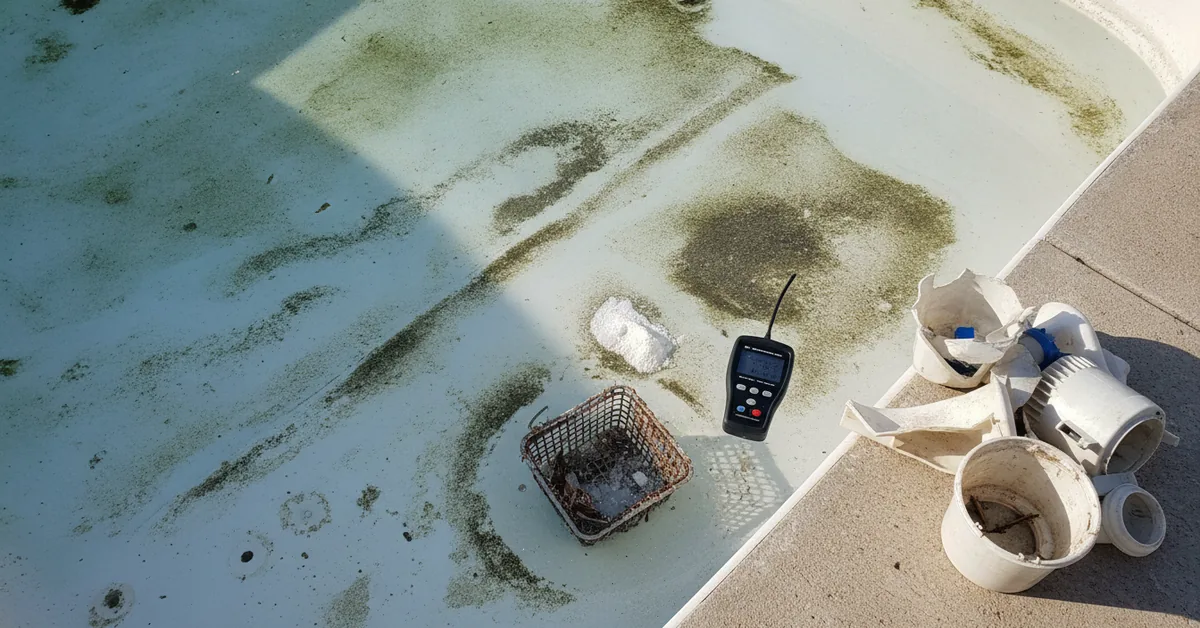
Dumping five bags of shock into a stubborn, murky pool is often the fastest way to guarantee it stays green forever. Homeowners naturally assume that persistent algae blooms stem from a simple lack of sanitizer, but in nine out of ten service calls I answer during peak summer heat, the real culprit is an invisible chemical over-saturation that renders every drop of chlorine completely useless. Cyanuric acid—commonly referred to in the trade as pool stabilizer or conditioner—is designed to shield chlorine from sunlight degradation, yet when it creeps above critical thresholds, it traps sanitizer in a chemical deadlock known as chlorine lock.
Understanding this chemical relationship is the difference between a pristine, low-maintenance backyard oasis and an endless cycle of clear-to-cloudy water, ruined equipment, and blown budgets. When stabilizer levels fall out of equilibrium, your chlorine either burns off in a matter of hours under the midday sun or becomes so thoroughly bound to the stabilizer that it cannot sanitize the pool. The financial implications are massive, ranging from bloated monthly chemical receipts to damaged heat exchangers and premature plaster etching.
Understanding Stabilizer Saturation: Executive Summary
Managing cyanuric acid is the single most misunderstood aspect of residential pool water chemistry, directly dictating whether your sanitizer functions or fails. Ignoring this parameter almost always leads to skyrocketing chemical costs, structural surface staining, and unnecessary drain cycles.
- Stabilizer acts as sunblock for chlorine, but excessive concentrations drastically suppress active hypochlorous acid levels.
- Tri-chlor pucks and di-chlor shock continuously introduce cyanuric acid into the water, causing levels to build indefinitely without evaporation relief.
- The industry target for conventional pools is 30 to 50 ppm, whereas saltwater chlorination systems demand 60 to 80 ppm for optimal cell performance.
- Chemical neutralizers for high stabilizer are notoriously unreliable, making controlled dilution or specialized reverse osmosis the primary fixes.
The Chemical Mechanics: Sunblock vs. Chlorine Lock
To grasp why cyanuric acid dictates your pool's health, you have to look at what happens on a molecular level when chlorine dissolves in water. Unstabilized free chlorine breaks down rapidly under ultraviolet light; direct sunlight destroys up to 90 percent of unstabilized chlorine in roughly two hours. Cyanuric acid binds weakly to chlorine molecules, creating a chemical shield that blocks UV photons from severing the active chlorine bond.
However, this chemical bond operates on a precise equilibrium. The portion of sanitizer actively killing pathogens and algae is free available chlorine in its hypochlorous acid form. As stabilizer levels rise, the percentage of hypochlorous acid decreases exponentially. When stabilizer concentrations exceed 100 parts per million (ppm), the equilibrium shifts so severely that the chlorine remains permanently bonded to the stabilizer molecules. This state, known in the field as chlorine lock, leaves your pool defenseless despite test kits reading elevated total or free chlorine levels.
The Golden Ratio of Free Chlorine to CYA
In modern pool management, testing total chlorine alone is useless without factoring in cyanuric acid. To prevent biological growth and maintain sanitary water, your free chlorine level must always remain at a minimum of 7.5 percent of your total cyanuric acid reading. If your stabilizer sits at 40 ppm, you need a minimum free chlorine level of 3 ppm. If your stabilizer rises to 120 ppm, you need to maintain nearly 9 ppm of continuous free chlorine just to achieve the exact same sanitizing power.
The Multi-System Impact of Incorrect Stabilizer Levels
The damage caused by imbalanced stabilizer goes far beyond cloudy water. Both overly high and dangerously low cyanuric acid trigger distinct cascading failures across your pool's physical infrastructure and water balance metrics.
| Stabilizer Level (CYA) | Free Chlorine Behavior | Impact on Pool Finish | Equipment & Hardware Risk | Corrective Action Required |
|---|---|---|---|---|
| Below 30 ppm (Too Low) | Destroys within 2 hours under UV light; extreme residual fluctuation. | Minimal direct impact; risk of algae staining from zero sanitizer. | Accelerates pump run time; high chemical feed rates wear feeders. | Add pure cyanuric acid directly to skimmer or slurry in bucket. |
| 30 to 50 ppm (Ideal Standard) | Optimal half-life; steady sanitization rate with low chemical waste. | Protects plaster and vinyl by maintaining stable, non-aggressive water. | Extends pump and filter lifecycle; preserves heater exchange cores. | Maintain routine testing; balance weekly based on bather load. |
| 60 to 80 ppm (Ideal Saltwater) | Balanced for low, continuous chlorine yield from salt cells. | Prevents premature cell scale formation when pH is controlled. | Reduces salt cell duty cycle; extends cell plate lifespan by years. | Monitor monthly; top off with fresh water after heavy backwashing. |
| Above 100 ppm (Danger Zone) | Trapped in chlorine lock; non-reactive to organic contaminants. | Causes severe organic staining and false LSI water balance math. | Corrodes copper heat exchangers due to forced hyper-chlorination. | Perform controlled partial drain or run reverse osmosis filtration. |
When pool owners attempt to fight algae in a high-CYA environment, they typically throw dozens of pounds of calcium hypochlorite or liquid chlorine into the pool. This radical chemical spike alters the Langelier Saturation Index (LSI). The sudden shift causes aggressive water conditions that attack equipment or force calcium out of solution, scaling up salt cell plates and filter grids. Furthermore, extreme high-shock treatments in high-CYA pools increase osmotic pressure on plaster finishes, contributing to long-term surface degradation.
A Service Route Reality: The $2,000 "Green Pool" Misdiagnosis
A few seasons back, I took over a residential route account in Texas where the homeowner was convinced he had a broken filter. He had spent three months buying weekly cases of di-chlor shock and keeping a floating feeder stuffed with six trichlor pucks at all times. Despite spending over $400 a month on chemicals alone, his pool remained a stubborn shade of pea-green. Every time he took a sample to a retail pool store, they sold him more shock, algaecides, and phosphate removers.
When I arrived on site with a photometer, his free chlorine was reading above 10 ppm, yet algae was thriving on the steps. I ran a turbidity test for stabilizer: the sight tube overflowed before the black dot vanished. His cyanuric acid was well over 180 ppm. Every single pound of di-chlor shock he added contributed approximately 0.9 ppm of CYA for every 1 ppm of chlorine delivered. He was actively poisoning his own water balance with every application of continuous accumulation chemicals.
Because his water contained such elevated cyanuric acid, his effective hypochlorous acid (HOCl) concentration was under 0.05 ppm. To kill the algae without draining, he would have needed to bring his free chlorine up to an impossible 45 ppm. The fix wasn't another chemical bottle; it was dropping a submersible sump pump into the deep end, safely evacuating 65 percent of the water volume, and refilling with fresh municipal water. Within 24 hours of dropping the CYA to 40 ppm and bringing the free chlorine to 4 ppm, the pool was crystal clear. His misdiagnosis cost him over $2,000 in wasted retail chemicals and unnecessary filter grid replacements.
The Saltwater Cell Paradox: Higher Targets, Lower Stress
Saltwater chlorination systems operate on a fundamentally different delivery model than standard tablet-fed pools. A salt cell generates tiny, continuous doses of pure hypochlorous acid inside the electrolytic cell chamber as water passes through. Because the rate of chlorine production is relatively low—typically measured in fractions of a pound per 24 hours—that fresh chlorine must be protected the precise second it enters the pool cavity.
If a saltwater pool maintains a standard CYA level of 30 ppm, the intense summer UV rays destroy chlorine faster than the cell can produce it. Homeowners usually react by cranking their cell output percentage to 100 percent or running their variable speed pump continuously at high speed. This subjects the delicate cell plates to constant electrical stress, causing premature cell failure and forcing expensive replacement cycles every two years instead of five to seven years.
By raising the stabilizer target to 60–80 ppm specifically in salt chlorine generators, you create a dense protective umbrella. This allows the cell to run at lower output levels (e.g., 30 to 40 percent duty cycle), preserving the precious ruthenium coating on the titanium plates while lowering energy usage on your variable speed pump.
Step-by-Step Field Checklist: Correcting Your CYA Today
Do not rely on cheap paper test strips to measure stabilizer. Strips are notorious for color-bleed, often misreading CYA by 30 to 50 ppm. Walk out to your equipment pad today and execute this diagnostic and correction routine:
- Perform a accurate drop test using a turbidity test tube (reagent drops added to pool water until the black dot at the bottom disappears). Record the exact level.
- Check your current sanitation routine. If you are using tri-chlor pucks in an offline feeder or floatie, calculate how much CYA you add weekly. Every 8-ounce puck adds roughly 0.6 ppm CYA per 10,000 gallons.
- If your CYA exceeds 80 ppm (non-salt) or 90 ppm (saltwater), stop using all trichlor pucks and dichlor granular shocks immediately. Switch exclusively to liquid sodium hypochlorite (liquid bleach/chlorine) or calcium hypochlorite for routine maintenance.
- Calculate your dilution ratio. Subtract your target CYA (e.g., 40 ppm) from your current CYA (e.g., 100 ppm). You need to replace approximately 60 percent of your pool volume to correct the balance.
- Inspect your local water table conditions and pool construction material. Never fully drain a plaster or vinyl liner pool without professional supervision, as hydrostatic pressure can pop the pool shell out of the ground or tear the liner. Perform controlled, partial drains of 20 to 30 percent at a time.
- Refill with fresh municipal water, run the filter pump for 24 hours to ensure complete turnover, and retest both CYA and pH before introducing new chlorine.
Advanced Troubleshooting FAQs
- How does high cyanuric acid distort total alkalinity readings and skew LSI calculations?
- Cyanuric acid contributes directly to the total titration reading during an alkalinity test, creating a condition known as cyanurate alkalinity. To calculate true carbonate alkalinity—which is required for accurate Langelier Saturation Index (LSI) math—you must correct your total alkalinity reading. Subtract roughly one-third of your total CYA reading from your measured Total Alkalinity (TA) if your pH is around 7.5. For example, if your TA reads 120 ppm and your CYA is 90 ppm, your actual carbonate alkalinity is only 90 ppm. Failing to adjust for this leads pool owners to incorrectly add acid, crashing their true alkalinity and turning the water severely aggressive to plaster surfaces.
- Can reverse osmosis (RO) mobile filtration remove cyanuric acid without draining the pool?
- Yes, mobile reverse osmosis units designed for swimming pools can successfully strip cyanuric acid, total dissolved solids (TDS), high calcium hardness, and heavy metals without significant water loss. These trailer-mounted systems draw water from the pool, force it through semi-permeable membranes at ultra-high pressure (filtering down to 0.0001 microns), and return purified water back to the basin. RO filtration typically reclaims 80 to 85 percent of the original pool water, making it the ideal solution for drought-restricted regions, high-water-table areas, or custom plaster pools where complete draining poses severe structural risks.
- Why do chlorine manufacturers continue using trichlor and dichlor if they cause CYA lock?
- Trichloroisocyanurate (trichlor) and dichloroisocyanurate (dichlor) are extraordinarily shelf-stable, easy to transport, and highly concentrated solid forms of chlorine. Raw hypochlorous acid is gas or liquid, making it difficult for the average consumer to store and handle safely. Pucks and granules provide a convenient, slow-release delivery method for small or newly filled pools that actually need initial stabilizer. The chemical industry designs these products for convenience, but they rely on the end-user or technician to monitor CYA buildup and transition off cyanurate-based compounds once ideal stabilizer levels are reached.