

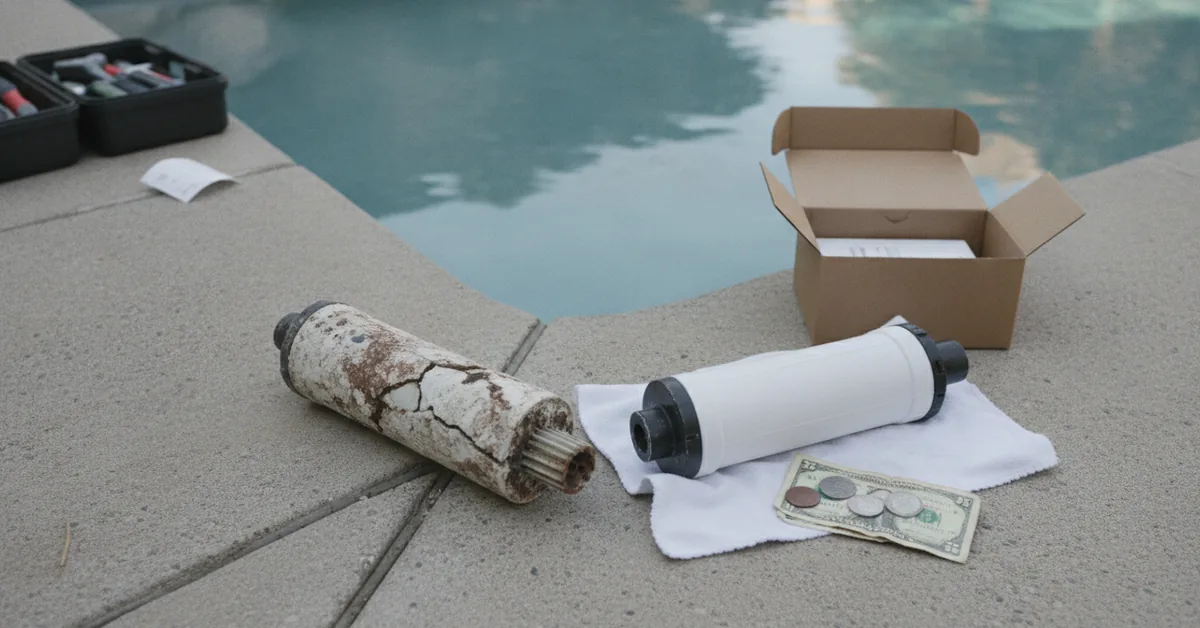
Replacing an $800 to $1,400 salt cell every two years is not an inevitable cost of salt water pool ownership—it is almost always the result of avoidable chemical damage. Most pool owners buy into the marketing myth that salt chlorine generators are 'set-it-and-forget-it' systems, only to end up shocked when their electrolytic plates fail years ahead of their expected lifespan. In my service routes, I regularly see homeowners destroy high-end titanium cells simply by misinterpreting equipment alerts or relying on harsh cleaning methods that strip the delicate chemical coatings right off the metal.
Understanding the actual mechanics of an electrolytic salt chlorine generator (SCG) shifts your perspective from reactive spending to proactive preservation. When managed properly, a quality salt cell should comfortably deliver 8,000 to 10,000 operational hours, translates to five to seven years of crystal-clear water. Achieving that longevity requires looking beyond basic chlorine readings and mastering the interaction between saturation index, electrical current, and preventative cell care.
The High Price of Ignorance: An Executive Overview of Salt Cell Longevity
Premature salt cell degradation is one of the single largest unnecessary expenditures in residential pool care today.
Premature salt cell degradation is one of the single largest unnecessary expenditures in residential pool care today. By addressing the root causes of cell plate strip-down and scaling, pool managers can double the functional lifespan of their chlorination hardware while cutting chemical spending.
- Ruined Precious Metal Coatings: Over-cleaning cells with aggressive muriatic acid mixtures strips the rare ruthenium dioxide coating off titanium plates, permanently killing chlorine production.
- Water Chemistry Mismanagement: Unbalanced Langelier Saturation Index (LSI) values force scale formation directly onto heat-generating cell plates, overloading the transformer and frying internal bridge rectifiers.
- Phantom Low-Salt Faults: Running chlorinators at 100% output to compensate for cold water or low cyanuric acid destroys electrolytic plates prematurely.
- Proactive Maintenance Protocol: Implementing low-concentration acid soaks, physical scale scraping, and proper salinity testing protects your initial hardware investment for up to seven full seasons.
How Excess Acid Washing Silently Destroys Your Electrolytic Cell
The biggest self-inflicted wound I see in the field involves acid washing. Somewhere along the line, pool owners were told that whenever their salt cell displays a inspect cell light, they should immediately submerge it in a bucket of aggressive muriatic acid. That practice is financial suicide for your equipment pad.
Salt generator plates are constructed from grade 1 titanium coated with an extremely thin layer of ruthenium dioxide or iridium oxide. This microscopic coating acts as the catalyst that turns dissolved sodium chloride into free available hypochlorous acid via electrolysis. When you dip a salt cell into a harsh 4:1 water-to-muriatic-acid solution, the acid eats away at the calcium scale, but it also foams away the precious metal coating on the titanium. Once that oxide coating dissolves down to bare metal, the cell will never produce chlorine again, regardless of how much salt you add to the pool.
I remember a client in Phoenix, Dave, who called me out because his salt system kept warning him of low cell output despite his salt level measuring a solid 3,400 PPM. When I pulled his cell from the plumbing line, the plates were completely free of white calcium scale, but they had turned a flat, matte gray instead of their normal metallic sheen. Dave proudly told me he soaked his cell in pure muriatic acid every month like clockwork to keep it 'spotless.' In his attempt to keep the unit clean, he had completely stripped the ruthenium catalytic layer in less than 14 months. He had to pay $1,100 for a fresh cell replacement simply because he cleaned away his initial investment.
Water Chemistry Factors That Accelerate Salt Cell Degeneration
Electrolytic cells do not operate in a vacuum; they operate as localized high-pH reaction chambers. During chlorine generation, the chemical process inside the cell produces hydroxide ions alongside chlorine gas. This causes the localized pH inside the cell housing to spike briefly above 10.0 and temperature to rise. If your bulk pool water chemistry is even slightly leaning toward scaling, scale will instantly precipitate out of solution and bind to the cell plates.
Maintaining a strictly balanced Langelier Saturation Index (LSI) between -0.2 and +0.2 is the absolute primary key to cell survival. High calcium hardness (above 400 PPM) combined with high total alkalinity (above 120 PPM) forces calcium carbonate to bake onto the plates. As scale accumulates between the narrow plate gaps, water flow diminishes, localized heat surges, and the system pulls excessive amperage to force electrical current across the bridged scale gaps. This extra thermal load degrades internal wiring harnesses and weakens the power center's main circuit board.
| Water Parameter | Standard Pool Range | Salt Cell Target Range | Consequence of Mismanagement on Salt Cell |
|---|---|---|---|
| Free Chlorine | 1.0 - 3.0 PPM | 2.0 - 4.0 PPM | Low levels force cell duty cycle to 100%, causing premature plate burn. |
| pH | 7.2 - 7.8 | 7.2 - 7.6 | High pH accelerates scale formation on titanium plates during high-temp electrolysis. |
| Calcium Hardness | 200 - 400 PPM | 200 - 300 PPM | Elevated hardness causes rapid calcium bridging between narrow plate gaps. |
| Cyanuric Acid (CYA) | 30 - 50 PPM | 60 - 80 PPM | Low CYA lets UV light burn off chlorine fast, driving constant cell operation. |
| Salt Concentration | 2,700 - 3,400 PPM | 3,200 - 3,600 PPM | Running below recommended PPM forces board to draw higher current, frying control components. |
The Electrical and Flow Mechanics Behind Premature Cell Burnout
Modern variable speed pumps (VSPs) are fantastic for energy bills, but when run at extremely low RPMs (e.g., 1,000 to 1,200 RPM), they can indirectly destroy an electrolytic salt cell if the plumbing loop is not dialed in correctly. At low flow rates, air or hydrogen gas pockets can collect in the top of a horizontally mounted cell housing. While safety flow switches are meant to kill power when flow drops, a sticking microswitch or incorrectly oriented cell can allow electrolysis to continue in an under-filled chamber.
When an active cell operates without full water submersion, the plates lose their thermal bath. The temperature spikes inside the housing, distorting the internal PVC spacer grids and warping the outer plastic casing. Additionally, running a chlorinator at 100% output continuously to overcome a hidden chlorine demand (like yellow mustard algae or high bather load) keeps the plates under constant voltage strain. Instead of running a cell at 100% output for 8 hours, it is far less taxing on the internal transformer to run the system at 50% output over a 16-hour pump runtime, as this gives the internal components built-in rest periods during cycle reversals.
A Step-by-Step Diagnostic Inspection for Your Pool Pad Today
To avoid finding out your cell is dead on the hottest weekend of summer, head out to your pool pad today and perform this methodical diagnostic check. Catching scale formation or electrical issues early can save you hundreds of dollars in equipment costs.
- Perform a Visual Cell Housing Check: Turn off the circuit breaker for the pool pump and salt system. Unscrew the threaded unions on both ends of the salt cell and remove it from the plumbing line. Look down the interior channels using a bright flash light. Look for crusty white build-up bridging the gap between titanium plates.
- Execute a Mechanical Soft Clean: If scale is visible, do not reach for acid immediately. Take a wooden chopstick or rigid plastic scraper and gently dislodge the heavy white deposits. Never use metal screwdrivers, wire brushes, or butter knives, as scraping metal against metal will scratch off the catalytic oxide coating.
- Apply a Low-Concentration Soak Only If Needed: If white deposits remain after physical scraping, mix a dilute solution of 10 parts water to 1 part muriatic acid in a clean bucket (always add acid to water, never water to acid). Stand the cell vertically in an cell cleaning stand and pour the diluted solution into the interior. Allow it to fizz for no more than 5 to 7 minutes, flush immediately with fresh hose water, and reinstall.
- Verify Salt Level with an Independent Liquid Test: Never rely exclusively on the digital reading displayed on your chlorinator control board. Control panels display an averaged or temperature-compensated reading that can drop as the cell plates age. Test your pool water salt content independently using a salinity drop test kit or digital handheld meter to make sure you aren't oversalting or undersalting your pool.
- Inspect and Clean the Flow Switch: Locate the mechanical flow switch (usually a tee assembly placed before or after the cell). Remove it and verify that the physical paddle moves freely without sticking, and clear away any hair or debris wrapped around the post.
Advanced Field Diagnostics: Frequently Asked Questions
- How does a negative LSI value impact the electrolytic lifespan compared to a high calcium scale condition?
- While a positive LSI causes scaling that physically clogs plates and draws excess current, a strongly negative LSI (aggressive, acidic water) directly attacks the metal hardware. Water with an LSI below -0.3 is hungry for minerals and will chemically leach trace metals from your cell housing, temperature sensors, and the ruthenium dioxide coating itself. Acidic water wears away the titanium's active layer far faster than scale buildup, causing irreparable loss of chlorine output without leaving any visible white residue.
- Why does my salt generator board display a Low Salt error when my independent liquid drop test shows 3,400 PPM?
- A false low-salt reading on your control panel is one of the classic signs of an aging cell plate coating or heavy scale accumulation. Salt generators calculate salinity by measuring electrical conductivity across the titanium plates under a set voltage. When plates are coated in non-conductive calcium scale or the ruthenium oxide layer has worn off, current cannot easily pass between plates. The system interprets this reduced current draw as a lack of salt in the water, prompting pool owners to incorrectly dump hundreds of pounds of salt into their pool, which causes corrosion elsewhere on the pad.
- Can running a variable speed pump at low speeds cause thermal shock or sensor failure inside the electrolytic cell housing?
- Yes, if the cell is installed incorrectly relative to flow direction or without an adequate straight pipe run preceding the flow switch. At very low flow rates (e.g., below 20 GPM), hydrogen gas created during electrolysis can accumulate at the top of the cell body if it is installed horizontally with the ports facing downward. This gas pocket isolates the internal temperature sensor, causing it to read dry air temperatures rather than water temperatures. The board may fail to shut off the current in time, leading to thermal distortion of the cell's outer PVC casing and premature failure of internal wire potting compounds.