

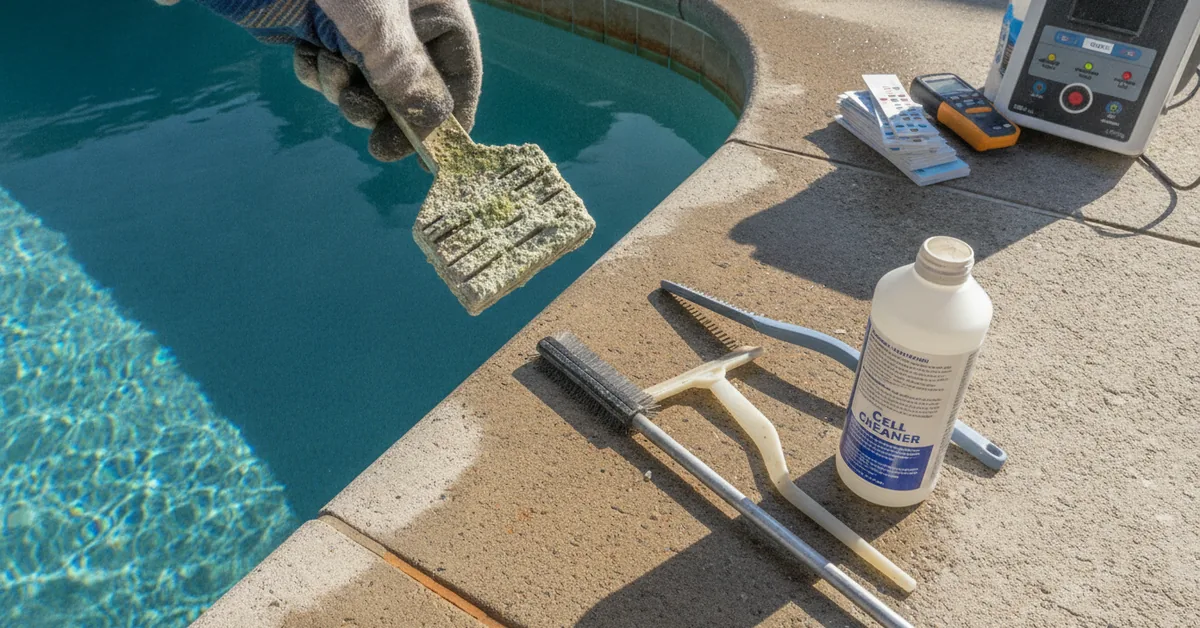
Replacing an etched titanium salt cell standardly runs between $800 and $1,600, while severe calcium scaling caused by unmanaged pH creep can destroy a $3,500 gas heater heat exchanger in under two seasons. Saltwater pools do not eliminate pool maintenance; they fundamentally change the biochemistry of your water chemistry. Homeowners lured by pool builder sales pitches believing they will never touch chemicals again routinely face thousands of dollars in avoidable equipment damage.
The Reality of Saltwater Pool Ownership: Executive Overview
Saltwater swimming pools are mini chlorine factories operating on electrolysis, not magic self-cleaning oases. Proper
Saltwater swimming pools are mini chlorine factories operating on electrolysis, not magic self-cleaning oases. Proper management requires diligent monitoring of unique electrochemical dynamics to protect equipment investment and guarantee sanitized water.
- Salt cells generate pure chlorine along with sodium hydroxide, causing continuous upwards pH creep that demands regular acid dosing.
- Electrolytic cell plates require routine descaling every 3 to 6 months to maintain adequate amp draw and chlorine output.
- Corrosion of metallic components, heaters, and stone coping remains a constant threat without balanced Langelier Saturation Index (LSI) management and sacrificial anodes.
- Cyanuric acid (stabilizer) and salinity levels must be manually adjusted; an automated salt chlorine generator cannot adjust water balance autonomously.
The Science of Electrolysis: Why Salt Pools Still Produce Chlorine
The single biggest myth I run into on my service routes is the belief that saltwater pools are non-chlorine pools. When I test water at a saltwater property, I am testing for the exact same free chlorine molecule (hypochlorous acid) found in a traditional pool treated with liquid bleach or trichlor pucks.
Your salt chlorine generator (SCG) uses a electrolytic cell installed on your return line. As pool water containing roughly 3,000 to 4,000 parts per million (PPM) of dissolved sodium chloride ($NaCl$) passes over titanium plates coated with ruthenium oxide, a low-voltage DC current splits the molecules. This reaction creates hypochlorous acid ($HOCl$), sodium hydroxide ($NaOH$), and hydrogen gas ($H_2$).
Because sodium hydroxide has a pH of roughly 13, the process continuously pushes your pool's pH upward. In traditional tablet-sanitized pools, trichlor pucks are acidic (pH ~2.8) and drag pH down. Salt systems do the exact opposite. Without regular additions of muriatic acid, your pH will spike past 8.0 within days, rendering your chlorine sluggish and precipitating heavy calcium scaling across your pool plaster and inside the generator itself.
Practical Field Case: The Case of the $1,400 "Broken" Salt Cell
Last summer, I took a call from a homeowner in Dallas who was ready to spend $1,400 on a brand-new salt cell replacement. His control panel was flashing a "Low Salt / Check Cell" light, even though a local pool store told him his salinity was sitting at a perfect 3,400 PPM. He assumed the electronics had failed after just 14 months of operation.
When I disassembled the cell on his equipment pad, the internal titanium plates were completely bridged by bright white, rock-hard calcium carbonate crust. The sensor could not read the electrical current through the dense mineral barrier, giving a false low-salt error. The pool's total alkalinity was sitting at 140 PPM, pH was off the charts at 8.2, and calcium hardness was sitting at 550 PPM.
Instead of throwing away a perfectly functional component, I soaked the cell in a diluted solution of four parts water to one part muriatic acid for 15 minutes until the effervescing calcium dissolved. I recalculated his LSI, lowered his total alkalinity down to 70 PPM to suppress the high pH drift, and got his system generating 3.0 PPM of free chlorine instantly. That $15 chemical fix saved him $1,385, but it highlighted how quickly lack of water balancing destroys high-end gear.
Traditional Chlorine vs. Saltwater Maintenance Realities
Understanding the true maintenance operational profile helps prevent surprises down the road. Below is a realistic breakdown of how saltwater pools compare to traditional sanitation routines in field conditions.
| Maintenance Variable | Traditional Liquid/Trichlor Pool | Saltwater Generator (SCG) Pool | Technician Recommendation |
|---|---|---|---|
| pH Management | Tends to drop or remain stable | Consistently drifts UPWARD (7.8 - 8.2+) | Add muriatic acid weekly; keep Total Alkalinity lower (70-80 PPM). |
| Chlorine Delivery | Manual dosing or dissolving pucks | Automated continuous generation | Adjust cell output percentage based on seasonal water temperature changes. |
| Equipment Inspections | Standard pump/filter checks | Requires physical cell inspection every 90 days | Descale cell with mild acid bath only when visual scaling appears. |
| CYA (Stabilizer) Target | 30 - 50 PPM | 60 - 80 PPM | Higher CYA is required to shield generated chlorine from quick UV degradation. |
| Lifespan Expectations | N/A (Chemicals added directly) | Cell replacement required every 3-7 years | Keep salt levels balanced; running a cell in low salt shortens plate coating life. |
Protecting Surrounds, Stone Coping, and Heaters from Salt Corrosion
Salt is an aggressive mineral. While 3,500 PPM salt concentration feels mild to swimmers (roughly 10% of ocean salinity), it is more than enough to oxidize exposed metal and erode porous flagstone or soft travertine coping. I frequently see thousands of dollars in stone damage around salt pool perimeters where splashed water evaporates, leaving concentrated salt crystals behind that expand inside the pores of the stone—a process known as spalling.
To mitigate this risk, any saltwater setup should feature a inline zinc sacrificial anode wired into the equipment pad's bonding grid. The anode acts as a protective shield; the corrosive electrical potential in the water attacks the soft zinc element instead of eating your gas heater's copper heat exchanger or stainless steel ladder anchors.
Furthermore, maintaining a neutral Langelier Saturation Index (between -0.2 and +0.2) is critical. Salt water with a high pH and high calcium creates heavy scaling inside the hot environment of a salt cell or heater core. Conversely, salt water with low pH and low calcium turns aggressively corrosive, stripping copper out of heat exchangers and turning pool water a distinct light green that stains plaster permanently.
Actionable Guideline: Your 5-Step Salt Pad Diagnostic Routine
Walk out to your pool pad today with this checklist to ensure your saltwater system operates efficiently and avoids premature failure:
- Check physical salt cell flow and orientation: Verify that your salt cell flow switch is aligned correctly with water directional arrows and that no air bubbles are trapped inside the clear cell housing.
- Inspect the diagnostic display screen: Compare the actual instantaneous salt reading on the screen against a manual drop-test (such as a AgNO3 titration test). If the display is more than 300 PPM off, suspect cell scaling or sensor recalibration needs.
- Examine the equipment pad for salt corrosion: Check surrounding pump motor bolts, filter clamps, and copper bonding wires for blue-green oxidation or rust. Rinsing salt residue off the pad area monthly prolongs equipment shell life.
- Perform a manual chemical balance check: Test pH, Total Alkalinity, Calcium Hardness, and Cyanuric Acid. Ensure CYA sits firmly between 60 and 80 PPM so the cell does not have to run at 100% capacity to maintain chlorine levels.
- Inspect natural stone perimeters: Look at your coping stone for signs of flaking, crumbling, or white salt rings. Apply a breathable, penetrating stone sealer annually to soft stone surfaces around salt water splash zones.
Advanced Saltwater Troubleshooting & Operational FAQs
- How does high calcium hardness specifically affect a salt chlorine generator cell?
- When water passes over the electrolyzed plates, the micro-environment directly adjacent to the titanium cathode becomes extremely alkaline. If your pool water's calcium hardness exceeds 400 PPM alongside elevated pH or alkalinity, calcium carbonate precipitates out of solution instantly and bonds to the cathode plates. This scale insulates the plates, reduces electrical conductivity, raises amperage draw, forces false low-salt errors, and ultimately overheats the cell electronics.
- Why does my salt pool drop its chlorine output during cold winter months?
- Salt cells rely on electrical conductivity, which decreases significantly as water temperature drops. Most major salt system manufacturers program cold-water cutoff safety features that automatically shut down generation when water temperatures fall below 50°F to 55°F (10°C to 13°C) to prevent plate damage. During winter, you must manually supplement your pool with liquid chlorine or reduce pump run times while relying on cold water's natural ability to retard algae growth.
- Will running a variable speed pump at low RPM cause my salt generator to stop working?
- Not if the system is plumbed and calibrated correctly. Salt chlorine generators require a minimum flow rate (typically 20 to 25 gallons per minute) to keep the internal safety flow switch closed. If your variable speed pump is running at an ultra-low RPM (e.g., 1,000 RPM) to save energy, the flow switch may open and pause chlorine production. You must adjust your pump's baseline speed slightly higher (typically 1,400 - 1,800 RPM) to satisfy the flow switch requirements while maintaining energy efficiency.