

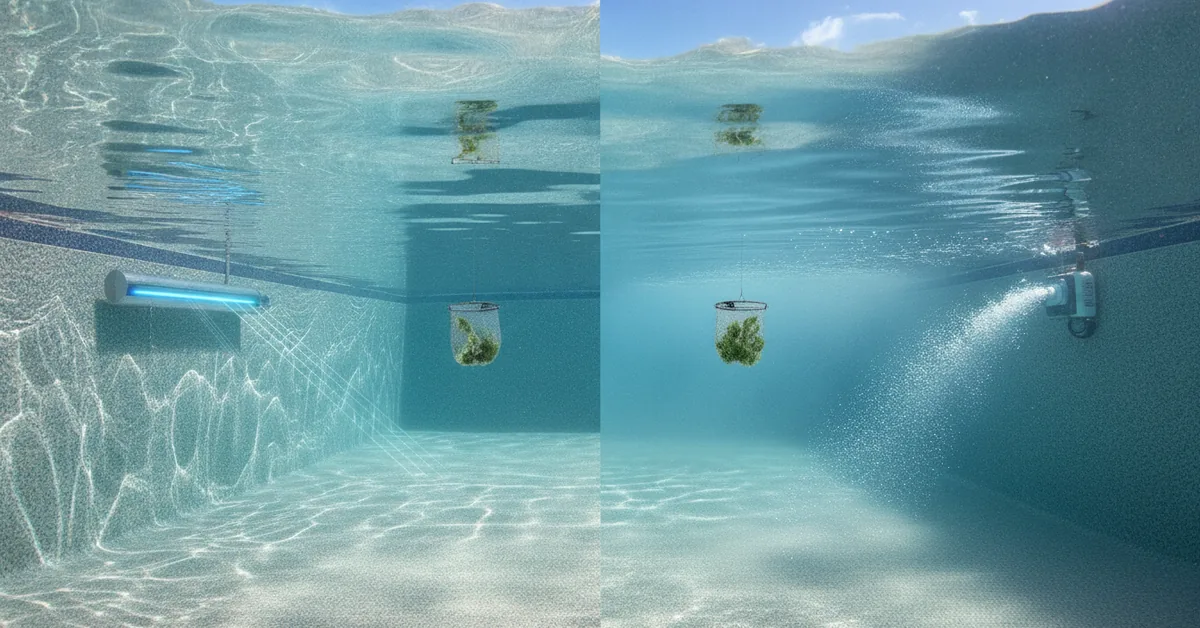
Installing a UV lamp or ozone generator on a saltwater pool under the impression that both systems offer equal supplemental sanitation efficiency is one of the most expensive chemical misconceptions I encounter on service routes. Homeowners frequently spend thousands of dollars on secondary sanitation expecting to turn their salt chlorine generators down to ten percent output while achieving drinking-water clarity, only to discover cloudiness, persistent combined chlorine, or rapid quartz sleeve fouling within six months. The industry habit of grouping UV and Ozone together as identical advanced oxidation tools hides fundamental differences in fluid dynamics, chemical oxidation potential, and pathogen inactivation kinetics.
While saltwater pools excel at maintaining a consistent baseline of free chlorine through the electrolysis of sodium chloride, electrolytic cells frequently struggle during high bather loads, heavy rainstorms, or intense thermal loads. When organic nitrogen compounds enter the water from sweat and sunscreens, the salt cell works overtime trying to oxidize these contaminants, which accelerates scale formation on the ruthenium oxide coated titanium plates and reduces cell service life. Secondary sanitizers are supposed to lift this oxidation burden, but UV light and ozone gas operate on radically different chemical principles that yield vastly different results in real-world salt pool chemistry.
The Technical Reality of Secondary Sanitation in Saltwater Systems
Supplemental sanitizers are not interchangeable; UV acts strictly as a point-of-use physical pathogen inactivator with
Supplemental sanitizers are not interchangeable; UV acts strictly as a point-of-use physical pathogen inactivator with zero oxidative capacity in standard low-pressure systems, whereas Ozone is a volatile dissolved gas that aggressively oxidizes organic waste and chloramines within the hydraulic loop. Selecting the correct system depends entirely on whether your saltwater system suffers from persistent combined chlorine buildup, organic loading, or high exposure to chlorine-resistant pathogens like Cryptosporidium.
- UV systems provide zero residual oxidation and require crystal-clear water with clean quartz sleeves to allow 254-nanometer light waves to disrupt micro-organism DNA during a single-pass contact window.
- Corona Discharge Ozone actively oxidizes organic compounds and chloramines directly in the pipe, reducing the workload on your salt cell and extending its typical 10,000-hour operational lifespan.
- Salt cell life is directly preserved by high-potential oxidizers, as ozone handles the heavy oxidation load that would otherwise force the salt cell to run at 100 percent capacity.
- Advanced Oxidation Processes (AOP) combine both mechanisms to create hydroxyl radicals, representing the highest oxidation energy available for residential pool pads.
Contact Chamber Physics vs. Gas Injection Mechanics: How UV and Ozone Function Differently
To understand why these systems are not equal, you have to look at what happens inside the plumbing line downstream of your media filter. Medium and low-pressure ultraviolet systems pass water around a sealed quartz sleeve containing a mercury vapor bulb. As water flows past, photons emitted at a wavelength of 254 nanometers penetrate the cell walls of bacteria, viruses, and protozoa, cross-linking their thymine bases and rendering them sterile. However, the moment water exits the stainless steel or composite UV housing, the germicidal action stops entirely. UV light does not destroy uncombusted lipids, body oils, or urea unless exposed to massive doses of medium-pressure polychromatic light, which is rarely installed on residential pads due to high electrical draw and heat output.
Ozone systems operate through gas injection, typically utilizing a Venturi injector that draws gas into the main circulation loop, creating a micro-bubble slurry. Ozone gas consists of three oxygen atoms and is exceptionally unstable, possessing an oxidation potential of 2.07 electron volts compared to chlorine's 1.36 electron volts. When these micro-bubbles enter a contact vessel, ozone attacks electron-rich organic molecules, breaking down complex chloramines, skin flakes, and cosmetics through direct oxidation. This fundamental difference means that while UV merely sterilizes organisms passing through its chamber, ozone actively destroys the precursor compounds that turn free chlorine into irritating combined chloramines.
The Trench Story: The Case of the Burned-Out Salt Cell and the Off-Gassing Cover
Two seasons ago, I was called out to diagnose a 38,000-gallon gunite saltwater pool in Austin, Texas. The owner had an inline UV unit and an 80,000-gallon rated salt cell, yet his water was consistently hazy, and his combined chlorine sat at a stubborn 1.2 parts per million. The homeowner had bumped his salt generator duty cycle to 100 percent in an attempt to burn off the chloramines, which drove the calcium hardness precipitation inside his cell into overdrive. Within nine months, the salt cell plates were bridged solid with calcium carbonate scale, and the chloramines remained unchanged.
When I inspected the UV system, I found the quartz sleeve coated in a thick film of silicate and scale. Because water in a salt pool has elevated total dissolved solids—typically between 3,000 and 4,000 parts per million—the thermal envelope around an active UV lamp creates a localized hot zone that accelerates mineral precipitation directly onto the glass. The UV light could not penetrate the scaled sleeve, rendering it useless. We removed the underperforming UV unit and installed a Corona Discharge Ozone system equipped with a Venturi bypass loop, a contact vessel, and a carbon-based degassing column to catch unreacted gas. Within 72 hours, the combined chlorine dropped to zero, the salt cell duty cycle was dialed back to 35 percent, and the visual clarity of the water achieved that brilliant glass-like polish that only gas oxidation provides.
Side-by-Side Performance Analysis: UV Systems vs. Ozone Generators in Salt Water
Evaluating supplemental equipment requires comparing quantifiable chemical metrics rather than marketing claims. Saltwater pools present a unique water matrix due to high sodium chloride levels, elevated electrical conductivity, and higher baseline total dissolved solids. The table below outlines how low-pressure UV, Corona Discharge Ozone, and Hydroxyl-based AOP perform when paired with electrolytic salt cells.
| Performance Parameter | Low-Pressure UV Systems | Corona Discharge Ozone | Hydroxyl Radicals (AOP) |
|---|---|---|---|
| Primary Mechanism | Photolytic DNA Inactivation (254 nm) | Direct Molecular Oxidation ($O_3$) | Hydroxyl Radical Oxidation ($\cdot OH$) |
| Oxidation Potential (eV) | 0.00 eV (No direct oxidation) | 2.07 eV | 2.80 eV |
| Combined Chlorine Reduction | Minimal (Requires high-pressure polychromatic) | High (Direct oxidation of chloramines) | Exceptional (Destroys chloramines and precursors) |
| Cryptosporidium Log-4 Reduction | Excellent (Single pass in clean water) | Moderate (Requires specific contact time) | Exceptional (Instantaneous inactivation) |
| Quartz Sleeve / Contact Maintenance | High (Requires frequent acid washing of sleeve) | Low (Check valve and injector cleaning) | Moderate (Varies by light/ozone engine design) |
| Impact on Salt Cell Lifespan | Neutral (Does not reduce cell load significantly) | High (Extends cell life by handling oxidation) | Maximum (Extends cell life up to 50 percent) |
| Equipment Lifespan before Overhaul | 10,000 Hours (Lamp replacement) | 15,000-20,000 Hours (CD Chip/Ozone Cell) | 10,000-15,000 Hours (Bulb/Ozone Chip) |
Hydroxyl Radicals and Synergistic Advanced Oxidation Processes (AOP): When UV and Ozone Converge
While standalone UV and Ozone have clear mechanical differences, modern water treatment has shifted toward combining both technologies into Advanced Oxidation Processes (AOP). When 254-nanometer ultraviolet light strikes dissolved ozone gas inside a pressurized reaction tube, a chemical reaction splits the ozone molecule in the presence of water to generate hydroxyl radicals. These radical molecules carry an oxidation potential of 2.80 electron volts, making them more powerful than ozone, chlorine, or chlorine dioxide.
For a saltwater pool owner, an AOP system provides the ultimate offload mechanism for the salt cell. Hydroxyl radicals react in microsecond timescales, oxidizing organic contaminants, micro-pollutants, and chloramines instantly within the plumbing manifold. This near-instantaneous reaction speed prevents organic loading from ever reaching the pool vessel, allowing your salt generator to focus solely on maintaining a low, stable free chlorine residual of 1.0 to 2.0 parts per million. However, AOP units require precise flow control and clean water to maintain optimal photolytic conversion of ozone to hydroxyl radicals, meaning proper filtration remains non-negotiable.
Field Pad Audit: Step-by-Step Inspection Checklist for Saltwater Supplemental Systems
If you currently operate or plan to install a UV, Ozone, or AOP unit on your saltwater pool pad, walk out to your equipment collection today and complete these diagnostic steps to verify peak system performance:
- Check the Differential Pressure across the Venturi or Chamber: Inspect your filter pressure gauge and flow meter. Ozone Venturi injectors rely on a precise pressure differential (typically 10 to 15 PSI drop across the injector) to draw gas; if your variable speed pump is running at too low an RPM, the injector will fail to draw ozone gas into the line.
- Inspect the UV Quartz Sleeve for Scale Formation: Power down the breaker, turn off isolation valves, and slide out the UV lamp. Check the quartz sleeve for white, hazy mineral scale. If scale is present, soak the sleeve in a ten-percent muriatic acid bath until optically clear.
- Perform a Differential Chloramine Test: Use a liquid FAS-DPD titrametric test kit to measure Free Chlorine (FC) and Total Chlorine (TC). Subtract FC from TC to calculate Combined Chlorine (CC). If your CC reading is above 0.2 ppm despite running your supplemental system, your UV bulb is expired, or your Ozone CD cell has failed.
- Audit the Ozone Check Valve and Degas Safety Loop: Trace the clear vinyl tubing running from the ozone generator to the Venturi injector. Verify that the Kynar check valve is functioning and shows no signs of salt water back-siphoning into the electrical housing, which destroys corona discharge chips instantly.
Master Technician Troubleshooting & Field FAQs
- How does high calcium hardness in a saltwater pool specifically degrade UV system performance?
- Saltwater pools run higher baseline total dissolved solids and often operate at a higher localized pH near the salt cell outlet. When water passes through a UV chamber, the thermal energy radiated by the quartz sleeve warms the thin boundary layer of water surrounding the glass. Calcium carbonate solubility decreases as temperature increases, causing calcium scale to drop out of solution and bind to the quartz glass. This scale acts as an opaque barrier, blocking 254 nm germicidal light from entering the water stream and dropping pathogen inactivation rates to near zero.
- Will adding an ozone generator allow me to turn off my saltwater chlorine generator completely?
- No. Ozone is an ephemeral gas that reacts quickly inside the equipment pipe line and off-gasses through a degas vessel or dissipates at the pool returns. It leaves zero active disinfectant residual in the swimming vessel itself. You must still run your salt cell to maintain a baseline of 1.0 to 2.0 ppm free chlorine to prevent cross-contamination from bathers in the water body, but the ozone system allows you to decrease your salt cell output setting significantly, saving energy and extending cell life.
- Can ozone off-gassing ruin an automatic pool cover on a saltwater pool?
- Yes, unreacted ozone gas that enters the pool vessel will accumulate in the air pocket underneath a closed automatic vinyl cover. Ozone oxidizes the plasticizers within the vinyl material, causing the cover to become brittle, bleach out, and crack prematurely. To prevent this, any ozone system installed on a pool with an automatic cover must include a degassing column and a catalytic carbon off-gas destroyer that vent unreacted ozone gas safely before the water reaches the return jets.