

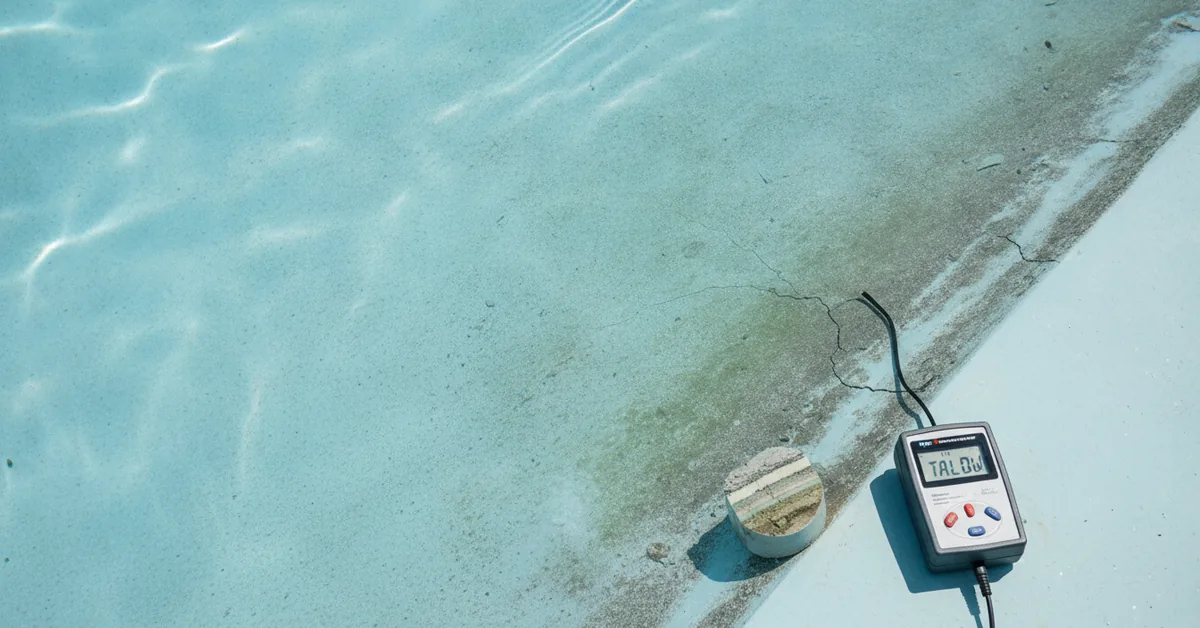
The sun was beating down on a back patio in Scottsdale, Arizona, as a homeowner ran his palm along the submerged bench of his three-year-old pool. Instead of smooth quartz, his hand came up covered in a milky white slurry, his skin scraped raw by micro-pitting that looked like coarse sandpaper. He had spent $14,000 on a complete resurfacing job just thirty-six months prior, yet his finish was disintegrating beneath his feet. When I walked onto his equipment pad and ran my drop test kit, his pH read a seemingly acceptable 7.4. But a deeper look into his water chemistry revealed the true culprit: his Total Alkalinity was chronically depressed, forcing the water to aggressively leach calcium hydroxide directly out of the cement matrix to satisfy its molecular hunger.
Executive Summary: Total Alkalinity as the Cement Matrix Shield
Total Alkalinity acts as the primary sacrificial buffer that prevents pool water from aggressively dissolving the calcium binder inside your plaster. Maintaining precise carbonate alkalinity levels is the single most critical factor in extending plaster lifespan beyond fifteen years.
- Total Alkalinity (TA) provides necessary bicarbonate ions to prevent destructive swings in pH and aggressive water conditions.
- Uncorrected Cyanuric Acid (CYA) creates false TA readings, leading homeowners to leave water in an etching state despite ideal test strip results.
- Low carbonate alkalinity causes chemical leaching, turning smooth white marcite or quartz into pitted, rough surfaces.
- Calculating the Langelier Saturation Index (LSI) using corrected carbonate alkalinity is mandatory for preventing both surface destruction and scale buildup.
The Chemistry of Plaster Dissolution: How Low Alkalinity Destroys Cement
Pool plaster is not an inert barrier; it is a dynamic concrete mixture composed primarily of white portland cement and aggregates like marble dust, quartz, or pebble assemblies. Portland cement relies heavily on calcium hydroxide to maintain its structural integrity. Water is naturally hungry for minerals, particularly calcium and carbonate compounds. When your pool water lacks an adequate reserve of bicarbonate ions, it shifts into an aggressive, under-saturated chemical state.
When Total Alkalinity drops below target thresholds, the water actively dissolves the calcium hydroxide matrix within the plaster to achieve chemical balance. This process, known as calcium leaching, leaves behind microscopic voids around the quartz or aggregate particles. Over time, these voids expand, causing white dust to float into the water column and creating an extremely rough texture that snag swimsuits and harbors black algae. This chemical degradation causes irreversible structural degradation that no amount of brushing or topical patching can reverse.
The Hidden Distortion: Calculating True Carbonate Alkalinity
One of the most common oversights in residential pool care is treating the number on a standard test kit as absolute. Total Alkalinity measures all titratable bases in the water, including bicarbonates, carbonates, hydroxides, and cyanurates. However, only carbonate and bicarbonate ions actively protect plaster from dissolving. Cyanuric acid (stabilizer) contributes significantly to the Total Alkalinity measurement but offers zero protection to the concrete matrix.
When Cyanuric Acid rises above 50 ppm, it creates a dangerous illusion of chemical balance. To find your true protection level, you must apply the Cyanuric Acid correction formula: subtract roughly one-third of your CYA reading from your measured Total Alkalinity. If your pool reads a TA of 80 ppm but your CYA is sitting at 90 ppm, Cyanuric Acid acts as a false buffer that masks your real condition. In reality, your effective carbonate alkalinity drops into the dangerous zone of approximately 50 ppm, leaving your plaster vulnerable to chemical attack every single day.
Field Diagnostics: The $14,000 Scottsdale Plaster Disaster
A case from my service route in Scottsdale perfectly illustrates this phenomenon. A client installed a custom dark pebble-finish pool and followed a retail pool store's advice to keep his TA at 80 ppm while running high stabilizer levels (120 ppm CYA) to combat intense summer sun. Within two years, white, cloudy streaks formed along the step treads, and the deep end floor developed a chalky film that cloudiness would spread whenever the pool cleaner swept past.
The store had failed to calculate his corrected carbonate alkalinity, which was actually sitting at a destructive 40 ppm. Furthermore, the owner was attempting to lower his rising pH by dumping large doses of muriatic acid in concentrated spots over the main drain. This created localized low-pH pockets that aggressively corroded the plaster floor. The water was literally bleeding calcium into the body of water, raising his Calcium Hardness from 300 ppm to over 600 ppm entirely from the surface finish. By debunking the acid column pouring myth and adjusting his chemistry to target true Carbonate Alkalinity using the Langelier Saturation Index, we halted the erosion, but the original smooth surface texture was permanently lost.
Water Chemistry Balance Matrix for Plaster Longevity
| Chemical Parameter | Low Condition (< Min) | Ideal Target Range | High Condition (> Max) | Direct Impact on Plaster Finish |
|---|---|---|---|---|
| Total Alkalinity (TA) | < 70 ppm | 80 - 120 ppm | > 140 ppm | Low causes severe pitting and leaching; High causes rapid pH rise and scale formation. |
| Corrected Carbonate Alkalinity | < 55 ppm | 70 - 90 ppm | > 110 ppm | Reflects actual structural protection after deducting CYA influence from total readings. |
| pH Level | < 7.2 | 7.4 - 7.6 | > 7.8 | Low acidic water dissolves cement paste; High pH leads to calcium carbonate precipitation. |
| Calcium Hardness (CH) | < 200 ppm | 250 - 450 ppm | > 550 ppm | Low CH forces water to extract calcium from plaster; High CH creates rough nodules. |
| LSI (Langelier Saturation Index) | < -0.30 | -0.0 to +0.20 | > +0.50 | Negative values indicate aggressive/etching water; Positive values indicate scaling conditions. |
Actionable Pad and Water Audit for Homeowners
To protect your plaster from chemical deterioration, take your test kit out to the pad and run through this systematic field audit today:
- Perform a Liquid Reagent Drop Test: Ditch single-use test strips. Use a professional FAS-DPD drop test kit (such as a Taylor K-2006) to get precise numbers for Total Alkalinity, pH, and Calcium Hardness.
- Calculate Corrected Carbonate Alkalinity: Measure your Cyanuric Acid level. Divide your CYA level by 3, and subtract that number from your total measured TA. Ensure the remaining number sits between 70 and 90 ppm.
- Calculate the Langelier Saturation Index (LSI): Factor in water temperature, pH, Corrected Alkalinity, Calcium Hardness, and Total Dissolved Solids. Keep your LSI score between -0.30 and +0.30 year-round, adjusting target chemistry down in summer and up in winter.
- Adjust Alkalinity safely: If TA is low, add sodium bicarbonate (baking soda) distributed evenly across the deep end with the pump running. If TA is high, lower pH to 7.0-7.2 with diluted muriatic acid, then aerate the water to raise pH back up without raising TA.
- Inspect Underwater Finishes with Light: Turn on your niche lights at night or use a dive mask to check under skimmer throats and main drains for micro-pitting, roughness, or white clouding.
Advanced Diagnostics: Frequently Asked Questions
- How does high cyanuric acid distort total alkalinity readings and accelerate plaster pitting?
- Cyanuric acid forms cyanurate ions when dissolved in water, which absorb hydrogen ions during a total alkalinity titration test. This process adds to the total alkalinity value without providing the bicarbonate buffering capacity needed to protect pool plaster. If CYA is high (e.g., 100+ ppm), a standard TA reading of 90 ppm may translate to an actual carbonate alkalinity of less than 60 ppm. This leaves the water aggressive and corrosive to calcium hydroxide, driving plaster pitting even though the initial test appears balanced.
- Why does adding muriatic acid to lower pH lower total alkalinity twice as fast, and how do I prevent "TA drag"?
- Muriatic acid converts bicarbonate ions into aqueous carbon dioxide gas, which off-gasses into the atmosphere. Every pint of acid added destroys alkalinity while simultaneously driving down pH. To prevent TA drag—where alkalinity crashes to dangerous levels while fighting rising pH—you must avoid over-acidifying. Lower pH to no less than 7.2, and use mechanical aeration (such as deck jets, spa spillways, or venturi features) to drive off dissolved CO2, raising pH back to 7.5 without altering your total alkalinity base.
- Can pebble finishes or quartz plaster withstand chronically low carbonate alkalinity better than standard white marcite?
- Pebble and quartz aggregates themselves are chemically inert naturally occurring stones that resist acid attack. However, the cement matrix binding those stones together is still standard hydraulic cement composed of calcium hydroxide. Chronically low carbonate alkalinity will not dissolve the pebble, but it will leach the cement holding it in place. This causes individual pebbles to pop out over time, leaving behind exposed, sharp pockets and a failing pool surface identical to damaged marcite.