

Most pool owners assume that an out-of-spec pH reading is primarily a swimmer comfort issue, but water running at an acidic pH of 6.8 will completely dissolve a copper heat exchanger inside a $3,500 gas heater long before anyone notices red eyes or itchy skin. Water is an relentless solvent. When we allow pH to drift outside the narrow operating band of 7.2 to 7.8, we effectively transform thousands of dollars of precision machinery into a sacrificial anode. Over 15 years on service routes troubleshooting pump failures and plumbing blowouts, I have replaced dozens of ruined pumps, leaking heaters, and scaled salt cells—the vast majority of which were destroyed not by manufacturing defects or simple age, but by mismanaged water chemistry.
Executive Summary: The Structural Threat of Mismanaged pH
Controlling pH is not merely about keeping water crystal clear; it is the fundamental barrier protecting your equipment pad from premature mechanical destruction. When pH strays from equilibrium, water aggressively seeks balance by either stripping metallic ions from equipment components or depositing solid mineral scale throughout your circulation plumbing.
- Low pH (below 7.2) turns pool water corrosive, rapidly etching plaster, devouring copper heat exchangers, and destroying rubber pump shaft seals.
- High pH (above 7.8) causes calcium carbonate to precipitate out of solution, coating heating elements and clogging salt chlorine generator plates.
- Total Alkalinity acts as the indispensable pH buffer; neglecting alkalinity causes violent pH swings that accelerate mechanical wear.
- Routine chemical testing paired with proactive physical equipment audits can double the working lifespan of expensive pad components.
The Chemistry of Corrosion: How Low pH Devours Equipment From Within
When pool water pH drops below 7.2, the concentration of free hydrogen ions increases exponentially. Water in this acidic state becomes aggressive and hungry for electrons. The first major component to fail on your equipment pad is almost always the copper or cupronickel tubing inside gas heaters. The acidic water strips copper ions directly from the heat exchanger tubes, creating microscopic pinholes that eventually burst under normal circulation pressure. I frequently see homeowners blame a faulty heater brand when they spot turquoise-green stains on their plaster, completely unaware that those stains are oxidized copper from their own heater coils being dissolved and pumped into the pool basin.
Beyond heat exchangers, low pH rapidly degrades the Viton and elastomer seals inside your pump housing. In modern variable speed pumps, the mechanical shaft seal relies on polished carbon and ceramic faces to prevent pressurized water from intruding into the high-RPM motor housing. Acidic water etches those carbon surfaces and hardens rubber boots. Once water bypasses the seal plate, it washes away bearing grease, turning a $30 shaft seal replacement into a $600 motor failure.
Field Report: The $4,200 Heater Autopsy on a Saltwater Pool
Last spring, I took a service call for a client whose premium gas heater had begun dumping water onto the pad overnight. The heater was barely three years old—well short of its expected 10-year lifespan. Upon removing the cast iron header off the copper heat exchanger, I discovered the metallic heat tubes were paper-thin, crushed, and corroded through in multiple places.
A quick water test revealed the root cause: the pool's pH was sitting at 6.4 and Total Alkalinity was under 30 ppm. The homeowner had been combatting his salt generator's natural tendency to push pH upward by dumping a full jug of muriatic acid directly into the skimmer basket twice a week. That concentrated slug of pure acid traveled straight down the suction pipe, hit the pump impeller, passed through the filter, and blasted directly into the running gas heater. The takeaway for every pool owner is critical: never dump concentrated acid directly into the skimmer, and never allow Total Alkalinity to drop below safe thresholds, as it leaves your pH completely unbuffered against catastrophic drops.
Scale Formation: How High pH Cripples Hydraulics and Salt Cells
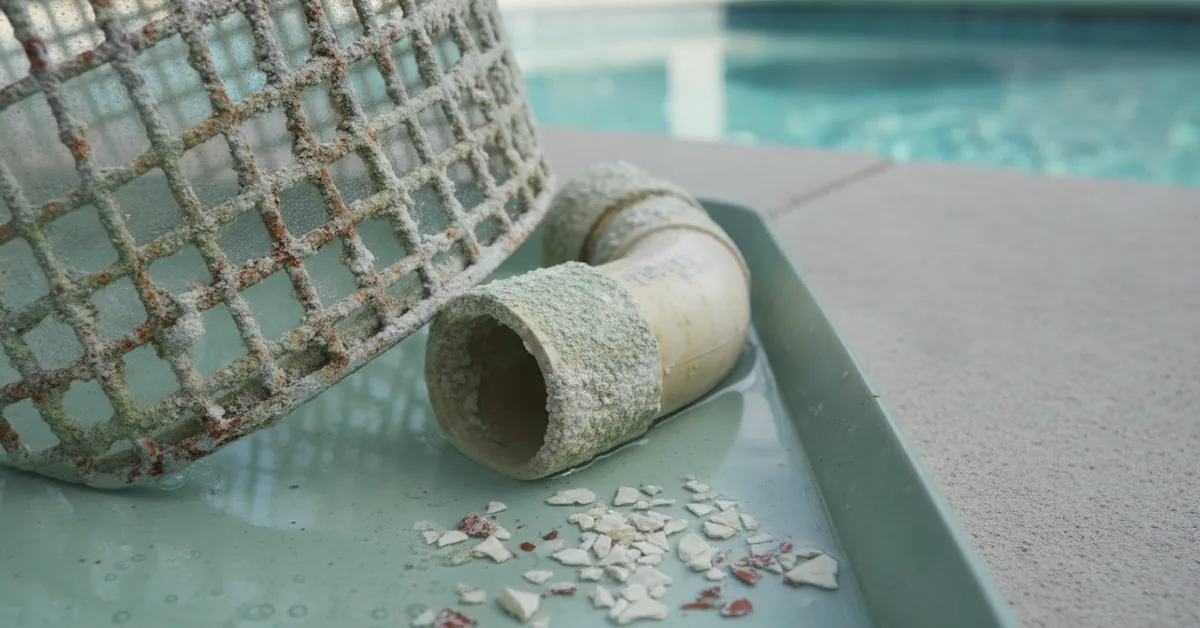
When pH climbs above 7.8, water becomes super-saturated with dissolved minerals, primarily calcium carbonate. Unable to hold these minerals in suspension, the water sheds them onto any physical surface available, particularly high-temperature components. The most immediate damage occurs inside salt chlorine generator cells. Salt cells rely on titanium plates coated with ruthenium oxide to electrolyze sodium chloride into hypochlorous acid. High pH causes rock-hard calcium scale to bridge these titanium plates, stopping electrical current flow. The control board pushes maximum amperage to compensate, which overheats electronics and shortens a $1,200 cell's operating life from five years down to twelve months.
High pH creates severe problems for gas heaters and heat pumps as well. Scale acts as a dense thermal insulator. A microscopic 1/16-inch layer of calcium scale inside heat exchanger tubes reduces heat transfer efficiency by roughly 15%, causing internal combustion chambers to overheat and thermal switches to trip repeatedly. Maintaining your pH strictly between 7.4 and 7.6 preserves optimal hydraulic flow rates while ensuring thermal transfer remains uninhibited.
Equipment Vulnerability Matrix: Acidic vs. Alkaline Water
Understanding how specific chemical imbalances affect individual mechanical components helps you diagnose problems before total system failure occurs. The table below outlines the damage vectors across standard pool pad equipment.
| Equipment Component | Low pH Impact (< 7.2) | High pH Impact (> 7.8) | Estimated Repair/Replacement Cost |
|---|---|---|---|
| Gas Heater Heat Exchanger | Copper erosion, pinhole leaks, green water staining | Heavy thermal scaling, reduced efficiency, burnout | $1,500 – $3,800 |
| Pump Shaft Seal & Impeller | Elastomer hardening, face pitting, motor bearing flooding | Scale drag on impeller, reduced flow, seal face friction | $150 – $750 |
| Salt Electrolytic Cell | Stripping of precious metal coatings from plates | Rapid calcium bridging, high amp draw, plate degradation | $800 – $1,400 |
| Filter Internals (Cartridge/Grid) | Weakened fabric structural integrity, manifold degradation | Calcification of fabric pores, rapid pressure spikes | $200 – $600 |
The 5-Minute Equipment Pad Inspection Protocol
To prevent chemical damage from turning into costly mechanical overhauls, perform this step-by-step physical inspection at your pool pad at least once a month:
- Inspect the underside of the pump seal plate (where the motor connects to the wet end housing) for weeping moisture or white salt-like crust, which indicates shaft seal degradation.
- Look through the clear inspection housing on your salt chlorine generator to check for chalky white scale build-up between the internal metallic plates.
- Check your filter pressure gauge baseline; a persistent 5 to 7 PSI elevation despite clean media usually points to internal grid calcification from elevated pH levels.
- Examine the exterior sheet metal housing and drain plugs of your gas heater for blue-green corrosion crusting, a direct indicator of internal copper coil leakage.
- Test both pH and Total Alkalinity using a high-quality liquid reagent drop kit (such as FAS-DPD) rather than test strips to verify pH is between 7.2–7.6 and alkalinity is within 80–120 ppm.
Advanced Operational FAQs: Chemical Dynamics and Machinery Protection
- How does high calcium hardness interact with high pH to accelerate salt cell destruction?
- Calcium Hardness measures the total concentration of dissolved calcium in your water. When high Calcium Hardness (above 400 ppm) combines with an elevated pH (above 7.8), the Langelier Saturation Index (LSI) shifts heavily into scaling territory. Inside a salt cell, the electrolysis process naturally generates localized high pH right at the cathode plates. This extreme local pH forces dissolved calcium out of solution instantaneously, creating dense calcification that locks up cell plates far faster than high pH would on its own.
- Why does low pH cause variable speed pumps to draw higher electrical wattage?
- While low pH directly attacks rubber seals, it also damages plaster and grout, releasing fine sand, silica, and rough debris into circulation. As these abrasive particles pass through the pump, they pit and erode the internal plastic diffuser and impeller vanes. This surface roughing disrupts the smooth hydrodynamic flow inside the wet end, forcing the variable speed pump motor to pull higher wattage from the breaker to maintain its programmed RPM or flow rate settings.
- Can a cyanuric acid (CYA) level over 100 ppm give a false impression of safe pH balance?
- Yes. High levels of cyanuric acid contribute significantly to Total Alkalinity readings through a chemical phenomenon known as cyanurate alkalinity. If your CYA is 100 ppm, approximately one-third of your measured alkalinity is actually stabilizer, not carbonate buffer. If your total test kit reading says 90 ppm alkalinity but 35 ppm of that is cyanurate, your actual carbonate alkalinity is only 55 ppm. This leaves your water severely unbuffered, causing sudden pH drops down into corrosive territory every time acidic rainfall hits the pool.