

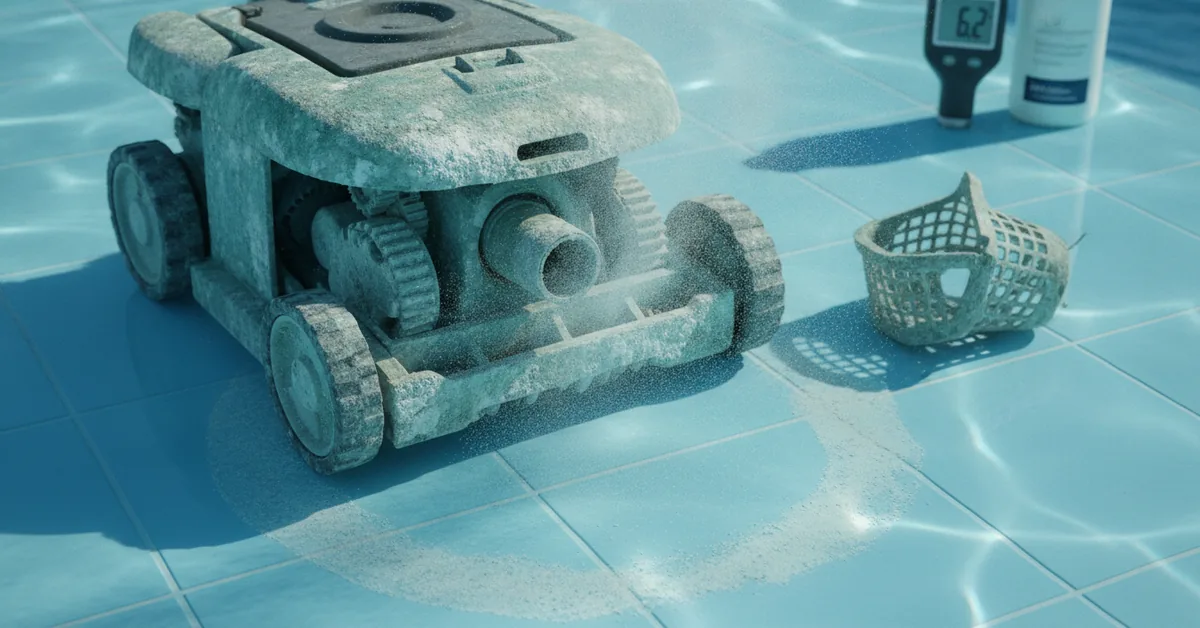
Buying a top-tier robotic or pressure-side pool cleaner and expecting it to survive three seasons in water with an unmonitored pH is like driving a brand-new luxury sports car through salt water every single day and wondering why the undercarriage rusted out. Over fifteen years servicing thousands of residential pads across the Sunbelt, I have seen homeowners spend $1,200 on a high-end cleaner only to pull out a brittle, scale-encrusted shell fourteen months later. The uncomfortable truth is that mechanical wear rarely kills a modern automatic cleaner; chemical degradation from corrosive or scaling water does long before the gears naturally wear down.
While most pool owners focus on pH solely to prevent red eyes or cloudy water, your automatic cleaner is submerged in this chemical solution 24 hours a day, 7 days a week. The plastics, rubber diaphragms, silicone seals, and stainless steel axles that power your sweep are constantly reacting to the chemical state of that water. Understanding this hidden dynamic is the difference between replacing a $30 wear pad every two years or dropping $800 on a complete motor drive replacement long before its time.
The Technical Blueprint: How pH Imbalance Destroys Pool Cleaners
Water chemistry directly controls the structural integrity and fluid dynamics of your automatic pool cleaner. When pH strays outside the ideal 7.2 to 7.6 window, rubber components leach plasticizers while dissolved minerals begin aggressively plating out onto mechanical drive assemblies.
Protecting your cleaner requires viewing pH management not just as a water clarity issue, but as fundamental preventive maintenance for mechanical hardware.
- Low pH (Acidic < 7.2): Rapidly strips plasticizers from rubber diaphragms, drive tracks, and O-rings, leading to cracking, stiffening, and loss of propulsion within 90 days.
- High pH (Alkaline > 7.8): Triggers calcium carbonate precipitation, forming abrasive scale inside turbine gearboxes, swivel hose joints, and robotic motor shaft seals.
- Fluid Resistance Impact: Stiffened materials and scaled water passages force booster pumps and drive motors to work against excessive head pressure, shortening total unit lifespan by up to 60%.
- Chemical Synergies: Low pH combined with high total chlorine creates an aggressive environment that dissolves internal rubber seals, allowing water to breach sealed robotic motor blocks.
The Acid Attack: How Low pH Dissolves Elastomers and Internal Seals
When pool water drops below 7.2, it becomes an aggressive solvent seeking minerals and plasticizers to reach equilibrium. Most pool owners think acidic water only stings swimmer eyes or etches pool plaster, but your cleaner's internal rubber and vinyl parts take the direct hit. Suction-side cleaners rely on flexible rubber diaphragms to create a rhythmic vacuum pulse. In acidic water, these elastomers lose their molecular flexibility, becoming hard, brittle, and prone to splitting along stress lines within months.
The problem extends beyond simple suction rubber. Robotic cleaners utilize specialized shaft seals surrounding the drive motor block to keep water out of the high-voltage electronics. Acidic water leaches the vinyl compounds from these seals, shrinking them just enough to compromise the waterproof barrier. Once water enters a sealed $500 motor drive, the unit is effectively dead. Additionally, low pH corrodes stainless steel axles, wheel ball bearings, and leaf canister latches, converting smooth rolling motion into abrasive friction that burns out drive tracks.
Field Report: The Case of the $1,500 Robotic Cleaner Destroyed in 120 Days
A client in Phoenix called me out to inspect a premium robotic pool cleaner that had stopped moving four months after installation. The homeowner was furious, claiming the manufacturer built a defective product because the drive tracks were slipping and the unit kept tilting onto its side. When I pulled the unit onto the deck, the warning signs were immediate: the drive belts felt like hard, cracked resin rather than supple rubber, and the plastic housing had turned white and chalky. A quick water test revealed a pH well below 6.8, driven down by continuous tri-chlor tablet usage without periodic total alkalinity buffering.
The water had literally starved the cleaner's rubber tracks of plasticizers while corroding the stainless steel roller bearings inside the drive assembly. The motor had to pull twice the normal amperage just to turn the seized wheels, causing the thermal overload fuse inside the sealed motor box to melt. A simple $15 bottle of liquid test reagent and $10 worth of soda ash would have saved a $1,500 piece of equipment. To prevent this, you must understand how different cleaner architectures react to water chemical imbalances.
| Cleaner Category | Low pH Effects (< 7.2) | High pH Effects (> 7.8) | Lifespan Reduction |
|---|---|---|---|
| Suction-Side Cleaners | Diaphragms stiffen/split; hose sections become rigid and lose flexible vacuum seal. | Calcium scale binds directional flappers; swivel neck joints seize up completely. | 50% - 70% reduction in diaphragm and hose life. |
| Pressure-Side Cleaners | Sweep hose tails degrade; internal silicone drive belts stretch and slip off pulleys. | Scale builds in internal drive turbine; thrust jet nozzles clog with calcium crust. | 40% - 60% reduction in gearbox and booster pump life. |
| Robotic Cleaners | Motor shaft drive seals shrink, causing internal motor chamber flooding; tracks snap. | Fine-mesh filter canister screens calcify; drive wheel bearings calcify and seize. | 60% - 80% risk of total catastrophic motor failure. |
High pH and Calcium Scale: Locking Up Turbines and Gearboxes
On the opposite side of the spectrum, allowing your pH to climb above 7.8 causes calcium carbonate to drop out of solution and crystallize on solid surfaces. In a pressure-side cleaner, water flows through a complex internal drive turbine and gear management system. As high pH water passes through these narrow internal jets, localized pressure drops trigger rapid calcium scale formation inside gear teeth and swivel hose joints.
This mineral crust acts like sand inside a clock mechanism. Swivel hoses bind up, causing the cleaner feed hose to coil into knots instead of covering the entire pool floor. In robotic cleaners, scale builds up on the fine mesh of the filter canister, drastically reducing water flow. When flow drops, the pump impellers cavitate, the motor overheats, and cleaning efficiency drops to zero even though the cleaner appears to be running perfectly fine.
Your Field Checklist: Protecting Your Cleaner from Chemical Destruction
Before you blame your automatic cleaner for poor performance or spend money on replacement drive belts, walk out to your pool pad and run through this five-step inspection protocol to isolate chemical damage from true mechanical failure.
- Perform a Water Balance Audit: Test pH, Total Alkalinity, and Calcium Hardness. Ensure pH is balanced between 7.2 and 7.6 before running any troubleshooting steps on the equipment.
- Inspect Elastomers and Rubber Tracks: Flex the drive tracks or suction diaphragm between your thumb and forefinger. If the material feels stiff, chalky, or shows micro-fissures, chemical oxidation from low pH is present.
- Check Swivel Joints for Calcification: Rotate the hose swivels manually. Any grinding sound or physical resistance points to calcium carbonate scale buildup caused by sustained high pH.
- Soak Scaled Components in Acid Solution: Dilute muriatic acid with water at a 10:1 ratio and submerge scaled plastic components (excluding electrical motor blocks) for 10 minutes to dissolve mineral crust.
- Establish an Out-of-Water Storage Routine: Never leave your cleaner sitting in the pool while adding shock, muriatic acid, or soda ash. Allow chemicals to circulate through the main filtration system for at least two hours before re-submerging the cleaner.
Frequently Asked Questions About Water Chemistry and Pool Cleaners
- How does high calcium hardness amplify the damaging effects of high pH on my cleaner?
- High pH acts as the trigger, but Calcium Hardness provides the raw material for scale. When pH rises above 7.8 alongside Calcium Hardness levels exceeding 400 PPM, the Langelier Saturation Index (LSI) tips heavily into scaling territory. Minerals instantly precipitate out of suspension inside high-friction areas like cleaner wheel bearings, drive turbines, and swivel hose connectors, rapidly locking up moving parts.
- Will keeping my pool cleaner in the water during liquid chlorine shocking void its warranty?
- Yes, in most cases. When you shock a pool, free chlorine skyrockets above 10 PPM while temporary pH fluctuations occur. This hyper-oxidizing environment rapidly degrades rubber tracks, vinyl tires, and motor shaft seals. Most major cleaner manufacturers explicitly state in their warranty terms that chemical damage caused by operating the unit in unbalanced water or during chemical treatments voids all coverage.
- Can low pH cause a suction-side cleaner to stick to the pool floor or walls?
- Yes. Low pH causes the rubber foot pads and skirt materials on suction cleaners to absorb water unevenly and lose structural rigidity. As the rubber softens and expands under acidic conditions, it creates excessive surface suction area, causing the cleaner to lock onto a single plaster spot or vinyl liner patch until the main pump shuts off.