

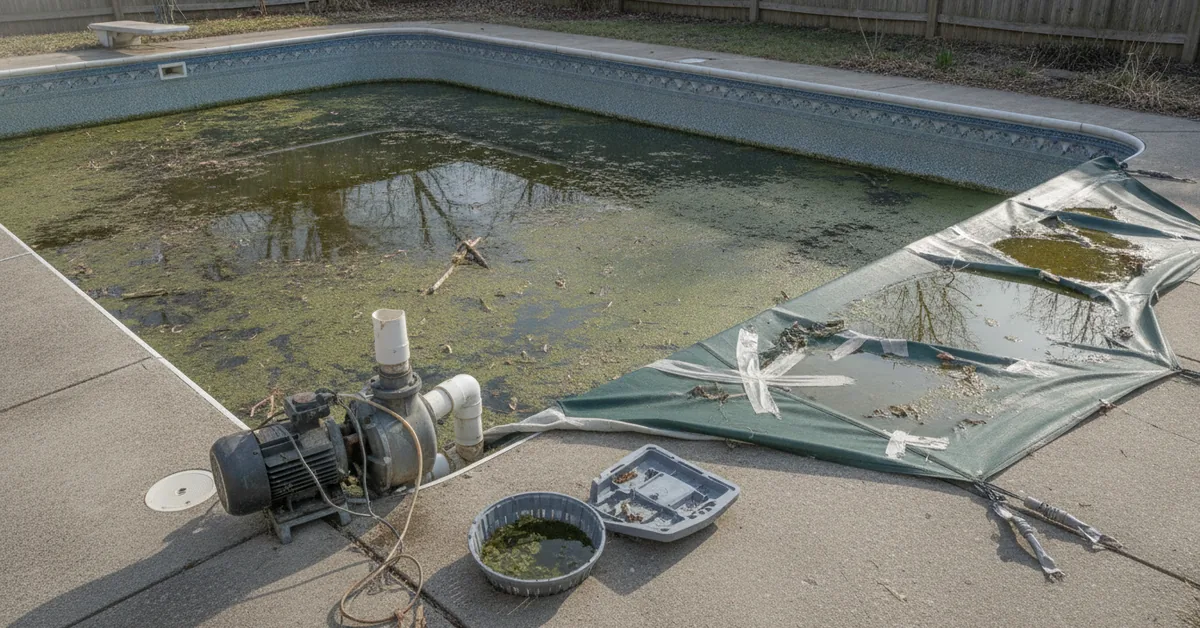
It was late April in New Jersey when I stepped onto a pool pad that perfectly illustrated why off-season neglect is the most expensive mistake a homeowner can make. The sun was out, but the moment we pulled back the mesh safety cover on a 40,000-gallon plaster pool, the smell of stagnant organic rot hit us immediately. Beneath the cover lay swamp-green water, rough plaster walls stripped of their smooth finish down to the rough aggregate, and a top-tier variable-speed pump housing split wide open like a frozen aluminum can. The homeowner had attempted a quick DIY closing late last November, skipping the line blowout and dumping six gallons of liquid chlorine into cold water without adjusting his water balance. That single afternoon of rushed mistakes ended up costing him over $5,200 in replacement equipment, masonry repairs, and chemical restoration.
Closing an in-ground pool isn't simply a matter of pulling a cover over the surface and tossing in a tub of winter shock. When water freezes, it expands by approximately 9% with a potential force exceeding 30,000 PSI—enough power to snap solid cast-iron fittings, shatter PVC manifolds, and crack hydraulic heater cores. Beyond the physical mechanics of freezing water, cold water completely alters chemical dynamics, turning mildly balanced water into an aggressive solvent that eats away at plaster and pool equipment throughout the winter months. Proper winterization demands an understanding of thermodynamics, fluid dynamics, and cold-water chemistry to ensure your outdoor living investment survives until spring intact.
Anatomy of a Failed Closing: Key Takeaways for Long-Term Protection
Improper winterization procedures account for nearly 65% of all non-wear-and-tear equipment replacements and plaster
Improper winterization procedures account for nearly 65% of all non-wear-and-tear equipment replacements and plaster repairs I perform during spring openings. Protecting your pool pad and hardscape requires a strict routine that accounts for temperature drops, trapped moisture, and chemical shifts long before the first freeze hits.
- Hydraulic Line Integrity: Compressed air blowouts must clear 100% of water from suction and return lines to prevent sub-surface PVC structural failure beneath expensive hardscapes.
- Cold-Water Chemical Saturation: As water temperature drops toward freezing, the Langelier Saturation Index (LSI) plunges into corrosive territory, forcing water to pull calcium directly out of pool plaster and tile grout.
- Equipment Pad Drainage: Removing drain plugs from pumps, filters, heaters, and salt cells is mandatory; leaving even a cup of standing water in a housing will shatter volutes and manifold headers.
- Cover Dynamics and Structural Support: Incorrect water level management beneath solid or mesh covers leads to deck anchor damage, wall stress, or cover collapse under heavy snow loads.
- Secondary Containment Protection: Utilizing expansion plugs and Gizzmos in skimmers absorbs ice expansion, protecting delicate skimmer throats from cracking internally.
The Thermodynamics of Freezing: How Trapped Water Destroys Equipment Pad Components
To understand why equipment fails during winter, you have to understand what happens to water inside a closed loop when the ambient temperature drops below 32°F. Water is one of the few liquids that expands as it transitions from a liquid to a solid lattice structure. When water trapped inside a closed vessel—like a pump volute, a gas heater header, or a brass check valve—begins to freeze, it creates an absolute pressure vessel. There is nowhere for the expanding volume to go, so the internal force spikes until the container yields.
In my 15 years servicing pads, the gas heater core is usually the first component to suffer. Copper or cupronickel heat exchanger tubes have thin walls designed for rapid heat transfer, not pressure containment. If you fail to open the heater drain plugs and blow out the internal header, ice forms in the bottom bends. By spring, you won't know it's broken until you startup the system and watch hundreds of gallons of water spray directly into the electrical control board. Replacing a damaged heat exchanger costs anywhere from $1,200 to $2,600, which often makes replacing the entire heating unit the only sensible option.
Variable speed pumps suffer a similar fate. While the pump basket body looks solid, the plastic volute and internal diffuser are vulnerable to microscopic stresses. Water left lingering in the bottom chamber settles near the drain plugs. When ice expands upward, it splits the pump housing along its factory seam. A proper blowout procedure requires removing all drain plugs, coating the rubber O-rings with silicone lubricant, and running a high-volume air compressor through the entire pump housing to guarantee zero moisture remains inside the cavities.
The Cold Water Chemistry Fallacy: Why LSI Drops Off a Cliff
A common misconception among homeowners is that if water chemistry reads balanced at 78°F in September, it will stay balanced when the water temperature drops to 40°F in December. This assumption ruins hundreds of plaster finishes every single year. Water chemistry is governed by the Langelier Saturation Index (LSI), which measures whether water is corrosive, balanced, or scale-forming based on five key variables: pH, total alkalinity, calcium hardness, cyanuric acid, and water temperature.
Temperature is a direct driver of LSI. As water grows colder, its capacity to hold dissolved calcium increases, which causes the LSI score to drop sharply into aggressive, corrosive territory. Water that was perfectly balanced with an LSI of +0.05 during mid-summer can easily drop to a dangerously corrosive -0.50 LSI in freezing temperatures, even if pH and alkalinity numbers don't change. When water becomes aggressive, it seeks calcium to balance itself, aggressively leaching calcium carbonate straight out of your plaster, quartz, or pebble finish.
When this happens, the plaster surface degrades, becoming rough like heavy sandpaper—a process known as surface etching. In severe cases, I've seen aggressive winter water dissolve tile grout completely, causing waterline tiles to fall off into the deep end during the January thaw. To prevent this, winter water balance requires artificially raising calcium hardness levels (often up to 350–450 ppm) and adjusting total alkalinity prior to closing. This deliberate buffer keeps the cold-water LSI close to neutral (0.00) while the pool sits dormant under the cover.
Field Case Study: The $4,500 Subterranean PVC Rupture
Two seasons ago, I took over a service call for a client in Pennsylvania who had handled his own pool closing using a standard home shop vacuum. He assumed that blowing air through his skimmers for five minutes was sufficient to evacuate the underground plumbing lines before screwing in rubber expansion plugs.
Unfortunately, a standard shop vac lacks the cubic-feet-per-minute (CFM) output and dynamic pressure required to push water past deep-water traps, such as the bottom main drain or deep-water return loops buried six feet underground. Water remained trapped in a low-point belly of the return line beneath his newly installed paver patio. During an extended January freeze where ground temperatures dropped below 15°F for a week, that trapped water expanded, cracking a 2-inch schedule 40 PVC pipe underground.
Come April, we started up the pump and instantly noticed a dramatic pressure loss on the return manifold alongside rapid water loss in the pool. Finding the leak required bringing in helium leak-detection equipment. The end result? We had to lift up three tiers of custom stone pavers, excavate four feet of packed soil, cut out the shattered pipe, and rebuild the deck foundation. The entire repair job totaled $4,500 in hardscape and plumbing labor—all because an inexpensive, dedicated heavy-duty air blower wasn't used to clear the lines properly during the autumn closing.
Winter Damage Matrix: Incorrect Closing vs. Spring Consequences
Understanding where failures occur helps prioritize your closing budget. The table below outlines the most common winterization mistakes I observe in the field, the underlying failure mechanism, and the real-world repair expenses associated with fixing them come spring.
| Closing Procedure Error | Affected Component | Physical/Chemical Mechanism | Estimated Spring Repair Cost |
|---|---|---|---|
| Failure to air-blow return/suction lines | Underground PVC Pipes & Hardscape | Ice expansion fractures subterranean pipe joints under stone decks. | $2,500 – $6,000+ |
| Leaving water in gas heater header | Cupronickel Heat Exchanger | Trapped water freezes, splitting heat transfer tubes and shorting electronics. | $1,200 – $2,800 |
| Neglecting cold-water LSI balance | Plaster / Pebble / Quartz Finish | Corrosive water leaches calcium from plaster, causing severe etching. | $4,000 – $10,000 (Resurfacing) |
| Skipping skimmer expansion plugs (Gizzmos) | Skimmer Throat & Tile Line | Ice sheet expands laterally, cracking skimmer plastic and surrounding tile. | $1,200 – $2,200 |
| Incomplete pump drainage | Pump Volute & Wet End Assembly | Ice expands against composite housing walls, splitting the volute body. | $350 – $900 |
The Spring Prevention Protocol: Step-by-Step Closing Checklist
To avoid these nightmare scenarios, I instruct all my technicians and DIY clients to follow a strict, methodical sequence when closing down an equipment pad. Walk out to your equipment pad and execute these critical steps in order before the first hard freeze hits your region:
- Perform Deep Filter Cleansing: Backwash sand or DE filters thoroughly, or pull cartridge elements out and soak them in filter cleaner. Organic oils left on filter media over winter will harden like concrete, rendering the elements useless by spring.
- Adjust Water Chemistry for Cold LSI: Bring pH to 7.4–7.6, adjust Total Alkalinity to 100–120 ppm, raise Calcium Hardness to 350–400 ppm, and ensure Cyanuric Acid stays below 50 ppm. Test cold-water LSI target to ensure it lands between 0.00 and +0.20 at 45°F.
- Evacuate All Plumbing Loops with High Pressure Air: Connect a commercial-grade air blower (such as a 3-HP Cyclone blower) to the pump strainer basket. Blow air through every valve configuration until clear air bubbles violently out of skimmers, returns, and main drains.
- Set Plugs and Anti-Freeze Containment: Thread expanding rubber plugs or threaded Teflon plugs into return fittings while air is actively bubbling. Insert gizzmos or foam rope into skimmer bodies to absorb ice expansion forces inside the skimmer throat.
- Pull All Pad Drain Plugs: Remove every drain plug on the pump body, filter tank, gas heater, chlorinator, and salt cell. Store these small plugs inside the pump strainer basket so they never get lost over the winter months.
- Disconnect Power at the Breaker: Flip off main electrical breakers for pumps, heaters, and automation systems to prevent accidental dry-runs during winter power surges or automated timer glitches.
Advanced Winterization FAQs from the Field
- How does water temperature drop specifically alter the Langelier Saturation Index (LSI), and why does balanced summer water become corrosive in winter?
- The LSI formula incorporates a temperature factor ($TF$) that scales down as water cools. For example, at 80°F, $TF$ is 0.7, but at 32°F, $TF$ drops to 0.0. Because LSI calculation adds this factor directly ($LSI = pH + TF + CF + AF - TDS$), losing 0.7 points from the equation drops balanced water ($0.00$ LSI) down to an aggressive $-0.70$ LSI without any change in pH or alkalinity. At this level, water actively seeks calcium carbonate, leaching it directly from plaster, mortar, and grout surfaces.
- Why does using a household shop vacuum often fail to winterize underground pool lines correctly?
- A standard shop vacuum produces high airflow under zero resistance, but lacks static pressure (measured in inches of water lift). Underground pool plumbing creates head pressure due to deep elevation changes and standing water columns. A commercial pool blower creates high pressure (often 3 to 5 PSI) capable of pushing water up and out of deep underground traps and main drains, whereas a shop vacuum stalls out, leaving water trapped in low pipe bellies that freeze and rupture underground.
- What specific chemical reaction happens if non-chlorine shock and copper-based algaecide are mixed incorrectly during closing?
- If you dump a high dose of chlorine shock alongside a copper-based algaecide without allowing proper circulation time between additions, the hyper-oxidizing environment converts dissolved metallic copper into insoluble copper oxide precipitates. These dark metallic ions immediately drop out of suspension and stick to cold plaster walls, causing stubborn black, green, or purple staining across the pool surface that requires expensive acid washing or chelating agents to remove in the spring.