

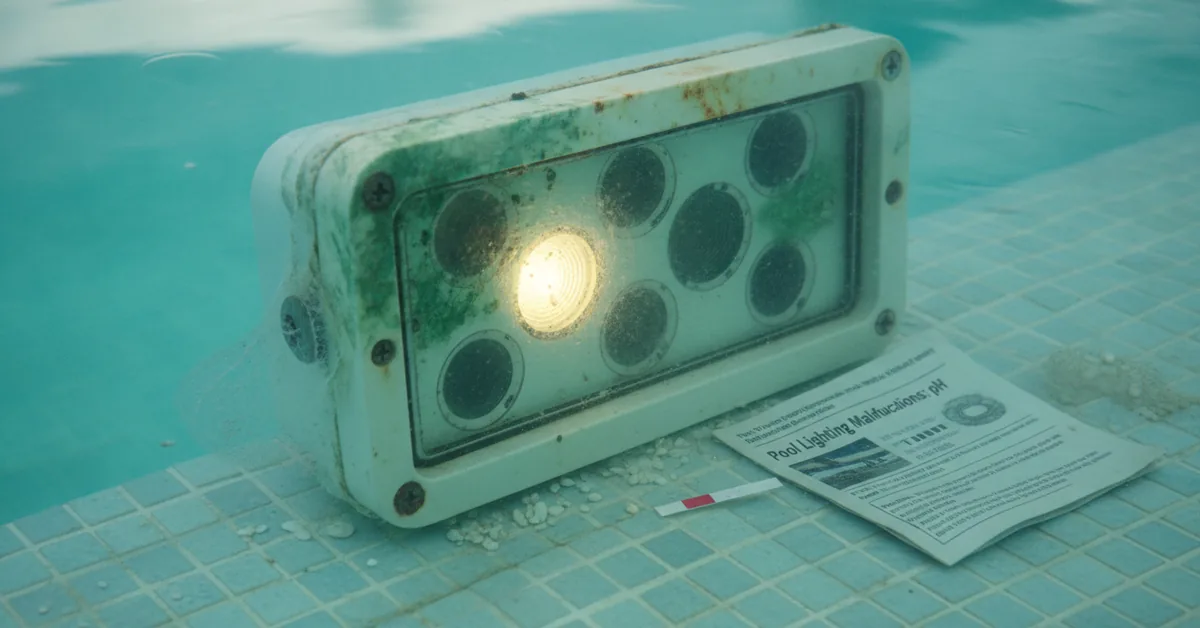
Crucial Takeaways: Protecting Underwater Luminaires from Chemical Wear
Water chemistry imbalances directly cause mechanical seal degradation, metal corrosion, and thermal dissipation failures in submerged pool lighting systems. Maintaining strict pH equilibrium is not merely a sanitizer requirement; it is a vital preventative maintenance strategy for electronic equipment longevity.
When pH drifts outside the ideal 7.4 to 7.6 envelope, underwater niches and internal fixtures experience accelerated wear patterns that typically end in complete fixture flood or driver board failure.
- Acidic Water (< 7.2 pH): Corrodes brass mounting screws, degrades nitrile rubber seals, and strips metal plating off niche housings, inviting water intrusion.
- Alkaline Water (> 7.8 pH): Induces heavy calcium scaling on glass lenses, acting as an insulator that overheats high-output LED heat sinks.
- Seal Saturation: Constant low pH strips plasticity from synthetic gaskets, hardening them until water breaches internal electronics.
- Diagnostic Vigilance: Checking niche grounding wires and lens clarity during routine chemistry adjustments prevents $1,200+ fixture replacements.
The Chemistry of Destruction: How pH Extremes Attack Light Assemblies
Most pool owners assume underwater light housings are impenetrable fortresses, engineered to withstand whatever chemical bath they sit in. The truth is much more delicate. A pool light fixture relies on tight tolerances, compression seals, and efficient heat exchange through thin-walled glass or polycarbonate lenses. When pool water strays below 7.2 pH, it becomes aggressive and hungry for minerals. Acidic water relentlessly strips copper from brass bronze niche fixtures and attacks the stainless steel clamp rings that hold the lens tight against the gasket.
In my route experience, when pH sits down at 6.8 for an extended period—often caused by aggressive trichlor tablet usage—the rubber or silicone ring seal loses its elastomeric properties. The chemical bath leaches plasticizers out of synthetic seals, turning soft pliable gaskets into hard, brittle plastic rings. Once that seal loses elasticity, microscopic pathways open up. Capillary action pulls water right past the seal, entering the lamp housing and shorting out circuit boards. On the opposite side of the spectrum, high pH (above 7.8) works hand-in-hand with high calcium hardness to drop scale out of solution directly onto the glass lens. High-intensity LED engines require liquid cooling through the lens face; a thin layer of calcium carbonate acts like a thermal blanket, driving internal operating temperatures past safe thresholds and burning out micro-driver circuits months after installation.
Trench Story: The $1,400 Multi-Color LED Failure
Two summers ago, I received a service call from a home in Arizona where the owner complained that his top-of-the-line multi-color LED underwater light had gone dead after less than fourteen months. The installer had already swapped the light engine under warranty once, but the second unit failed again in identical fashion. When I walked up to the equipment pad, the water was crystal clear, but my liquid reagent test kit registered a pH well below 6.8. The owner had been heavily reliant on automatic floating erosion feeders crammed full of low-pH trichlor pucks while keeping his total alkalinity at a basement-level 40 ppm.
I pulled the light fixture out of its niche and rested it on a towel on the coping. The moment I loosened the bronze pilot screw, a jet of foul, rusted water bled out from behind the lens—the housing was completely flooded. The acidic water had corroded the nickel-plated mounting hardware, allowing aggressive pool water to seep straight into the transformer interface. We didn't just have to replace a $1,400 optical fixture; we had to replace the entire niche assembly and re-establish proper bonding wire continuity. Once I stabilized his water at 7.5 pH and brought his alkalinity up to 90 ppm, the replacement light unit operated flawlessly. It was a costly lesson for the client: chemical imbalance, not defective manufacturing, was the root cause of hardware failure.
Materials Breakdown: Component Degradation Matrix
To understand why underwater lights fail, you must understand how different construction materials react under varying chemical environments. Modern pool lights are complex amalgamations of metals, polymers, glass, and silicone. Each material responds differently when water chemistry strays outside industry standards.
| Component | Acidic Water (pH < 7.0) | Balanced Water (pH 7.4–7.6) | Alkaline Water (pH > 7.8) |
|---|---|---|---|
| Silicone / EPDM Gaskets | Leaches plasticizers; hardens, cracks, and loses seal compression. | Maintains elastic seal integrity for 5–7 years. | Slight stiffening over prolonged exposure; minor scale adhesion. |
| Stainless Steel Screws / Bands | Pitting corrosion, rust streaks, stress cracking, thread binding. | Zero corrosion; smooth thread engagement. | Minor scaling; non-corrosive build-up on thread faces. |
| Tempered Glass / Polycarbonate Lens | Maintains clarity, but surface etching can occur on plastic lenses. | Optically clear; optimum light transmission. | Heavy calcium carbonate scale deposits; traps heat inside housing. |
| Bronze Niche Housing & Bonding Screw | De-zincification, copper leaching into water, severe thread rot. | Stable patina; strong ground pathway retention. | Scale accumulation inside niche cavity; hampers heat dissipation. |
Step-by-Step Diagnostic Protocol: Checking Light Health Before Circuit Failure
Catching water damage early will save you thousands in electrical gear replacements. Whenever you notice drift in your water chemistry or spot subtle shifts in light output, perform this practical field inspection on your pool lighting system.
- Cut Power at the Breaker: Safety is absolute. Switch off the dedicated sub-panel circuit breaker powering the pool lighting transformer before touch testing or removing any underwater fixtures.
- Inspect Lens Water Line and Clarity: Look through the lens while the light is in the niche. If you spot condensation, fogging, or a visible line of water inside the glass dome, the gasket seal has failed.
- Check Niche Water Chemistry and Flow: Light niches can become dead zones for stagnant water. Test the pH inside the light niche cavity using a sample drawn directly behind the fixture face to make sure water circulates freely around the light.
- Examine the Pilot Screw and Face Ring: Inspect the top pilot screw securing the light to the niche. If you spot green or rust-brown oxidation around the screw head, low pH has begun attacking the mounting metals.
- Evaluate Lens Temperature and Thermal Scale: Feel the outer glass while the pool is running. If you detect a crusty white texture on the lens face, dissolve it using a mild acid wash solution to prevent LED thermal driver failure.
Master Technician Troubleshooting FAQs
- Why does low pH cause electrical shorting inside a factory-sealed niche light housing?
- Low pH water creates a corrosive solution that aggressively attacks the rubber or silicone O-ring seals through plasticizer extraction. As the seal hardens and loses memory, water creeps past the gasket boundary into the dry chamber housing the light driver and electrical contacts, shorting the high-voltage circuit.
- Can high calcium hardness combined with high pH burn out modern high-efficiency LED pool lights?
- Yes. High pH drops calcium carbonate out of solution, forming an insulating scale layer directly over the light lens. High-output LED fixtures rely on water flowing across the lens glass to dissipate internal circuit heat. Scale acts as an insulator, driving internal temperatures up until thermal runaway destroys the micro-driver board.
- Will running an acidic pool void the manufacturer warranty on underwater fixtures?
- Virtually every major pool equipment manufacturer explicitly excludes damage caused by chemical imbalance from warranty coverage. Service centers easily detect chemical corrosion by checking for pitted stainless steel rings, copper oxidation inside the housing, or hardened rubber gaskets, resulting in denied claims for fixture replacements.