

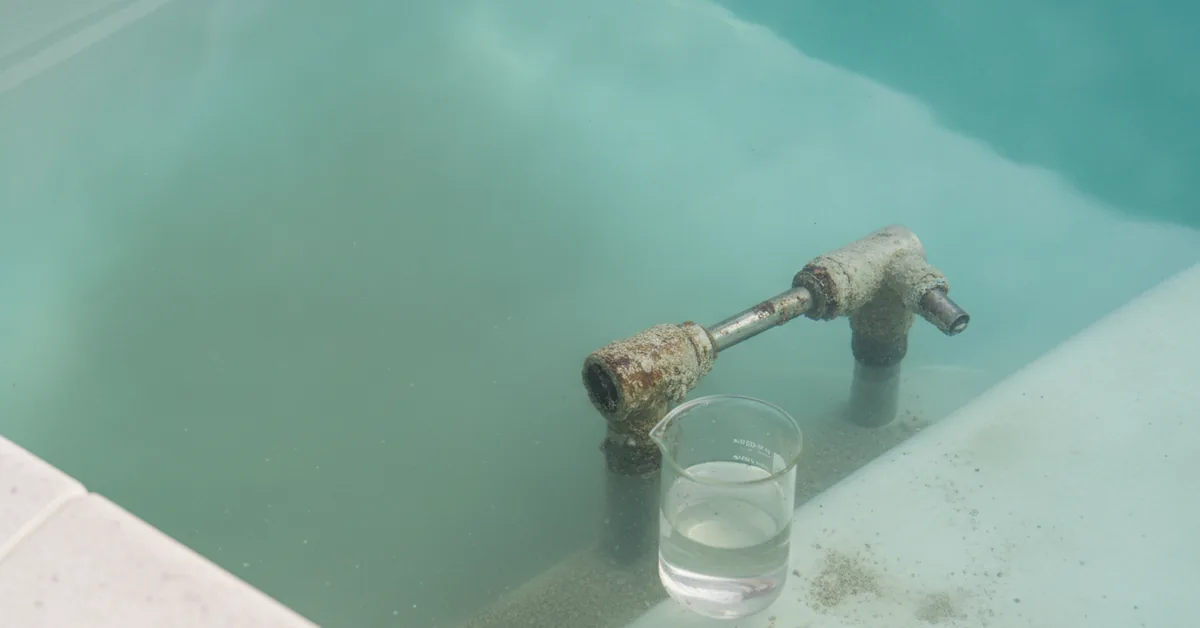
The backyard barbecue is set for 4:00 PM on a sweltering July Saturday, but at 10:00 AM, the host walks out to find clear water that turned hazy overnight, despite adding three gallons of liquid chlorine. By 2:00 PM, after throwing in two more bags of calcium hypochlorite shock, the pool looks like diluted milk, and the high-efficiency gas heater trips out with a thermal limit error while emitting an ominous metallic vibration. When I get dispatched to emergency calls like this on summer weekends, the pool owner almost always points to the chemical buckets sitting against the fence. But when I dip my digital salinity and conductivity probe into the skimmer, the real culprit isn't a lack of sanitizer—it's Total Dissolved Solids (TDS) sitting above 4,800 parts per million (PPM), quietly destroying water balance and stripping the interior of the pool heater core.
Why High TDS Is the Invisible Engine Behind Water Quality Crises and Equipment Destruction
Total Dissolved Solids represent the combined mass of all organic, inorganic, and chemical compounds dissolved in pool water over its operational cycle. When this cumulative total climbs beyond recommended baseline limits, water loses its thermodynamic capacity to stay balanced, turning routine maintenance into an expensive cycle of chemical chasing and premature equipment failure.
- TDS accumulates perpetually because evaporation removes only pure water molecules, leaving minerals, chemical salts, and bather waste permanently behind in the pool basin.
- When net TDS elevates more than 1,500 PPM over tap water baseline, it shifts the osmotic pressure of the water and corrupts the accuracy of standard Langelier Saturation Index calculations.
- High concentrations of dissolved solids reduce free available chlorine reaction speed and accelerate mineral scaling on salt chlorine generator cells and heater copper exchangers.
- Physical water exchange or commercial reverse osmosis filtration remains the only effective method to lower TDS levels back within factory-recommended parameters.
The Thermodynamics of Saturated Water: How TDS Distorts the Langelier Saturation Index
In my early years running service routes across South Texas, we used to treat TDS as an afterthought—something you checked only when a pool refused to clear up after a shock treatment. However, modern pool chemistry dictates that TDS is a core driver of water thermodynamics. The Langelier Saturation Index (LSI) calculates whether water is corrosive, balanced, or scale-forming based on pH, temperature, calcium hardness, cyanuric acid, total alkalinity, and TDS. When total dissolved solids exceed 2,000 PPM in a standard chlorine pool, the ionic strength of the solution increases dramatically, altering how calcium carbonate behaves.
As water becomes heavily saturated with sulfates, chloramines, and chemical byproducts, its physical density and electrical conductivity increase. This forces calcium out of solution even when your pH and alkalinity look acceptable on standard test strips. The water becomes chemically crowded, creating unpredictable scale formation on the hottest surfaces in your system—typically the inside of your gas heater copper heat exchanger or variable speed pump mechanical seals.
Lessons From a $3,200 Heater Failure: A San Antonio Field Case Study
Two summers ago, I was called out to diagnose a premium 400,000 BTU low-NOx gas heater on an 18,000-gallon quartz plaster pool. The unit was only 38 months old—well under its expected 8 to 12-year lifespan—yet the copper heat exchanger core was leaking internally and choked with heavy green copper sulfate scale. The homeowner had spent over $1,200 on shock, clarifiers, and algaecides over six months because the pool kept turning dull within 48 hours of every chemical dosage.
When I sampled the municipal tap fill water, it registered a modest 280 PPM TDS. The pool water, however, registered an astonishing 5,200 PPM TDS with a Cyanuric Acid level over 140 PPM. The homeowner was caught in a classic chemical trap: continuous dosing with dry shock (calcium hypochlorite and dichlor) kept adding non-evaporating solids to the water. The elevated TDS caused severe galvanic corrosion inside the heat exchanger, stripping heavy metals directly from the heating coils and destroying the header gasket. A $3,200 equipment replacement could have been prevented with a simple $300 partial water drain a year earlier.
| Water Parameter | Ideal Industry Range | San Antonio Case Study Pool | Operational Impact on System |
|---|---|---|---|
| Total Dissolved Solids (TDS) | Tap Water + 1,000 to 1,500 PPM | 5,200 PPM | Extreme chemical saturation; loss of chlorine oxidation velocity. |
| Cyanuric Acid (CYA) | 30 - 50 PPM | 140+ PPM | Severe chlorine lock; requires 10x higher free chlorine for sanitation. |
| LSI Score | -0.30 to +0.30 | +0.82 (Highly Scale Forming) | Rapid calcium precipitation inside heater heat exchanger tubes. |
| Heater Lifespan Expectancy | 8 - 12 Years | Failed at 3.1 Years | Internal tube wall thinning, header flange cracking, and total core failure. |
This case highlighted an inescapable truth in pool maintenance: you cannot treat saturated water with more chemicals. Once the dissolved solid baseline is breached, physical water replacement is non-negotiable.
Salt Chlorine Generators and the High TDS Paradox
Saltwater pools operate under a unique set of rules regarding TDS because salt (sodium chloride) is intentionally added to the water to reach operational concentrations between 3,000 and 4,000 PPM. I frequently meet homeowners who believe that because their salt generator requires high salinity, high overall TDS doesn't apply to them. This misunderstanding destroys electrolytic cell plates faster than almost anything else I repair in the field.
The salt chlorinator cell relies on ruthenium-coated titanium plates to pass an electrical current through salt water, converting chloride ions into hypochlorous acid. When non-salt TDS—such as calcium, sulfates, nitrates, and accumulated cyanurates—builds up to excess levels alongside the sodium chloride, the total conductivity surges beyond design tolerances. The control board pushes maximum amperage to the cell to compensate, causing the plates to overheat. This continuous thermal stress leads to premature coating flaking on the cell blades, cutting a cell's expected 5-to-7-year operational lifespan down to fewer than two seasons, while triggering false low salt error messages on the control display.
Chlorine Lock vs. TDS Saturation: Diagnosing the Hazy Water Trap
In route service work, one of the most common client complaints is sluggish water. The pool isn't green, but it lacks that razor-sharp brilliance, looking flat and slightly gray under high-noon sunlight. Technicians and homeowners alike often confuse this condition with cyanuric acid over-stabilization, but high TDS creates its own distinct physical barrier to water clarity.
When total dissolved solids reach high concentrations, the elevated osmotic pressure affects microscopic organic debris and chloramine byproducts. Instead of being rapidly oxidized by free chlorine, organic waste fragments remain suspended in the water column because the solution's high conductivity reduces the rate of molecular collision between hypochlorous acid and contaminants. Additionally, high TDS acts as a physical shield for fine particulates passing through sand, cartridge, or DE filters. If you notice that backwashing your filter or rinsing your cartridges only restores water clarity for 24 to 48 hours before pressure spikes again, you are likely dealing with filter medium blinding caused by heavily saturated water solids rather than standard organic dirt.
The 5-Step Pad Audit: How to Test and Manage TDS Before Equipment Fails
Whenever I perform a preventative maintenance audit on an equipment pad, I follow a strict sequence to catch TDS-related issues before they turn into costly component failures. You can execute this exact diagnostic workflow on your own pool pad today:
- Establish Tap Baseline: Take a fresh sample from your hose spigot and test its TDS using a calibrated digital conductivity meter. Record this background baseline PPM (typically 100 to 500 PPM depending on your municipal supply).
- Measure Pool Water Net TDS: Test your pool water and subtract your tap baseline. If your net TDS exceeds 1,500 PPM on a standard chlorine pool (or if non-salt TDS exceeds 1,500 PPM on a salt system), your water is entering the high-risk saturation zone.
- Inspect Heater Headers and Pressure Switches: Look for dry white, blue, or green crusting around the inlet and outlet unions of your gas heater. Flaking or weeping near these seals is a direct indicator of high TDS acid oxidation or internal scaling.
- Examine Salt Cell Turbidity: Unthread the unions on your electrolytic cell and inspect the inner titanium fins. Thick chalky buildup at the trailing edges of the plates indicates high LSI saturation driven by high TDS and elevated water temperatures.
- Calculate Target Drain Percentage: Determine your required water exchange volume using the formula: Percentage to Drain = ((Current Pool TDS - Target TDS) / Current Pool TDS) * 100. Never drain more than 30% of a vinyl or fiberglass pool at once to prevent structural floating.
Frequently Asked Questions Regarding Total Dissolved Solids
- How does a high TDS level physically damage a gas heater core even if pH and alkalinity read normal?
- High TDS increases the electrical conductivity of water, creating an environment ripe for galvanic corrosion. When different metal alloys inside your heater and pad plumbing exist in a high-conductivity liquid, low-level electrical currents pull copper ions directly off the inner furnace coils. This causes localized wall-thinning and pitting, leading to internal core breaches regardless of whether your standalone pH test reads a neutral 7.5.
- Can commercial reverse osmosis (RO) filtration eliminate high TDS without draining a plaster pool?
- Yes, mobile reverse osmosis filtration trailers can process pool water directly from the skimmer and return purified water back to the return lines. This process strips out TDS, calcium, cyanuric acid, and heavy metals down to bottled-water quality without removing the physical water volume, preserving interior plaster finishes from atmospheric cracking or hydrostatic vaulting in high water-table areas.
- Why do standard liquid reagent and strip test kits give false readings when TDS exceeds 3,000 PPM?
- Traditional colorimetric chemical tests rely on specific ionic strengths to yield accurate indicator color shifts. When TDS climbs beyond 3,000 PPM, the elevated ionic concentration alters the reaction equilibrium between the indicator dyes (such as DPD or phenol red) and the chemical target. This often results in bleached-out color reactions or artificially low pH and chlorine readings that lead homeowners to add unnecessary, harmful chemicals.