

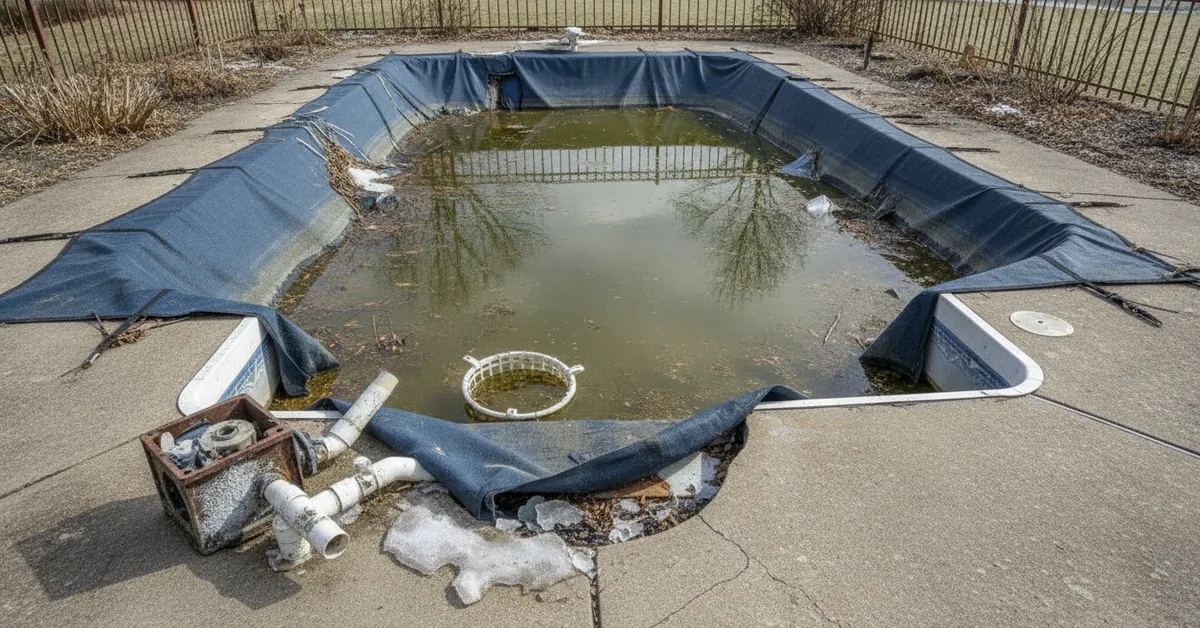
Spending $150 on proper winterization blowouts and chemical balancing in October prevents the average $2,400 to $4,800 baseline invoice for freeze-damaged equipment manifolds, ruptured heat exchangers, and cracked underground plumbing in April. Most pool owners assume closing a pool simply means throwing on a cover and turning off the breaker, but winterizing is a precision engineering procedure. When water freezes, it expands by approximately 9% in volume, exerting up to 30,000 pounds per square inch of outward pressure against unyielding PVC and cast iron. Over my 15 years blowing out plumbing loops and rescuing neglected pool pads in cold climates, I have learned that winter water leaves zero margin for technical error.
Executive Summary: Preventing Catastrophic Freeze Damage and Spring Water Ruin
Improper pool closing procedures account for nearly 65% of major spring equipment overhauls and costly liner or plaster
Improper pool closing procedures account for nearly 65% of major spring equipment overhauls and costly liner or plaster restorations across cold-climate regions. A successful winterization protocol preserves equipment integrity, safeguards interior pool finishes, and eliminates month-long spring green-to-clean chemical battles.
- Pressure-blowing plumbing lines and sealing lines with expandable rubber plugs prevents sub-zero pipe bursts and costly underground leaks.
- Adjusting pH, total alkalinity, and calcium hardness before closing protects plaster finishes from aggressive cold-water leaching.
- Evacuating water from filter tanks, pump housing, and heat exchangers protects expensive cast components from freeze expansion.
- Utilizing non-staining polymeric algaecides prevents winter bio-blooms under covers.
The Physics of Hydrostatic Pressure and Unblown PVC Plumbing
In my service calls every spring, the most heartbreaking damage happens underground. Water trapped inside rigid Schedule 40 PVC pipes does not simply freeze into ice; it forms rigid hydraulic wedges. When the ambient temperature drops below 32°F, water inside closed plumbing loops undergoes phase expansion, generating internal pressure that easily exceeds the 450 PSI burst strength of standard 2-inch PVC lines.
If you fail to evacuate lines with a high-volume air blower—such as a 3-stage commercial blower delivering at least 120 CFM—water migrates to low points in suction lines and main drains. Over three winter months, repeated freeze-thaw cycles fracture pipe elbows beneath concrete equipment pads. Replacing subterranean plumbing requires concrete demolition and hydraulic pressure testing, converting a simple maintenance oversight into an extensive construction project. Installing thread-locking winter expansion plugs and utilizing non-toxic propylene glycol antifreeze inside lines creates an essential cushion against expansion forces.
Thermal Shock and Freezing inside Gas Heater Cores and Salt Cells
Gas heaters and salt chlorine generators are the most vulnerable financial targets on your equipment pad during winter. A typical copper or cupronickel tube heat exchanger inside a gas heater holds up to two gallons of water across its multi-pass design. If you pull the exterior drain plugs without opening the internal pressure relief valve or blowing air through the header, water remains trapped inside the lowest copper U-bends.
When ice forms within these tight copper turns, it tears the metal headers apart. Replacing a damaged heater manifold costs anywhere from $1,200 to $2,200, which is often close to half the price of a brand-new unit. Similarly, salt chlorine generator cells house delicate titanium plates set millimeter distances apart. Water trapped inside electrolytic cell housings expands, cracking the clear acrylic body and shearing the precious-metal coated plates off their terminal anchors. I always insist on removing salt cells entirely, storing them inside a climate-controlled basement or garage, and inserting a dummy winter bypass pipe on the pad.
Field Story: The $6,500 Spring Awakening on a Gunite Pool in Ohio
Two seasons ago, I was called out to inspect a 40,000-gallon gunite pool in suburban Cleveland. The homeowner had decided to save money by winterizing the pool himself using a household shop vacuum and off-the-shelf liquid shock. When I walked onto the pool pad in mid-April, the damage was immediate and severe. The shop vacuum had failed to push water past the deep-end main drain loop, leaving roughly fifteen gallons of water sitting trapped in the suction manifold.
When sub-zero January cold hit Ohio, the main suction line split beneath four inches of reinforced pool deck concrete. Worse, the homeowner lowered the water level below the skimmers but neglected to add pool anti-freeze or install a skimmer expansion compensation device. The skimmer throat cracked down its side seam, allowing surface water to penetrate behind the gunite shell. The total repair bill included jackhammering 12 linear feet of stamped concrete, pressure-grouting the gunite wall, replacing the skimmer assembly, and replacing a shattered heater header. The final repair invoice came out to $6,540 in preventable damages—all because of improper blowing technique and missing $15 freeze bottles.
Water Chemistry Under Wraps: How Cold Temperatures Drive Corrosive LSI
Water balance is dynamic and heavily dependent on water temperature. The Langelier Saturation Index (LSI) calculates whether water is scale-forming, balanced, or aggressive (corrosive). As water temperature drops from 80°F summer operational levels down to 35°F under a winter cover, the LSI value drops significantly into negative territory. Cold water inherently hungers for calcium.
If you do not balance your total alkalinity and calcium hardness specifically for cold-water offset prior to closing, the water becomes aggressive under the cover. It will aggressively leach calcium directly from quartz, pebble, or plaster finishes, causing severe surface pitting, rough textures, and premature replastering costs. In vinyl liner pools, cold acidic water leaches plasticizers out of the vinyl, causing it to shrink, wrinkle, and split at seam stress points. Maintaining a slightly positive LSI (+0.1 to +0.3) at closing temperature ensures your pool surfaces remain silky smooth when uncovered.
| Winterization Component / Step | Common Incorrect DIY Procedure | Technical Consequence | Average Spring Repair Cost |
|---|---|---|---|
| Plumbing Blowout | Using shop-vac or letting gravity drain lines | Water trapped in low points freezes, bursting underground PVC | $1,800 – $4,500 |
| Gas Heater Drain | Removing outer plugs only; leaving internal bypass shut | Copper heat exchanger tubes split; internal header cracking | $1,200 – $2,200 |
| Skimmer Protection | Draining water without skimmer expansion devices | Skimmer body splits along plastic side welds due to ice pressure | $1,100 – $2,500 |
| Water Balance (LSI) | Adding heavy chlorine shock without balancing pH/TA/CH | Negative LSI water leaches plaster calcium and bleaches vinyl liners | $2,000 – $7,000 |
| Salt Cell Storage | Leaving salt cell inline with trapped water | Titanium plate anchors shear off; acrylic housing cracks open | $700 – $1,400 |
The Master Technician’s Pre-Winterization Checklist
Before putting your pool to sleep for the cold months, follow this step-by-step winterization checklist to ensure complete protection against structural, chemical, and mechanical damage.
- Adjust Water Balance for Cold Offsets: Seven days prior to closing, adjust Total Alkalinity to 100–120 PPM, Calcium Hardness to 250–350 PPM, and pH to 7.4–7.6 to prevent cold-water LSI corrosion.
- Deep Clean Filter Media: Degrease cartridge elements or chemically backwash sand/DE filters to remove oils and scale before debris hardens inside the filter matrix over winter.
- Lower Water Level Correctly: Lower water 4–6 inches below the skimmer for mesh covers, or 1–2 inches below the tile line for solid winter covers, keeping water high enough to support cover loads.
- Evacuate Plumbing with High CFM Blower: Connect a commercial air blower to the pump manifold. Blow out skimmers, return lines, cleaner lines, and main drains until continuous air bursts emerge, then cap with winter plugs.
- Drain and Store Equipment Plugs: Remove all drain plugs from pump pots, filter tanks, heater manifolds, and chlorinators. Leave plugs off and store them inside the pump basket.
- Install Skimmer Expansion Protection: Thread winter expansion bottles into skimmer bottoms to absorb ice pressure and pour non-toxic pool antifreeze into suction lines.
Advanced Winterization Technical Troubleshooting FAQs
- How does temperature drop alter the Langelier Saturation Index (LSI), and why does balanced water in September become corrosive in January?
- Water temperature has a direct mathematical relationship with LSI. The temperature factor drops from 0.7 at 84°F down to 0.0 at 32°F. This sudden drop causes an automatic 0.7 decrease in overall LSI, shifting balanced pool water into aggressive negative territory. To offset this, technicians boost Total Alkalinity and Calcium Hardness before closing to keep LSI slightly positive as water cools.
- Why does leaving water inside a salt chlorine generator cell cause permanent cell failure even if the electrical power is disconnected?
- Salt generator cells contain closely spaced parallel titanium plates coated with ruthenium dioxide. When water freezes within the cell body, ice expansion creates powerful shear forces that push these thin plates out of alignment, breaking internal electrical solder joints and fracturing the plastic housing shell.
- What is the technical danger of lowering pool water levels too far beneath a winter safety cover?
- Winter safety covers rely on displacement water support. When heavy snow and ice accumulate on top of a cover, it sags until it rests on the water surface beneath. If the water level is dropped too far below the coping, snow loads exert enormous downward force on cover brass anchors and aluminum deck rivets, shearing anchors out of the concrete deck or bending top rails on vinyl-lined pools.