

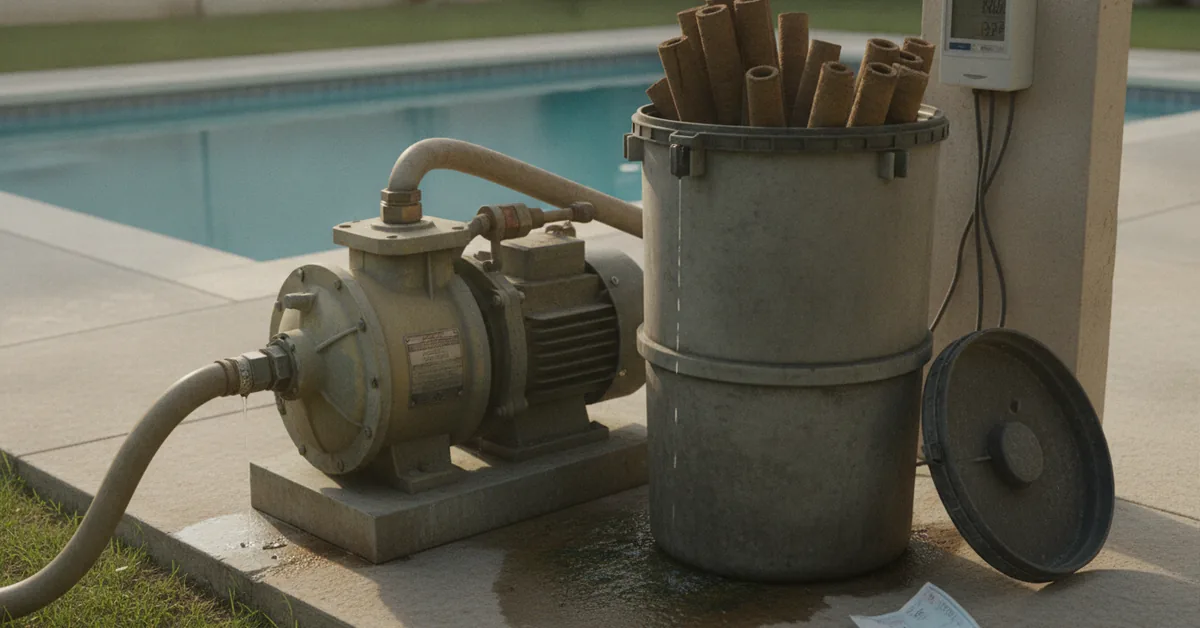
The sound of a 3-horsepower single-speed pump trying to force 90 gallons per minute through a choked 1.5-inch suction line is unmistakable: it sounds like a glass jar full of gravel marbles being shaken aggressively. Last July in Scottsdale, I walked onto a pad where the pool owner had replaced his burned-out pump with the largest motor sold at his local supply house, convinced bigger meant better. Within three weeks, the extreme hydraulic backpressure had cracked the filter lid, shredded the internal cartridge core, and pushed his monthly electric bill past $450. Over-pumping and filter mismatching are quiet pad killers that drain homeowner bank accounts long before the equipment physically explodes.
Key Takeaways: Navigating Hydraulics and Equipment Matching
Matching your pool pump motor output directly to your plumbing diameter and filter surface area is the single most critical engineering decision on your pad. When flow rates exceed equipment design thresholds, energy bills skyrocket, filtration efficiency drops to zero, and catastrophic mechanical failures become inevitable.
- Over-pumping creates channel blowthrough in sand and cartridge filters, forcing fine dirt and debris straight back into the pool.
- Operating a high-flow pump on restrictive 1.5-inch suction plumbing creates severe pump cavitation and premature seal failure.
- Variable Speed Pumps (VSPs) cut electrical costs up to 80% only when tuned to match the filter's maximum GPM limits.
- Proper sizing requires calculating Total Dynamic Head (TDH) rather than relying on motor horsepower ratings alone.
The Physics of Pad Failure: TDH, GPM, and Hydraulic Resistance
When I inspect a troubleshooting call, nine times out of ten, the homeowner bought a pump based solely on horsepower ratings printed on the label. Horsepower is merely a measure of motor strength, not flow rate. What actually dictates water movement is Total Dynamic Head (TDH)—the sum total of friction loss caused by pipe diameter, elbows, valves, heaters, and elevation changes. Throwing a 3.0 Total Horsepower (THP) pump on a pool with standard 1.5-inch Schedule 40 PVC plumbing creates a severe bottleneck.
Plumbing codes limit water velocity to 6 feet per second on suction lines and 8 feet per second on return lines to prevent dynamic stress. A 1.5-inch pipe maxes out at approximately 42 to 45 Gallons Per Minute (GPM) under standard friction conditions. If your pump tries to push 80 GPM down that pipe, the dynamic resistance forces water molecules to collide violently, creating micro-bubbles near the pump impeller. This phenomenon, known as impeller cavitation, literally pitted-implodes metal and plastic components over time while starving the pump motor of cooling liquid.
On the pressure side, an undersized filter acts like a brick wall against high flow rates. Filter media—whether paper media, silica sand, or diatomaceous earth (DE)—requires specific flow rates to capture organic matter. When GPM exceeds the manufacturer design limit, water punches physical channels through the filter bed. Instead of trapping algae and silt, the water blasts fine particulate right through the torn paper or displaced sand, returning it back to your swimming pool while your system pressure gauge reads an alarming 30 to 35 PSI.
Field Case Study: How an "Upgraded" Pump Ruined a $3,000 Pad Setup
I recall servicing a 22,000-gallon pool in Phoenix where the customer complained that his water remained stubbornly cloudy despite dumping four bags of calcium hypochlorite shock into it every three days. Up on the pad, he had installed a brand-new 2.7-THP variable speed pump configured to run at maximum speed (3450 RPM) 8 hours a day. However, his filter was an older 48-square-foot DE filter with a maximum design flow rate of 96 GPM, hooked up to 1.5-inch suction plumbing.
The high-velocity flow was generating 34 PSI of baseline backpressure. The intense pressure differential collapsed the internal plastic grid assembly, tearing the fine mesh sleeves. Diatomaceous earth was being pumped straight into the pool, coating the plaster in a fine white dust that the owner kept mistaking for algae dead-fall or calcium scaling. The high operational pressure forced the pump motor to pull peak amperage, resulting in an electric bill of $380 per month. By reconfiguring the variable speed profiles to max out at 2100 RPM (delivering roughly 52 GPM at 11 PSI) and replacing the crushed DE grid assembly, I restored crystal-clear water clarity in 48 hours and lowered his monthly electrical usage for the pool to under $45.
Fluid Dynamics Matrix: Matching Plumbing, Filter Surface Area, and Flow Rates
To avoid damaging internal components and burning through electricity, every piece of equipment on your pad must be synchronized. The table below outlines standard hydraulic performance boundaries across common filter designs and plumbing dimensions observed on residential pool pads.
| Filter System & Size | Max Design Flow (GPM) | Min. Pipe Diameter | Ideal Operational Pump Setup |
|---|---|---|---|
| Sand Filter (24-inch Tank, 3.1 sq ft) | 62 GPM | 1.5-inch / 2.0-inch | 1.65 THP VSP (Capped at 2400 RPM max) |
| Cartridge Filter (200 sq ft) | 75 GPM | 2.0-inch | 1.85 THP VSP (Optimized at 1750-2200 RPM) |
| Cartridge Filter (420-520 sq ft) | 120 - 150 GPM | 2.0-inch / 2.5-inch | 2.7 THP VSP (Provides high flow at ultra-low RPM) |
| DE Filter (48 sq ft) | 96 GPM | 2.0-inch | 2.2 to 2.7 THP VSP (Capped at 2600 RPM max) |
When selecting a pump, larger motor capacities are only advantageous if you run them at low RPM settings. A 2.7-horsepower variable speed pump running at 1500 RPM produces the same flow as a 1.0-horsepower single-speed pump running flat out, but it consumes roughly 80% less wattage due to the Affinity Laws of fluid dynamics. However, if that 2.7-HP pump is programmed to operate without flow limiters on an undersized filter, excessive fluid velocity destroys media within months.
Step-by-Step Equipment Pad Audit Protocol
Before buying a replacement pump or replacing torn filter elements, walk out to your equipment pad with a notebook and perform this step-by-step diagnostic to determine if your current system is properly balanced.
- Measure Rigid Plumbing Diameters: Check the outer diameter of the PVC entering the front of the pump basket. Standard 1.5-inch Schedule 40 PVC measures 1.9 inches on the outside; 2.0-inch PVC measures 2.375 inches outside. If you have 1.5-inch pipe, your maximum safe continuous flow rate is capped near 45 GPM.
- Locate Filter Label GPM Rating: Inspect the manufacturer data plate on your filter tank. Note the maximum flow rate in GPM (Gallons Per Minute). If your pump is pushing 75 GPM into a filter rated for 50 GPM, hydraulic blowthrough will occur.
- Record Baseline System Operating Pressure: With a clean filter (after backwashing or rinsing), check the pressure gauge on top of the filter. A healthy, properly matched system should operate between 8 PSI and 15 PSI. A baseline reading over 22 PSI indicates extreme dynamic resistance from restrictive piping or an undersized filter.
- Inspect Pump Sight Glass and Basket Cavitation: Look through the clear pump lid while running at normal operating speed. If you see churning micro-bubbles, water sloshing away from the top of the lid, or hear severe chatter, the pump is trying to pull more water than the suction lines can supply.
- Calculate Minimum Daily Turnover Flow: Multiply your total pool volume in gallons by 1.5 to establish a daily turnover target. Divide that total by your intended daily run time in hours, then divide by 60 to find your required minimum baseline GPM.
Expert Troubleshooting & Hydraulic Diagnostics
- What structural damage occurs inside a sand filter when flow rate (GPM) severely exceeds factory ratings?
- When water velocity exceeds the filter's design limits, high pressure forces fluid down the center wall of the tank, causing sand displacement known as channeling. Beyond poor filtration, extreme backpressure can crack the internal top diffuser, split the lower lateral umbrella assembly, and strip plastic threads on the multiport valve, sending sand directly into the pool floor and causing heater heat exchanger abrasion.
- How does pump cavitation caused by undersized suction piping destroy internal mechanical seals and impellers?
- Cavitation creates extreme low-pressure zones near the center of the rotating impeller, causing water to vaporize instantly into microscopic steam bubbles. When these bubbles move into higher-pressure zones near the outer edge of the impeller housing, they violently collapse. These micro-explosions generate localized shockwaves that pit plastic impellers, warp structural motor shrouds, overheat carbon-ceramic mechanical shaft seals, and allow water to leak into the front motor bearings, burning out the engine wind coil prematurely.
- Why can running a Variable Speed Pump at ultra-low RPMs cause flow switch failures on salt chlorinators or gas heaters?
- While operating a pump at low RPMs (e.g., 1000-1200 RPM) drastically reduces energy consumption, fluid velocity may drop below the minimum GPM threshold required to actuate mechanical reed flow switches. Most inline salt cells require a minimum of 20 to 25 GPM to close the circuit, while gas heaters often demand 30 to 40 GPM to close pressure switches. Operating below these hydraulic parameters triggers error codes, shuts down chlorine generation, and prevents water heating. Variable speed schedules must be stepped up to high enough speeds during operational cycles to guarantee safety switches stay engaged.