

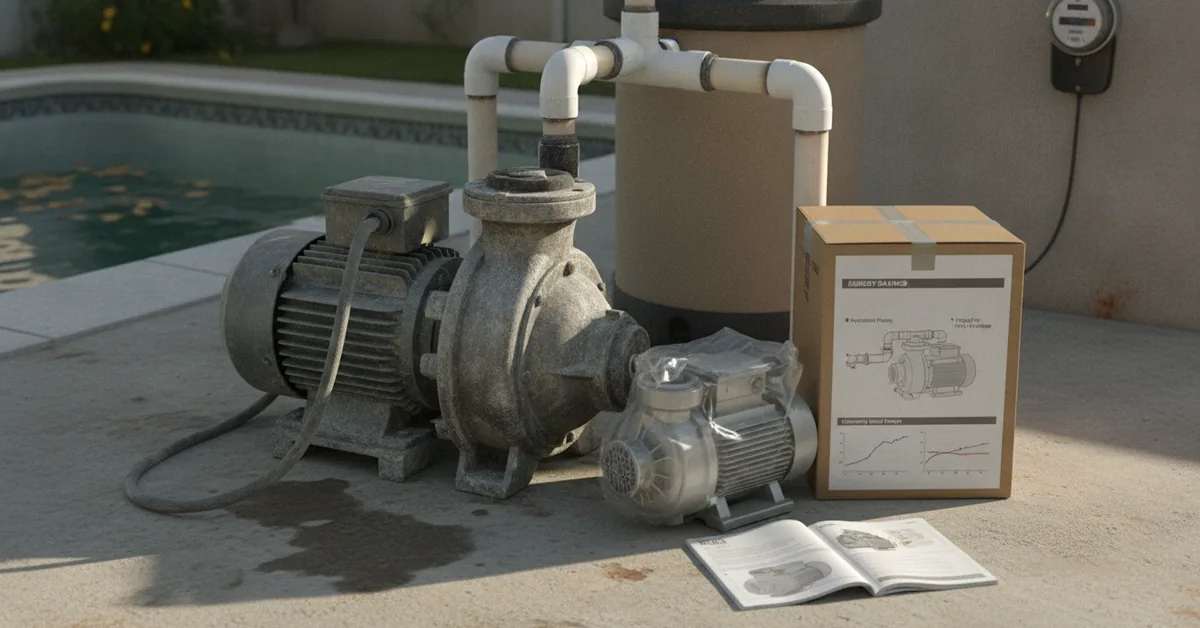
Executive Summary: Navigating Hydraulic Sizing and Energy Efficiency
Selecting the correct pool pump horsepower is fundamentally a hydraulic calculation rather than a brute-force contest of motor size. An improperly sized pump degrades water filtration, damages internal filter components, and inflates annual electric utility costs by hundreds of dollars.
- Flow Rate Synchronization: Pump output must match pipe diameter and filter square footage to prevent excessive backpressure.
- Cavitation Mitigation: Starving a high-horsepower pump on small suction lines induces internal vacuum implosions that ruin impellers.
- Filtration Efficiency: Slower water movement through sand, DE, or cartridge media dramatically improves micro-particle capture.
- Energy Optimization: Utilizing variable speed pumps at reduced RPMs reduces electrical consumption by up to 80% through fluid dynamic Affinity Laws.
Why the "Bigger is Better" Fallacy Wrecks Pool Hydraulics
When I walk onto a diagnostic service call and hear a pool pad screaming like a jet engine, I almost always find a 3-horsepower pump bolted to a single 1.5-inch suction line. Homeowners often assume buying the most powerful pump available guarantees crystal-clear water, but hydraulic friction losses increase exponentially with fluid velocity. Pushing 80 gallons per minute through a pipe rated for 42 GPM creates immense resistance, forcing the motor to work against crushing Total Dynamic Head (TDH).
When suction lines cannot feed the impeller fast enough, pressure drops below the vapor point of water. This creates microscopic vacuum bubbles that collapse violently against the impeller face. This destructive phenomenon, known as cavitation, literally eats away pump components while starving your pool filter of gentle, effective turnover rates.
System Performance Matrix: Oversized, Undersized, and Properly Matched Systems
To understand how pump selection cascades through every piece of pad equipment, we must analyze operational tradeoffs. The table below outlines real-world performance metrics observed across field service diagnostics.
| System Parameter | Oversized Single-Speed (2.5+ HP) | Undersized Single-Speed (<0.75 HP) | Matched Variable Speed Pump |
|---|---|---|---|
| Average Flow Rate (GPM) | 75 - 95 GPM (Exceeds pipe ratings) | 20 - 30 GPM (Below filter ideal) | 30 - 50 GPM (Programmable) |
| Filter Operating Pressure | 26 - 34+ PSI (Dangerous backpressure) | 6 - 10 PSI (Sluggish lift) | 8 - 14 PSI (Optimal baseline) |
| Filtration Quality | Poor (Channels debris through media) | Moderate (Inadequate turnover) | Exceptional (Low-velocity capture) |
| Monthly Electrical Draw | ~2,200 Watts/hr ($180 - $280/mo) | ~750 Watts/hr ($60 - $90/mo) | ~250 Watts/hr ($25 - $45/mo) |
| Pump Impeller Lifespan | 2 - 4 Years (Cavitation erosion) | 5 - 7 Years (Thermal stress runouts) | 10+ Years (Reduced heat and stress) |
Matching motor output to total pipe capacity ensures water moves through filtration media at design velocity. When water rushes through cartridge or sand filters too quickly, channeling occurs, allowing debris to blow straight back into the pool basin.
Field Notes: The $2,400 Equipment Pad Breakdown
Last summer, a homeowner called me after dealing with recurring cloudy water and two burnt-out single-speed pump motors in under three years. The previous installer placed a 2.5 HP max-rate pump on an older 1.5-inch plumbing loop attached to a 48-square-foot DE filter. The operating pressure gauge on the filter tank sat at an alarming 32 PSI every time the system kicked on.
Inside the tank, high water velocity had cracked the internal plastic manifold and crushed three fabric grid frames. The owner was spending over $200 a month just to power the pump, yet fine particles were tearing through crushed DE grids and circulating straight back into the pool basin. I re-engineered the pad by replacing the single-speed motor with a 2.2-horsepower Variable Speed Pump, programming baseline filtration runs at 1,750 RPM.
The system operating pressure dropped from 32 PSI down to a silky 8 PSI. Flow velocity slowed enough for the newly installed grid elements to capture sub-micron debris, clearing the pool within 36 hours. Best of all, the client's monthly pump electrical cost dropped by nearly 80%, recovering the equipment upgrade investment in under two seasons.
Mathematical Foundations: Calculating GPM and Total Dynamic Head
Sizing a pump correctly requires determining required Gallons Per Minute (GPM) based on total pool volume and target turnover time. For standard residential sanitization, I aim for a single full turnover every 8 hours. For a 20,000-gallon pool, divide 20,000 by 480 minutes to arrive at a target continuous flow rate of roughly 42 GPM.
Next, we must account for suction line limitations. Standard Schedule 40 PVC pipe has strict velocity limits to prevent extreme hydraulic friction and noise:
- 1.5-inch PVC pipe: Maximum recommended suction flow is 42 GPM (at 6 feet per second).
- 2.0-inch PVC pipe: Maximum recommended suction flow is 73 GPM.
- 2.5-inch PVC pipe: Maximum recommended suction flow is 120 GPM.
If your pool relies on a single 1.5-inch suction line coming out of the ground, installing a pump that pulls 75 GPM creates severe hydraulic choking. Running a high-horsepower pump on undersized plumbing wastes electrical power without delivering actual water movement.
Actionable Pad Audit: A 5-Step Inspection for Pool Owners
You do not need an engineering degree to perform a basic health check on your filtration system. Walk out to your equipment pad today and follow this diagnostic sequence to evaluate hydraulic balance:
- Inspect Suction and Discharge Pipe Diameters: Read the stamped markings on exposed PVC pipes entering and leaving your pump housing.
- Read the Filter Pressure Gauge: Note baseline PSI while operating at maximum normal speed. Operating pressures consistently exceeding 22 PSI indicate high friction head loss or filter restriction.
- Listen for Impeller Cavitation: Place your hand gently on the pump housing lid. Continuous popping, marble-rattling noises indicate suction starvation.
- Check Filter Tank Strain Bands and Relief Valve: Look for signs of structural stress, weeping O-rings, or bulging plastic caused by high internal tank pressure.
- Calculate Real Turnover Cost: Check motor nameplate wattage and multiply by operational hours to determine daily kilowatt usage against local electric utility rates.
Advanced Troubleshooting: Hydraulic and Sizing Complexities
- How does an oversized pump directly shorten the operational lifespan of a gas pool heater?
- High flow rates forced through a gas heater heat exchanger cause internal bypass valves to chatter or lock open, leading to localized condensation and thermal stress. Excessive internal pressure erodes copper or cupro-nickel heat exchanger tubes over time, causing internal leaks and prematurely ruining burner assemblies.
- Can I safely install a high-horsepower Variable Speed Pump on older 1.5-inch plumbing?
- Yes, provided you electronically cap the maximum operating speed (RPM) within the digital controller settings. A high-output VSP running at 1,500 to 2,200 RPM on 1.5-inch pipe provides exceptional flow and low pressure, giving you the energy benefits of a modern motor without forcing excessive water volume through restricted lines.
- Why does running a pump at lower GPM improve chemical contact time and filtration efficiency?
- Lower flow velocities allow depth-filtration media (such as sand or DE) to capture microscopic organic debris rather than forcing it through channel paths. Slower movement across salt chlorination cells or inline chemical injection points also ensures uniform, stable sanitizer distribution throughout the recirculation loop.