

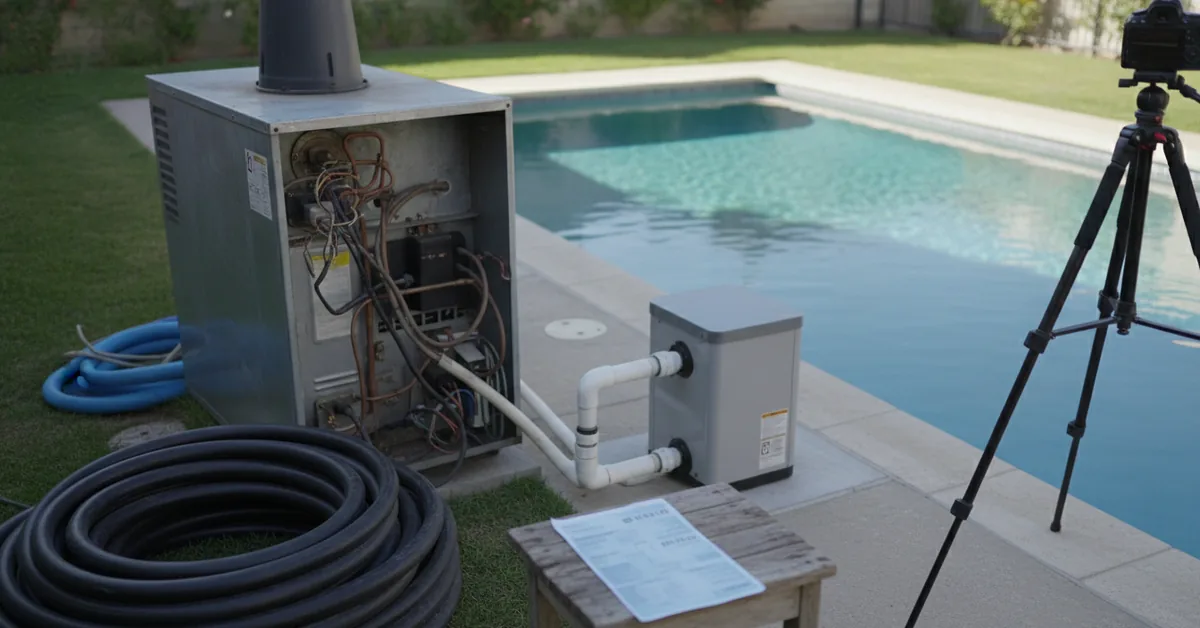
Opting for a smaller, 200,000 BTU pool heater over a proper 400,000 BTU unit to save $800 upfront is one of the most expensive mistakes I see on my service routes. On paper, both heaters will eventually raise the temperature of a 20,000-gallon pool, but the mechanical realities tell a vastly different story. An undersized unit can easily burn through an extra $1,400 in natural gas or propane every season while operating continuously for 36 hours straight, dragging exhaust temperatures down into the condensation zone and prematurely destroying its own heat exchanger.
Over my 15 years in the field, troubleshooting thousands of equipment pads across fluctuating seasonal climates, I have pulled apart countless scaled-up, soot-choked combustion chambers. The hidden costs of improperly sized pool heaters go far beyond longer wait times before a weekend swim. They directly impact mechanical longevity, hydraulic efficiency, and chemical stability.
Executive Summary: The Real Costs of Heater Mis-Sizing
Selecting a pool heater requires calculating thermal dissipation rates, hydraulic flow, and ambient environmental
Selecting a pool heater requires calculating thermal dissipation rates, hydraulic flow, and ambient environmental factors rather than merely choosing a unit based on pool volume. Installing an incorrectly sized gas heater or heat pump triggers a cascade of efficiency losses, premature component wear, and elevated operational overhead.
- Undersized units cause exhaust condensation: Running continuously without reaching optimal heat exchanger temperatures produces acidic condensation that corrodes copper tubes and chokes burner trays with soot.
- Oversized units risk hydraulic short-cycling: High-output heaters paired with inadequate flow rates cause internal bypasses to overheat, cycling high-limit pressure switches and accelerating control board failure.
- Surface area outweighs total gallonage: Over 75% of heat loss occurs via surface evaporation, making pool surface dimensions and wind exposure far more critical to sizing calculations than total volume.
- Variable speed pumps require flow matching: Modern energy-efficient pumps running at low RPMs can starved heaters of required GPM, causing internal safety shutdowns or flame rollouts.
The Fallacy of Gallonage: Why Surface Area and Delta T Rule Combustion
The most common error property owners make—and frankly, many inexperienced pool builders as well—is sizing a heater based strictly on pool volume. You cannot calculate heat load the same way you calculate salt content or chlorine demand. Water volume dictates chemical dosing, but surface area and temperature differential (ΔT) dictate BTU demand.
Physics tells us that 1 British Thermal Unit (BTU) is the amount of heat required to raise 1 pound of water by 1 degree Fahrenheit. One gallon of water weighs approximately 8.33 pounds. Therefore, heating a 20,000-gallon pool (166,600 lbs of water) by 10°F requires 1,666,000 BTUs of energy, assuming zero thermal loss. But pools do not sit inside insulated thermoses. Heat immediately escapes through the water surface into the surrounding air.
Because evaporation accounts for roughly 75% of all thermal loss in a swimming pool, a shallow pool with a massive surface area loses heat exponentially faster than a deep pool with a small surface area, even if both hold the exact same volume of water. When I calculate sizing, I evaluate the surface surface area in square feet, local average wind speed, and the desired heat-up rate per hour. Installing a small 150,000 BTU heater on a broad, un-covered 800-square-foot pool during a cool autumn night results in a situation where heat dissipation matches heater output, causing the heater to run indefinitely without gaining a single degree.
The Mechanical Consequences of Undersizing: Condensation, Sooting, and Heat Exchanger Rot
When an undersized gas heater fires up to warm a cold body of water, it must run continuously for extended periods. While this might sound harmless beyond the high utility bill, it introduces a insidious chemical phenomenon inside the combustion chamber known as dew-point condensation.
Standard atmospheric and low-NOx gas pool heaters are non-condensing appliances. They are designed to operate with high internal flue gas temperatures, keeping exhaust moisture in a vaporized state. When return water entering the heat exchanger drops below approximately 68°F (20°C), thermal transfer cools the combustion gases below their dew point. Flue gases contain water vapor mixed with natural gas or propane combustion byproducts, forming mild sulfurous and carbonic acids.
When these acidic droplets condense on the exterior of a cold copper heat exchanger, three destructive processes begin:
- Soot Accumulation: Acidic moisture grabs microscopic carbon dust from the flame, forming a heavy, black tar-like soot between the heat exchanger fins.
- Airflow Restriction: Soot buildup blocks exhaust venting, smothering the flame, producing dangerous carbon monoxide, and causing flame rollout that burns control wiring.
- Acidic Cupro-Nickel/Copper Corrosion: The acidic moisture eats the heat exchanger fins from the outside, turning them into green, flakey copper carbonate dust until the wall fails and floods the burner tray.
I recall a service call in Dallas a few winters back. The homeowner complained that his two-year-old 175,000 BTU propane heater was making a rolling thunder sound and emitting foul, black smoke. When I removed the door panel, I found the burner tray piled three inches deep with green scale and black soot. The unit had been installed on a 28,000-gallon un-covered pool. Because the heater was severely undersized, it spent 48 straight hours in low-temperature condensation mode every time he turned it on. The heat exchanger was completely destroyed. Upgrading him to a properly sized 400,000 BTU unit eliminated the condensation phase within 15 minutes of startup, solving the mechanical failure completely.
Oversizing Mechanics: Short-Cycling, Pressure Relief Triggers, and Flow Rate Bottlenecks
If undersizing rots heaters from condensation, can you simply put the largest possible heater on any pool pad? Not without evaluating your plumbing setup. Oversizing a heater without matching hydraulic infrastructure creates a distinct set of operational failures.
A 400,000 BTU gas heater typically requires a minimum hydraulic flow rate between 30 and 40 Gallons Per Minute (GPM) to safely pull thermal energy out of the combustion chamber, with internal bypass assemblies directing excess flow around the core up to roughly 125 GPM. If you pair a large 400,000 BTU heater with an old 1.5-inch plumbing system or a small single-speed pump producing insufficient GPM, the heat exchanger cannot dump its thermal load quickly enough.
The result is thermal short-cycling. Internal water temperatures within the header spike rapidly, triggering high-limit thermal switches (usually set at 135°F to 150°F) that cut power to the gas valve for safety. The heater turns on for two minutes, shuts off for three, and cycles repeatedly. This constant opening and closing of gas valves and mechanical relays induces severe thermal fatigue across the heat exchanger headers, leading to cracked cast iron or polymer headers and premature control board failure.
Sizing and Performance Comparison Matrix
To visualize how heater input capacity changes run times, hydraulic demands, and operational efficiency, review the following field-tested matrix calculated for a standard 20,000-gallon outdoor pool seeking a 15°F temperature rise at 55°F ambient air temperature.
| Heater BTU Input | Min. Required Flow Rate (GPM) | Estimated Heat-Up Time (15°F Rise) | Risk of Condensation / Sooting | Primary Application Suitability |
|---|---|---|---|---|
| 150,000 - 200,000 | 20 - 25 GPM | 18 to 24+ Hours | High (When water temp < 65°F) | Small Spas, Above-Ground Pools (<10,000 Gal) |
| 250,000 - 300,000 | 25 - 30 GPM | 10 to 14 Hours | Moderate (In cold climates) | Mid-size Pools (10,000 - 18,000 Gal) with cover |
| 400,000 | 35 - 40 GPM | 4 to 6 Hours | Low (Rapidly passes dew point) | Standard In-ground Pools (18,000 - 35,000 Gal) |
| Heat Pump (110k-140k BTU) | 30 - 45 GPM | 24 to 48 Hours (Sustained) | None (No combustion) | Long-term daily maintenance heating in warm zones |
The Interplay Between Modern Variable Speed Pumps and Heater Fire Tubes
In modern pool design, variable speed pumps (VSPs) are the standard for energy savings. Running a VSP at 1,100 RPM uses a fraction of the electricity of a traditional single-speed pump. However, this creates a dynamic that directly impacts heater performance.
Gas heaters utilize an internal water pressure switch to verify that water is flowing through the unit before allowing the ignition control module to fire. This switch typically requires 1.5 to 2.5 PSI of backpressure to close. When a variable speed pump drops to its lower energy-saving speeds (often delivering 12 to 20 GPM), water pressure drops below this critical threshold.
If your heater is undersized, you might be tempted to leave it running overnight while your VSP drops down to low speed to save power. What actually happens? The pressure switch opens, turning off the heater completely, or worse, the pressure switch sits right on the edge of activation, rapidly cycling the ignition control module. If the mechanical internal bypass flapper inside the header does not receive adequate flow, localized boiling occurs inside the copper heat exchanger tubes, producing a knocking sound known as thermal cavitation. To safely run high-capacity heaters alongside VSPs, pump automation must be programmed to ramp up RPMs whenever thermal heating is active.
The Equipment Pad Audit: 5 Steps to Verify Your Heater Sizing Today
If you suspect your current pool heating system is inefficient, undersized, or damaging itself, walk out to your equipment pad and execute this step-by-step technical audit:
- Calculate Your True Surface Area: Measure the maximum length and width of your pool surface in feet. For rectangular pools, multiply length by width. For irregular or freeform shapes, multiply maximum length by maximum width by 0.85 to establish approximate surface square footage.
- Identify Your BTU Rating Plate: Open the side access panel of your gas heater or heat pump and locate the silver rating plate. Note the exact BTU input capacity (e.g., 175k, 250k, 400k) and verify whether it uses Natural Gas or Propane.
- Check exhaust headers for physical signs of undersizing: Inspect the top exhaust vent and lower burner tray. If you see green powder flake, damp dark soot, or rusted burner tubes, your heater is spending too long operating below dew-point temperature due to thermal overload.
- Verify VSP Flow Rates During Heating Cycles: Turn your heater on and check your pump interface. Ensure your pump is programmed to deliver at least 35–40 GPM (typically 2,200 to 2,800 RPM depending on head loss) whenever the heater receives a call for heat.
- Audit Evaporative Thermal Loss: Check if a solar blanket or liquid pool cover is in use. Installing a physical thermal cover reduces BTU demand by up to 50%, effectively allowing an borderline heater to operate without extreme efficiency losses.
Advanced Technical Troubleshooting and Operational FAQs
- Why does my gas pool heater produce a distinct sulfur smell and wet black soot beneath the burner tray during cold weather startup?
- This occurs when return pool water temperatures are below 60°F–65°F, causing flue gas condensation inside non-condensing heaters. The heat exchanger tubes cold-shock the exhaust gases, causing water vapor to condense out of combustion airflow, combining with trace sulfur in gas lines to form liquid acid and heavy carbon soot. If the heater is properly sized (e.g., 400,000 BTU), internal water bypass valves raise core copper temperatures above condensation point within minutes, eliminating the issue. An undersized unit cannot warm the return water fast enough, remaining in condensation mode for hours and destroying the combustion chamber.
- Will running a high-capacity 400,000 BTU gas heater on a Variable Speed Pump at low RPM damage the heat exchanger or void the manufacturer warranty?
- Yes, operating a high-capacity heater without adequate GPM flow causes extreme localized heating inside copper heat exchanger tubes, triggering water boiling, severe calcium scale drop-out, and header cracking. While built-in pressure switches attempt to shut off the heater when pressure drops too low, running on the low-pressure threshold can cause rapid short-cycling. Most manufacturers specifically exclude damage caused by low flow, thermal shock, or scale buildup resulting from improper hydraulic flow settings from warranty coverage.
- How does wind velocity dramatically skew heater sizing calculations compared to static ambient temperatures?
- Wind accelerates surface evaporation, which accounts for approximately 75% of total pool heat loss. A 10 mph wind across an open pool surface increases thermal loss by up to 300% compared to completely still air at the exact same ambient air temperature. When sizing heaters for exposed, un-sheltered pools, technicians must add a wind factor calculation, frequently requiring an upgrade from a 250,000 BTU unit to a 400,000 BTU unit or requiring the mandatory installation of a solid physical pool cover to retain heat gains.