

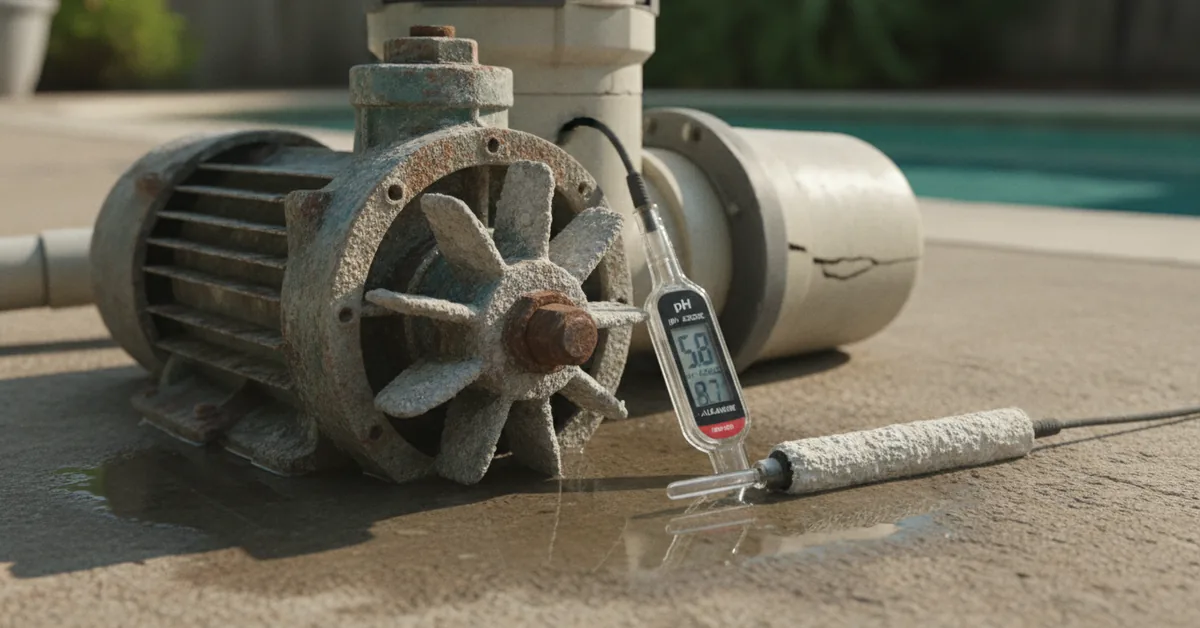
A $35 gallon of muriatic acid and a $12 box of sodium bicarbonate are often all that stands between a residential pool system lasting 12 years or disintegrating in under 36 months. Last season alone, I condemned over twenty gas heaters and saltwater chlorinator cells that looked cosmetically pristine on the outside, yet were completely destroyed internally. The culprit was not mechanical wear, manufacturer defects, or heavy bather load—it was chronic pH imbalance. When pH strays outside the narrow 7.4 to 7.6 gold standard, pool water transforms from a refreshing haven into either an aggressive solvent or a scale-depositing nightmare. The financial consequence is rarely limited to a few extra dollars in chemical adjustments; it frequently leads to a $4,000 heat exchanger teardown and early pump shaft seal failure that quietly bleeds pool owners dry.
The Silent Catalyst: How pH Balance Dictates Mechanical Lifespan
Maintaining proper pH is not merely about preventing stinging eyes or cloudy water; it is the fundamental governor of
Maintaining proper pH is not merely about preventing stinging eyes or cloudy water; it is the fundamental governor of your pool's total dynamic chemistry and mechanical durability. Water constantly seeks saturation equilibrium, and when pH drifts, the water actively attacks or coats every submerged metallic and elastomeric component on your equipment pad.
Understanding this chemical relationship protects high-value capital assets from premature mechanical degradation and optimizes overall filtration efficiency.
- Corrosive Low pH (< 7.2): Strips copper from heat exchangers, pit-corrodes stainless steel motor shafts, and shrinks mechanical pump seals, leading to drive-end housing leaks.
- Scaling High pH (> 7.8): Forces dissolved calcium out of solution, coating salt cell plates with insulating scale and clogging filter media grids with irreversible mineral crusts.
- Sanitizer Inefficiency: At a pH of 8.0, free chlorine loses over 75% of its killing power, forcing longer pump run times and excessive chemical consumption.
- Langelier Saturation Index (LSI): True balance requires pairing pH with alkalinity, calcium hardness, and temperature, preventing water from becoming aggressively destructive.
Low pH Destruction: The Acidic Solvent Engine on Your Pad
When pool pH drops below 7.2, the water shifts into an unsaturated, acidic state. In technical terms, the concentration of hydrogen ions increases dramatically, turning your pool into a hungry solvent seeking minerals and metals to satisfy its chemical deficit. The primary victim on any equipment pad is the copper heat exchanger inside gas pool heaters. Copper is a soft, highly conductive metal, making it ideal for thermal transfer, but it dissolves rapidly when exposed to acidic water.
As low pH water rushes through the heater header at 50 to 80 gallons per minute, it leaches copper ions directly out of the smooth internal tube walls. This leached copper travels down the plumbing line, eventually oxidizing and staining pool plaster with dark green or black rings around return jets. Worse, the thinning metal walls of the exchanger inevitably pinhole, flooding the heater combustion chamber and burning out expensive ignition boards. Simultaneously, low pH causes elastomeric rubber components—such as pump lid O-rings, shaft seals, and valve gaskets—to absorb acid, swell, lose elasticity, and fail prematurely under standard operating pressure.
High pH Scaling: The Calcification Matrix of Salt Cells and Filters
Conversely, operating a pool at a pH above 7.8 creates an over-saturated chemical environment. Water can no longer keep calcium carbonate dissolved in solution, causing micro-crystals to precipitate onto surfaces with high local temperatures or high physical turbulence. The frontline casualty in modern residential pools is the electrolytic salt chlorine generator cell. Inside the cell, titanium plates generate chlorine through electrolysis, a process that naturally creates an intense, localized high-pH micro-environment at the cathode plate surface.
If the bulk pool water is already elevated at pH 7.8 or higher, calcium scale forms instantly across these titanium plates. This white, rocky crust acts as a thermal and electrical insulator. Current draw spikes, chlorine production drops to zero, and the cell's precious ruthenium oxide coating burns off, turning a five-year cell into scrap metal in less than two seasons. In cartridge and DE filters, high pH combined with elevated calcium hardness calcifies the polyester fabric pores and DE grids, locking debris into the matrix and drives baseline filter pressure up permanently by 10 to 15 PSI.
Field Case Study: The $4,200 Heater Breakdown in a "Crystal Clear" Pool
Two summers ago, a new client called me out to inspect a gas heater that had stopped firing on a 25,000-gallon plaster pool. The homeowner was confident in his maintenance, proudly pointing out that his water was crystal clear and perfectly blue. He relied entirely on basic test drops once every few weeks and added trichlor pucks continuously through an inline feeder.
When I pulled the drain plug on the heater header, blue-green water poured out—a classic signature of dissolved copper. My digital photometer revealed the truth: free chlorine was 5.0 PPM, but pH was well below 6.8 (off the bottom of the scale), total alkalinity was 20 PPM, and Cyanuric Acid (CYA) was pushing 120 PPM. The trichlor pucks, which have an inherent pH of roughly 2.8, had driven the water into severe acid lock. While the water looked pristine because high chlorine kept algae away, the aggressive water had completely eaten through the copper heat exchanger. The repair required a complete exchanger replacement and a full pump overhaul, costing the homeowner $4,200—all because a $15 water test was misread or neglected.
| Water Parameter | Target Operating Range | Equipment Impact (Low Range) | Equipment Impact (High Range) |
|---|---|---|---|
| pH Level | 7.4 – 7.6 | Copper tube erosion, heater core leaks, pump shaft seal breakdown | Salt cell calcification, reduced chlorine efficacy, filter grid clogging |
| Total Alkalinity (TA) | 80 – 120 PPM | pH bounce, rapid acid damage to metal hardware | pH lock, persistent high pH scale accumulation on surfaces |
| Calcium Hardness | 200 – 400 PPM | Etching of plaster, corrosion of exposed metal fittings | Severe scale on salt cell blades, heat exchanger scaling |
| Langelier Saturation Index (LSI) | -0.3 to +0.3 | Aggressive water stripping copper and metal components | Precipitating water dropping calcium onto heat plates and piping |
The Chemistry Bridge: How LSI and Total Alkalinity Control pH Stability
To master pool chemistry, you must understand that pH does not exist in isolation. Total Alkalinity acts as a chemical buffer—a sponge that absorbs hydrogen ions to prevent sudden, drastic swings in pH. If total alkalinity falls below 80 PPM, the pH becomes wildly unpredictable, plunging rapidly after heavy rain or dropping whenever acidic sanitizers are added. Conversely, if total alkalinity exceeds 120 PPM, it exerts a constant upward pressure on pH, forcing you into an endless cycle of pouring gallon after gallon of muriatic acid into the deep end.
The true benchmark used by veteran technicians is the Langelier Saturation Index (LSI). The LSI factors together pH, total alkalinity, calcium hardness, cyanuric acid, total dissolved solids (TDS), and water temperature. A pool with a pH of 7.8 in cold winter water (50°F) might have a perfectly balanced LSI of 0.0, while that exact same pH of 7.8 in warm summer water (90°F) pushes the LSI into severe scaling territory (+0.45). By managing LSI rather than chasing pH in isolation, you create water that neither eats your equipment nor leaves calcified deposits on your investment.
Equipment Pad Inspection: A 5-Step Diagnostic Protocol for Homeowners
Before small chemical imbalances turn into thousands of dollars in mechanical failure, walk out to your equipment pad and perform this systematic visual and operational check:
- Examine the Heater Drain Plug and Exchanger Header: Look for blue, green, or teal weeping around the metallic copper connections and drain plugs. Any greenish staining indicates active copper dissolving inside the heat core.
- Inspect the Variable Speed Pump Shaft Housing: Look closely at the gap between the plastic wet end housing and the dry end motor. Any white salt crusting or water drips behind the impeller housing signal a compromised mechanical shaft seal caused by acidic water.
- Check the Salt Chlorinator Cell Housing: Inspect clear cell housings or remove the cell to view internal plates. Thick white flake or bridge-like build-up between titanium blades indicates sustained high pH scaling that requires an immediate acid cleaning bath.
- Monitor Baseline Filter Pressure Gauges: Note your baseline pressure after a thorough backwash or cartridge cleaning. If baseline pressure remains elevated by 8 to 10 PSI despite clean media, calcium scaling has clogged the pore structure of the filter elements.
- Verify Skimmer Weir Door and Gasket Integrity: Check elastomeric gaskets, check valves, and rubber O-rings around your chlorinator and skimmer. Soft, sticky, or deformed rubber rings indicate acid degradation from improper chemical feeding routines.
Advanced Technical FAQ: Pool Chemistry and Mechanical Performance
Here are direct answers to technical questions encountered during field diagnostic services:
- How does high calcium hardness combined with high pH specifically affect a salt chlorine generator cell?
- When power flows through titanium cell plates, electrolysis splits sodium chloride and water, producing sodium hypochlorite and hydrogen gas. This reaction generates an intense, localized micro-zone of extreme high pH directly against the cathode plate surface. If bulk pool water pH is already high (> 7.8) alongside elevated calcium hardness (> 400 PPM), calcium instantly precipitates out of solution onto the titanium blades. This scale insulates the plates, increases electrical resistance, causes low salt warnings, and drastically shortens cell lifespan.
- Will running a high or low pH level void the manufacturer warranty on my gas heater or heat pump?
- Yes. Major manufacturers explicitly state in their warranty terms that damage caused by chemical imbalance—whether copper erosion from low pH/low LSI or heat exchanger lime scaling from high pH/high LSI—is classified as owner neglect. Exchangers returned for warranty analysis are sectioned open by factory engineers; copper thinning or heavy internal scaling provides undeniable forensic proof, resulting in immediate denial of warranty claims.
- Why does my pool pH continually rise even when I am not adding any chemicals?
- Constant pH rise is driven primarily by the outgassing of carbon dioxide (CO2). Pool water contains dissolved CO2, and whenever water is agitated—by spa spillways, waterfall features, deck jets, or pool sweep venturis—CO2 escapes into the atmosphere. As dissolved carbonic acid leaves the water, pH naturally climbs. High total alkalinity (above 120 PPM) exaggerates this effect by maintaining high carbonate levels. Lowering total alkalinity to 80 PPM and controlling aeration features will significantly slow down this automatic upward drift.