

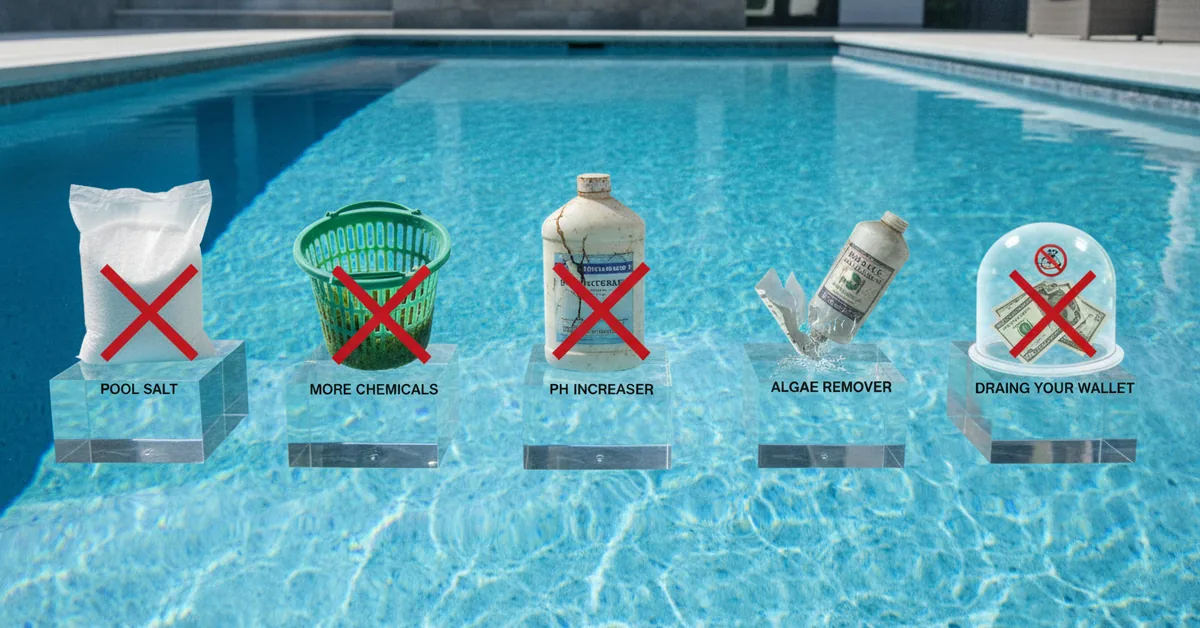
Adding high-dose chemical shock from a retail bucket to a cloudy pool is frequently the worst action you can take for your water clarity and pool surface. For over fifteen years maintaining equipment pads and balancing chemistry across Florida, I have watched well-meaning pool owners walk out of retail pool stores carrying hundreds of dollars in specialty algaecides, clarifiers, and bag shock, only to make their water quality drastically worse. The retail business model relies on selling reactive chemical Band-Aids rather than teaching fundamental water balance mechanics.
Executive Summary: What Retail Pool Counters Will Not Explain
Navigating residential pool maintenance requires looking past high-margin retail sales pitches to focus on true fluid dynamics and chemical equilibrium. Understanding these mechanical truths will instantly protect your plaster finish, preserve your equipment pad, and dramatically reduce your annual chemical expense.
- Excessive reliance on stabilized chlorine shock drives cyanuric acid to toxic levels, forcing unnecessary pool draining.
- Saltwater chlorination systems generate pure chlorine and naturally elevate pH, requiring regular muriatic acid additions.
- Clarifiers and flocculants frequently coat cartridge filter media, permanently restricting hydraulic flow rates.
- Variable speed pumps operating at lower speeds slash electrical costs while drastically improving mechanical filtration efficiency.
Myth 1: Bagged Chlorine Shock Fixes Every Water Clarity Problem
When a pool owner walks into a retail store with cloudy or green water, the default recommendation is almost always a handful of calcium hypochlorite or dichlor shock bags. What the clerk behind the counter fails to mention is that granular shocks contain heavy additives that permanently alter your water baseline. Dichlor and trichlor products contain cyanuric acid, also known as stabilizer or conditioner. While cyanuric acid protects chlorine molecules from ultraviolet degradation under the intense sun, it does not evaporate or break down over time.
Every time you broadcast stabilized shock into your water, your stabilizer baseline rises. Once your pool exceeds 80 to 100 parts per million (PPM) of cyanuric acid, your sanitizer experiences chlorine lock. At this stage, even high chlorine readings become chemically ineffective because the stabilizer holds onto the chlorine molecules, preventing them from oxidizing organic waste. The solution promoted by stores is usually to buy even more shock, creating a destructive feedback loop. The only way to lower elevated cyanuric acid concentration is to physically drain and refill pool volume, a costly maneuver that can risk structural flotation in high water table environments.
Myth 2: Saltwater Pools Are Chemical-Free and Do Not Contain Chlorine
One of the most persistent misunderstandings propagated by salesmen is that saltwater pool systems eliminate the need for chlorine and chemical monitoring. In reality, a saltwater generator is simply an on-site chlorine factory. As pool water mixed with sodium chloride passes through an energized electrolysis cell, the system breaks down the salt and water molecules to form hypochlorous acid—the exact same active sanitizing agent found in traditional liquid bleach.
Because the electrolytic reaction produces a sodium hydroxide byproduct, an operating electrolytic salt cell constantly drives water pH upward. Unchecked pH levels above 7.8 drastically reduce chlorine efficiency and cause dissolved calcium to precipitate out of suspension. This scale coats heater exchangers and cell plates, causing premature cell failure. Salt pools actually require more vigilant monitoring of total alkalinity and frequent additions of muriatic acid to maintain chemical equilibrium and prevent permanent hardware degradation.
| Sanitizer Method | Primary Active Chemical | Impact on pH / Total Alkalinity | Primary Operational Risk |
|---|---|---|---|
| Liquid Chlorine (Sodium Hypochlorite) | Hypochlorous Acid | Slight increase (Neutral over time) | Bulk storage weight and short shelf-life |
| Trichlor Pucks / Dichlor Granular | Chlorinated Isocyanurates | Dramatically lowers pH & TA | Rapid Cyanuric Acid buildup and pool lock |
| Salt Water Generator (SWG) | Hypochlorous Acid (Generated) | Dramatically elevates pH | High calcium scaling on electrolytic plates |
| Cal-Hypo (Calcium Hypochlorite) | Hypochlorous Acid + Calcium | Elevates pH and Calcium | Increases Calcium Hardness, causing cloudiness |
Trench Story: How a $40 Retail Solution Turned into a $7,000 Plaster Finish Failure
A few seasons ago, I took over a residential account in Tampa where the homeowner had spent six months following weekly store advice. His water had turned hazy after heavy summer rains, and the store continuously sold him copper-based algaecides along with weekly dry acid doses to lower his rising alkalinity. What the computerized photometer at the retail counter missed was that the pool's cyanuric acid had reached 160 PPM from years of continuous puck use, rendering his free chlorine useless against simple algae spores.
To compensate for persistent cloudiness, the homeowner dumped gallons of liquid copper algaecide into the water over several months. Because the store kept recommending aggressive dry acid doses without proper distribution, the dissolved copper dropped out of solution and bound directly into the newly installed quartz plaster finish. When I arrived, the vibrant white quartz was completely stained a deep turquoise blue-green. We had to drain the entire basin, perform a harsh acid wash treatment, and ultimately perform a partial surface patch. The owner spent over $7,000 to remediate damage caused by $40 bottles of unnecessary copper-based algaecides sold to mask a basic stabilizer lock issue.
Myth 3: Clarifiers and Algaecides Are Essential Weekly Preventatives
Retail shelves are stacked with brightly colored bottles promising crystal-clear water through weekly preventative dosing. Clarifiers work by binding microscopic suspended particles together into larger clumps so your filter media can trap them. However, synthetic polymers and coagulants do not select what they bind to; they cling aggressively to filter media itself.
When poured down the skimmer or directly into the basin, these thick coagulants coat the synthetic fibers inside cartridge filter elements or weld diatomaceous earth (DE) grids together into a solid cake. The pressure inside your filter tank spikes, reducing circulation flow rates and forcing your pump to labor under extreme head pressure. True water clarity comes from proper hydraulic circulation, balanced saturation index metrics, and adequate mechanical turnover—not chemical thickening agents that blind your filtration hardware.
Myth 4: Single-Speed Pumps Are Cheaper Than Upgrading to Variable Speed Models
Many homeowners resist replacing an aging 1.5-horsepower single-speed pump because the upfront equipment purchase cost of a variable speed unit seems steep. Pool supply counters often reinforce this hesitation by selling cheap replacement motors for single-speed setups, arguing that running a pump fewer hours per day saves money. This advice defies basic mechanical physics.
Under the mathematical Affinity Laws of hydraulics, power consumption by an electric pump motor is proportional to the cube of its shaft rotation speed. If you cut the pump motor revolutions per minute (RPM) in half, you reduce the electrical energy consumption by approximately 87 percent. While running a single-speed pump at 3,450 RPM for 8 hours draws massive electrical current, running a modern variable speed pump at 1,500 RPM for 18 hours moves more total water volume while consuming a fraction of the electricity. In high-use southern climates, a variable speed unit pays for its initial cost differential in energy savings within 12 to 18 months.
Myth 5: Free Computerized Store Water Scans Are Always Accurate
Free water testing at retail stores seems like a fantastic service, but automated optical disc photometers and strip-reading computers are subject to significant calibration errors. These photometers rely on delicate optical lenses and precise chemical reagent disc storage. In a busy retail store environment where water samples sit on counters for hours before testing and equipment lenses gather dust, cross-contamination is standard.
Furthermore, automated computer readouts are pre-programmed with aggressive dosing algorithms designed to sell product off the shelf. If your total alkalinity drops slightly below a broad arbitrary target, the software automatically prints out a ticket telling you to buy 10 pounds of sodium bicarbonate. A seasoned technician uses a manual drop-count liquid reagent kit (such as a Taylor K-2006) to observe physical reagent color transitions, factoring in water temperature and total dissolved solids to calculate the actual Langelier Saturation Index (LSI) before adding a single ounce of chemicals.
The 5-Step Equipment Pad Inspection Protocol
Before buying another chemical container or component off a retail shelf, walk out to your equipment pad today and execute this operational checklist to verify system health:
- Check Pressure Gauge Differential: Inspect your filter pressure gauge with the pump running at full speed. If the reading is 8 to 10 PSI above your baseline clean filter pressure, clean the cartridges or backwash the grid assembly before adding any sanitizing chemicals.
- Inspect Skimmer Weir Door Velocity: Look inside the skimmer throat to verify the floating weir door is upright and moving freely. A jammed or missing weir door reduces surface skimming action by 80 percent, allowing organic debris to sink and create chemical demand.
- Examine Salt Cell Plates: Turn off power to the pad, remove the electrolytic salt cell union, and look down the internal titanium plates. If you observe hard white chalky scale bridging the plates, perform a diluted acid soak to restore chlorine production efficiency.
- Calculate Cyanuric Acid Ratio: Use a drop-count reagent test to measure CYA. Ensure your free chlorine baseline remains above a strict 7.5 percent threshold of your total CYA reading (for example, at 80 PPM CYA, your minimum free chlorine must never drop below 6 PPM).
- Audit Pump RPM Schedules: Ensure your variable speed pump is programmed to run for extended low-RPM cycles rather than short high-speed bursts. This optimizes mechanical particle filtration and chemical dispersion throughout the basin. Scope out your equipment pad monthly to catch mechanical failures early, saving thousands in premature replacement costs.
Expert Operational FAQs: Advanced Water Mechanics
- How does elevated Calcium Hardness specifically compromise a salt chlorination cell?
- When water passes through a salt cell, the electrolytic generation process creates localized micro-environments of extreme heat and high pH directly on the titanium cell plates. High ambient Calcium Hardness (above 400 PPM) combined with high water temperature causes dissolved calcium carbonate to rapidly convert into solid scale on these plates. This scale creates electrical resistance, forces the system power supply to draw excessive amperage, degrades the rare-metal ruthenium coating on the plates, and drastically shortens cell service life.
- Will running a variable speed pump at low RPMs prevent a gas pool heater from firing?
- Yes, if the hydraulic flow rate falls below the safety threshold required by the heater pressure switch. Gas heaters utilize an internal water pressure switch to verify circulation before sparking the burner assembly, preventing catastrophic heat exchanger meltdown. If your variable speed pump operates at low RPMs (typically under 1,800 RPM depending on plumbing diameter and pipe distance), the dynamic flow may not generate enough pressure to activate the switch. To remedy this, create a designated high-speed pump schedule block that coincides with your desired heating cycles.
- Why does a manual drop test show zero chlorine right after adding heavy shock?
- When free chlorine levels spike extremely high (typically above 15 to 20 PPM), the high concentration of oxidizer actually bleaches out the DPD indicator reagents (specifically the DPD-1 and DPD-3 liquid reagents or DPD powder) used in standard drop testing kits. This causes the sample water to instantly turn clear or light pink, mimicking a zero-chlorine condition. If you suspect chemical bleaching, dilute the pool water sample with equal parts distilled water, re-test, and multiply the resulting value by two to obtain an accurate baseline.