

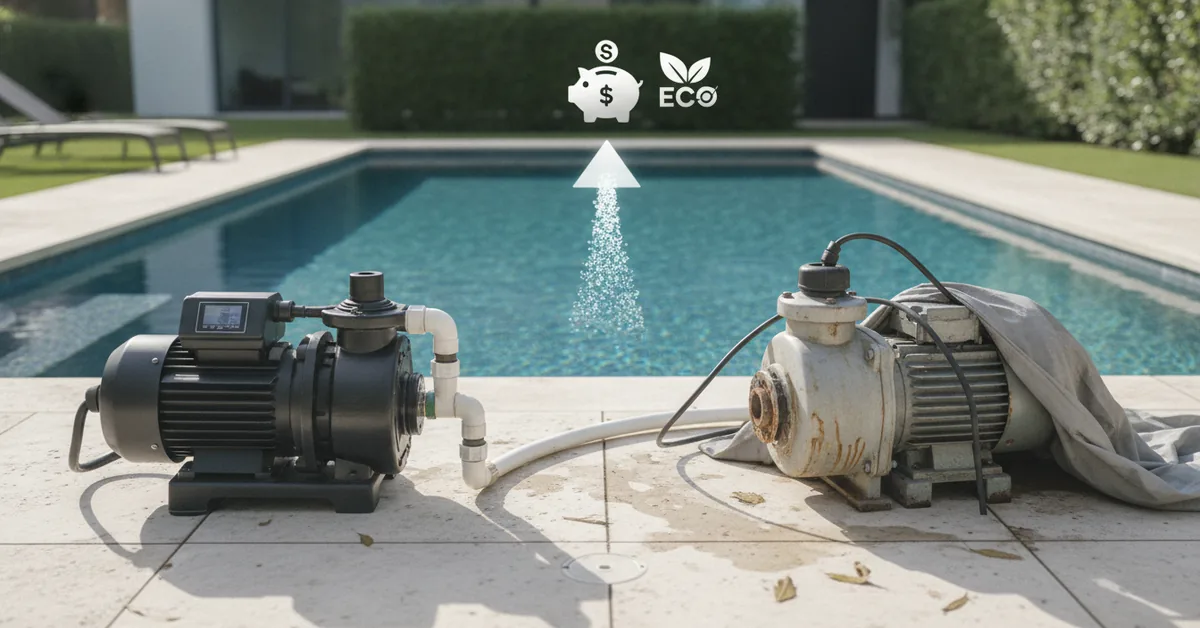
Running a pool pump at maximum speed for eight hours a day does not give you cleaner water; it simply shreds your filtration media while transferring thousands of dollars directly from your bank account to the electric utility. Single-speed pool pumps are energy-hungry relics, forced to operate at a fixed 3,450 RPM regardless of whether you are skimming a few surface leaves or backwashing a heavyfilter. When pool owners call me complaining about a summer electric bill that spiked by $150 or $200 a month, my first stop on the equipment pad is that roaring, red-hot single-speed motor. Upgrading to a Variable Speed (VS) pump is not an over-hyped equipment sales pitch—it is the single highest-return financial decision you can make for your backyard ecosystem.
Executive Summary: The Financial and Operational Reality of VS Pumps
Variable speed pool pumps drop power consumption dramatically by leveraging fluid dynamic affinity laws, allowing you to run your filtration at lower speeds for longer periods. This operational shift delivers crystal-clear water while recovering your initial equipment investment in under two years for the vast majority of pool owners.
- 80% Average Energy Reduction: Cutting motor speed in half reduces energy consumption by roughly 87% due to the Affinity Law of pump physics.
- 12 to 24-Month Payback Window: Annual electricity savings ranging between $700 and $1,300 quickly offset the higher upfront purchase price of a modern VS pump.
- Superior Water Clarity and Filtration: Low-velocity water flow allows sand, cartridge, and DE filters to capture much smaller sub-micron particulates.
- Extended Equipment Service Life: Lower plumbing line pressures mean less wear on heat exchangers, plumbing joints, valve seals, and salt chlorinator cells.
The Physics of Pump Affinity Laws: Why Slower Saves Big
To understand why variable speed pumps yield such absurdly high financial returns, you have to look at the Affinity Law of hydraulics. This principle states that the power consumed by a pump motor is proportional to the cube of its shaft speed (RPM). When you reduce the speed of an electric motor, the power required to drive it drops far faster than the flow rate does.
If I dial a pump down from its maximum speed of 3,450 RPM to 1,725 RPM, I cut the water flow rate in half. However, because of that cubic mathematical relationship, the motor now consumes only one-eighth (12.5%) of the electricity it needed at full speed. Even though you run the pump longer at low speed to achieve your necessary water turnover, the net watt-hour consumption plummets. In my fifteen years servicing pads across hot sunbelt climates, single-speed pumps remain the single largest residential electricity drain behind central air conditioning units.
Real-World Cost Comparison: Single-Speed vs. Dual-Speed vs. Variable Speed
Let us look at actual field data comparing a typical 20,000-gallon inground pool operating across a standard 120-day summer window versus year-round operation. For calculation consistency, assume an average residential energy rate of $0.21 per kilowatt-hour (kWh).
| Pump Type & Operating Mode | Motor Speed (RPM) | Power Draw (Watts) | Daily Hours | Monthly kWh | Est. Monthly Cost | Est. Annual Cost |
|---|---|---|---|---|---|---|
| Single-Speed (1.5 Total HP) | 3,450 RPM | 2,000 W | 8 hrs | 480 kWh | $100.80 | $1,209.60 |
| Dual-Speed (High Flow Mode) | 3,450 RPM | 2,000 W | 2 hrs | 120 kWh | $25.20 | $302.40 |
| Dual-Speed (Low Flow Mode) | 1,725 RPM | 450 W | 10 hrs | 135 kWh | $28.35 | $340.20 |
| Variable Speed (Low Filtration) | 1,250 RPM | 170 W | 18 hrs | 91.8 kWh | $19.28 | $231.36 |
| Variable Speed (Skim/Clean) | 2,400 RPM | 650 W | 3 hrs | 58.5 kWh | $12.29 | $147.42 |
Notice the extreme variance in total operational expenditures. Moving from a traditional single-speed pump to a custom-programmed variable speed schedule slashes your annual electrical output from over $1,200 down to less than $380. That represents a net operational return of over $800 every single year, pure money that stays in your pocket long after the equipment has paid for itself.
Field Story: Correcting a $2,100 Annual Mistake on a Service Route
A few summers back, I picked up a service client named Mark in Scottsdale, Arizona. He was running a legacy 2.5-horsepower single-speed pump that sounded like a jet engine spooling up every morning at 7:00 AM. His summer utility bill for the pool pad alone was pushing $240 a month. On top of that, he was tearing through cartridge filter elements every 18 months because high-velocity water was driving fine debris deep into the polyester pleats, permanently embedding dirt into the core fabric.
We pulled that old motor off the pad and replaced it with an oversized 3.0-horsepower variable speed unit. Why oversized? Because a larger drive operating at 1,400 RPM can move the exact same water volume as a smaller motor screaming at 2,800 RPM, while operating in near-total silence and consuming less power than a couple of standard incandescent light bulbs.
We programmed a 24-hour operational schedule tailored to his pool parameters: 18 hours at a low whisper of 1,200 RPM for biological filtration, 4 hours at 2,200 RPM to run his suction-side pool cleaner and skim the surface, and 2 hours at 2,800 RPM to satisfy the flow switch on his salt chlorinator and heater. His monthly pool electric bill plummeted from $240 to $58. The unit cost $1,850 installed; Mark recovered his entire investment in under 11 months. Three years later, that same pump is still silently earning him money every day.
Step-by-Step Equipment Pad Inspection Before Upgrading
Before you purchase a variable speed pump, walk out to your equipment pad and perform these vital pre-installation checks to ensure seamless hydraulic performance and maximum operational ROI:
- Inspect Suction and Return Pipe Diameters: Measure your PVC pipes. If your pad is plumbed entirely with 1.5-inch PVC, installing a massive 3-horsepower VS pump can cause cavitation if ramped up to maximum speed. Ensure your planned flow speeds match your plumbing capacity (1.5-inch pipe tops out around 45–50 GPM safely; 2-inch pipe safely handles up to 80–90 GPM).
- Verify Electrical Supply Voltage: Check the rating plate inside your breaker panel or old motor junction box. Many smaller VS pumps (1.5 HP to 1.85 HP) can run on dual voltage (115V or 230V), whereas high-output 3.0 HP or 3.9 HP drives strictly demand a dedicated 230V line.
- Check Filter Maximum Flow Rating: Locate the flow limits on your filter tank (Sand, Cartridge, or DE). Running a pump beyond the filter's rated Gallons Per Minute (GPM) can crack internal filter grids, blow out cartridge elements, or channel sand beds.
- Assess Automation System Compatibility: If you use an automated control panel (Pentair, Hayward, Jandy), choose a pump that speaks the same digital communication protocol (RS-485 control wire) so you retain seamless scheduling from your indoor controller or smartphone app.
Advanced Technical FAQs: Operational Nuances Demystified
- How does running a variable speed pump at low RPM impact my gas pool heater?
- Gas heaters rely on an internal pressure switch to confirm water flow before firing the burner. If your VS pump runs at a very low speed (e.g., under 1,400 RPM), the dynamic line pressure may drop below the heater switch threshold (usually 1.5 to 3 PSI), preventing it from turning on. To fix this, simply program your automation system or pump drive to step up RPMs automatically whenever the heater calls for heat, then drop back to low filtration speed once the heating cycle terminates.
- Will operating at lower pump speeds prevent my salt chlorine generator from generating chlorine?
- Salt chlorinator cells feature a mechanical or magnetic flow switch that requires a minimum water velocity (typically 20 to 25 GPM) to close the circuit and protect the cell from explosive hydrogen gas buildup. While ultra-low speeds (e.g., 1,000 RPM) might trip the "No Flow" light, medium-low speeds (1,600 to 2,000 RPM) usually generate more than enough flow to satisfy the switch while still keeping electrical draw under 200 Watts.
- Are Department of Energy (DOE) regulations forcing variable speed updates nationwide?
- Yes. Federal regulations established by the U.S. Department of Energy require all dedicated-purpose pool pumps over a specific hydraulic horsepower threshold (typically motors above 1.15 THP) manufactured or imported after July 2021 to meet strict energy efficiency standards. In practice, virtually all replacement filtration pumps sold for residential inground pools must now be variable speed models to comply with federal law.