

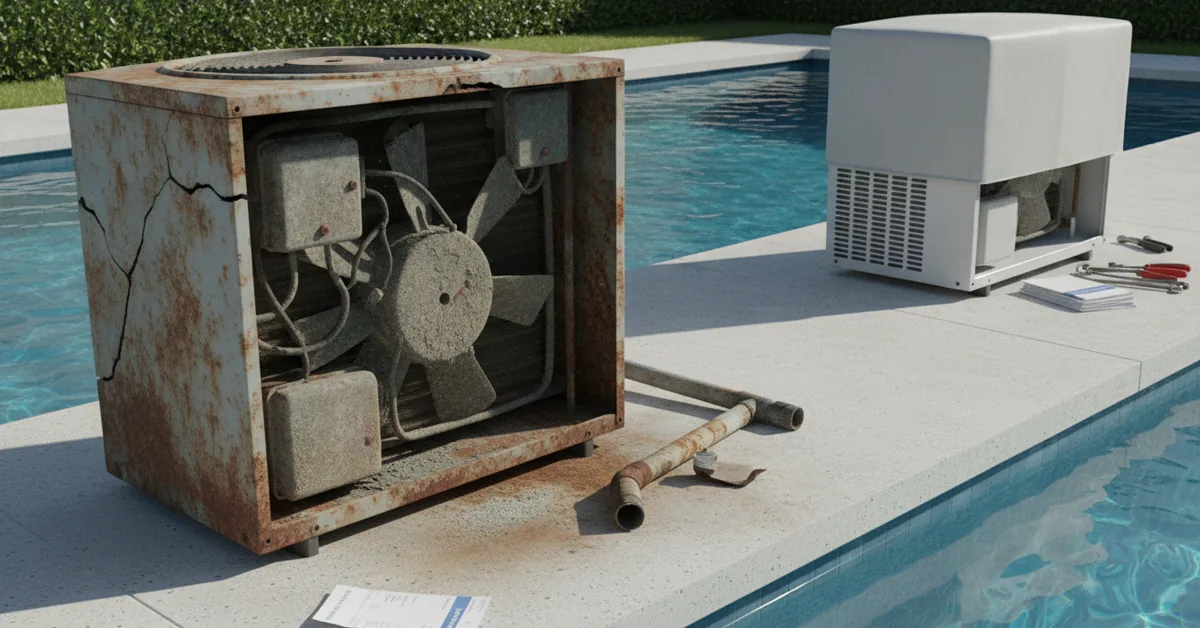
Why do so many pool builders assure homeowners that a heat pump with a titanium heat exchanger is completely indestructible against chemical damage? I hear this myth repeated on almost every service route I take over from frustrated homeowners who just received a $4,200 replacement quote on a unit that is barely four years old. While titanium is remarkably resilient against aggressive oxidation compared to old-school cupronickel or copper coils, treating it as bulletproof is one of the most expensive miscalculations you can make on your equipment pad.
Executive Summary: The True ROI of Preventive Heat Pump Management
Replacing a prematurely failed pool heat pump involves significantly more than the baseline sticker price of the new unit, encompassing plumbing re-configuration, electrical labor, and years of wasted operational energy. By transitioning from a reactive repair model to a structured maintenance protocol, pool owners can double the operating lifespan of their heating equipment while preventing severe secondary damage to the pool pad.
- Titanium heat exchangers suffer indirectly from unmanaged water chemistry, as extreme scale build-up creates thermal isolation that destroys the compressor through liquid refrigerant floodback.
- Airflow starvation and coil fouling force the refrigeration system to run at dangerously high head pressures, increasing amperage draw by up to 35% and drastically shortening motor winding life.
- Upstream chemical feeder placement without automated check valves allows concentrated acid or chlorine gas to back-siphon during pump shutdown, ruining internal sensors and unions.
- Structured preventive maintenance costs a fraction of emergency capital replacements, yielding a 10-year cumulative savings exceeding $6,000 for the average residential installation.
The Chemistry Trap: How Out-of-Balance LSI Destroys Heat Pumps From Within
When I walk up to a failing heat pump, the first tool I reach for isn't a multimeter or a set of refrigeration gauges; it's my liquid reagent test kit. Most pool owners assume that as long as their free chlorine is sitting between 2.0 and 4.0 PPM, their high-ticket heating equipment is safe. The reality is that your compressor doesn't care about chlorine; it cares about the Langelier Saturation Index (LSI).
When your water drops into an LSI-corrosive state (below -0.3), it actively seeks calcium. While the titanium tube itself won't dissolve like copper would, corrosive water attacks the surrounding components: the thermal well sensors, internal bypass valves, and rubber O-rings. Conversely, when your water is heavily scaling (LSI above +0.3), calcium carbonate precipitates directly onto the inner walls of the titanium tube. This layer acts as a thermal insulator. Because the heat cannot efficiently transfer into the pool water, the internal refrigerant pressure spikes. Over time, this chronic thermal stress causes the oil in the compressor to break down, resulting in mechanical seizure long before the manufacturer's expected 10-to-12-year mark. Keeping your pH between 7.4 and 7.6 and Calcium Hardness between 200 and 400 PPM isn't just about swimmer comfort—it's compressor life insurance.
Reactive vs. Proactive vs. Predictive Maintenance: A Financial Breakdown
Over 15 years servicing commercial and residential equipment pads, I have categorized pool owners into three distinct maintenance profiles. The financial gap between running an equipment pad into the ground versus managing it proactively is staggering once you account for labor, parts, and electrical efficiency losses.
| Maintenance Strategy | Annual Service Investment | Avg. Heat Pump Lifespan | 10-Year Repair & Replacement Cost | 10-Year Cumulative Expense |
|---|---|---|---|---|
| Reactive Run-to-Failure (Fix only when broken) | $0 | 3 to 5 Years | $9,000 - $11,000 (2x replacement units + emergency labor) | $11,500+ (Includes high energy drag) |
| Proactive Annual Maintenance (DIY or Tech spring tune-up) | $150 - $250 | 8 to 10 Years | $1,200 - $1,800 (1x fan motor or capacitor, 0 replacements) | $3,200 - $4,300 |
| Predictive System Optimization (VSP flow balancing + LSI monitoring) | $300 - $450 | 12 to 15 Years | $400 - $800 (Minor wear parts only) | $3,900 - $5,300 |
Trench Story: The $4,500 Salt Cell and Heat Pump Disaster
Two seasons ago, I took on a client in North Scottsdale who complained that his high-efficiency heat pump was throwing an "HP" (High Pressure) fault code every time his salt chlorine generator turned on. The unit was only three years old, but the compressor sounded like a coffee grinder full of marbles.
When I cut open the plumbing, the issue was immediately clear. The installer had plumbed an inline salt cell directly upstream of the heat pump output without installing a sacrificial check valve or a dedicated physical loop. Even worse, the variable speed pump was programmed to drop down to a low flow rate of 18 GPM (gallons per minute) while the heat pump required a minimum of 30 GPM to actuate its water pressure switch reliably. During periods of low flow, chlorine gas concentrated in the pipe and backed up directly into the heat pump housing. The localized concentration was so intense that it compromised the internal plastic water header, baked scale onto the pressure switch micro-diaphragm, and caused the unit to short-cycle 40 times a day. The homeowner had to spend $4,500 on a complete heat pump replacement and plumbing redesign—a disaster that a $45 Hastelloy-spring check valve and proper flow programming would have completely prevented.
Airflow Starvation and Electrical Stress: The Silent Mechanical Killers
A heat pump does not create heat; it extracts solar heat from the ambient air utilizing a fan motor, an evaporator coil, and R-410A refrigerant. When ambient air flow is restricted, efficiency plummets. I routinely see heat pumps crammed into tight equipment enclosures under low overhangs or choked out by unclipped bougainvillea bushes.
If your evaporator coil is choked with lawn clippings, dirt, or pine needles, the system cannot pull enough air across the aluminum fins. This drops the suction pressure, forcing the compressor to work twice as hard to extract the same BTUs. You end up paying 30% to 40% more on your monthly electric bill while baking the compressor motor windings. Furthermore, run capacitors degrade naturally over time due to heat exposure. Operating a heat pump with a weak capacitor forces the compressor to draw excessive starting amperage (Locked Rotor Amps), which eventually melts the electrical terminal connections right off the side of the compressor shell.
Your 5-Step Equipment Pad Audit: Spotting Heat Pump Stress Today
You don't need a mechanics license to spot early signs of heat pump failure. Walk out to your equipment pad today and run through these five critical checks:
- Inspect the Clearance Envelope: Ensure there is at least 24 inches of unobstructed clearance around the side evaporator coils and 6 to 8 feet of clear vertical space above the fan discharge grid.
- Audit the Water Pressure Switch: Turn your variable speed pump to its lowest daily filtration speed. If the heat pump continues to fire or rapidly clicks on and off, your pressure switch is improperly adjusted or scaled over, putting the unit at risk of dry-firing.
- Check the Condensate Runoff: A healthy heat pump produces substantial condensation. If the drain ports at the base are clogged with leaves, standing water will submerge the lower fan motor mounts and rust out the bottom structural frame.
- Examine the Chemical Feeder Placement: Verify that your salt cell, erosion chlorinator, or acid injection point is installed downstream of the heat pump. A corrosion-resistant check valve must be visibly present between the heater outlet and the chemical source.
- Measure the Temperature Differential (Delta T): Place an accurate thermometer in the water entering the heat pump and compare it to the water leaving the return jets. A healthy system typically operates at a 3°F to 5°F temperature rise. A reading higher than 7°F usually indicates dangerously restricted water flow.
Advanced Heat Pump Diagnostics and Operational FAQs
- How does running a variable speed pump at low RPMs affect heat pump efficiency (COP)?
- Operating at lower flow rates increases the residence time of water inside the heat exchanger, which actually increases the outlet water temperature slightly. However, if the flow drops below the manufacturer's minimum threshold (typically 25-30 GPM), the internal bypass valve cannot function correctly, driving up refrigerant pressure and drastically lowering the Coefficient of Performance (COP). You should program a dedicated high-flow speed curve during heating cycles.
- Will high Calcium Hardness void my heat pump manufacturer warranty?
- Yes. Virtually all major equipment manufacturers explicitly state in their warranty documentation that damage caused by scale buildup or chemical imbalance—specifically Calcium Hardness above 400 PPM or LSI values consistently outside the range of -0.2 to +0.2—is classified as environmental abuse and will void warranty coverage on both the titanium coil and compressor assembly.
- Why does my heat pump freeze up and ice over during early morning operation?
- Ice formation on the evaporator coils occurs when the ambient air temperature drops below approximately 45°F to 50°F and relative humidity is high. While modern units feature an automatic Defrost Cycle (or reverse-cycle hot gas defrost), persistent icing usually indicates either severe airflow restriction across dirty fins, a failing ambient air sensor, or a slow refrigerant leak within the sealed system.