

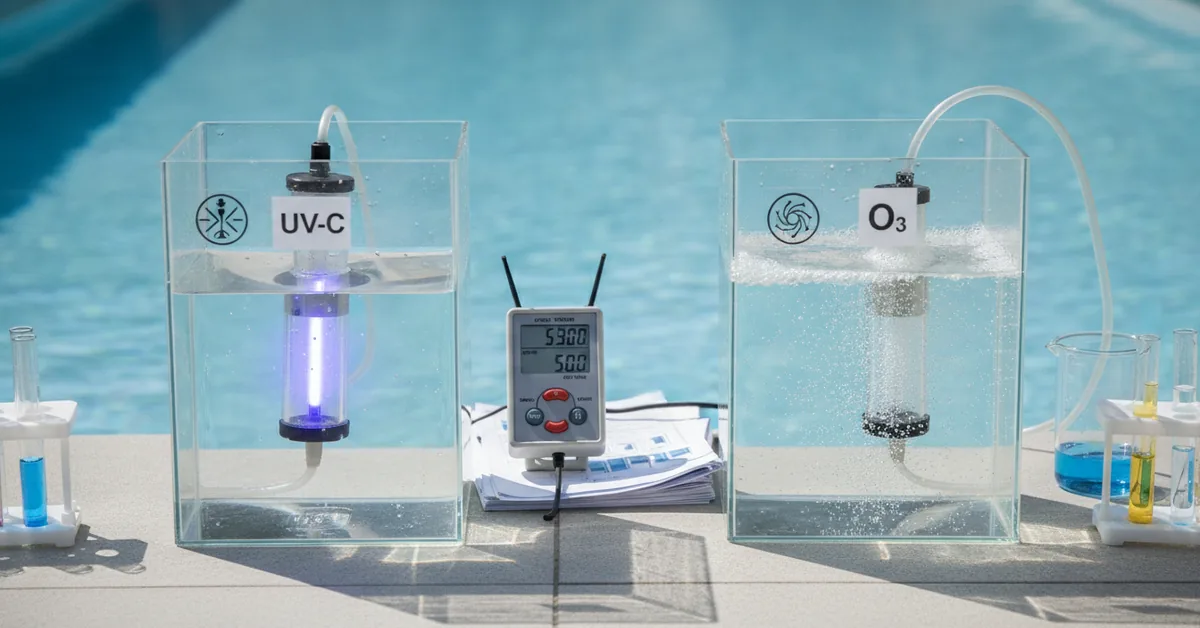
Installing a secondary sanitation system will not allow you to operate a chlorine-free residential pool, and treating ultraviolet irradiation and ozone gas as interchangeable technologies is the single fastest way to waste money on equipment pad upgrades. Over my fifteen years diagnosing circulating loops and equipment failures across hundreds of residential pads, I consistently see homeowners misled by sales pitches promising that light bulb tubes and gas injectors do identical jobs. They do not.
While both UV and Ozone reduce reliance on traditional shock treatments by targeting organic load and chloramines, their atomic mechanisms, physical delivery, and chemical oxidation capacities exist in entirely different tiers. Believing a UV light will destroy non-living bather waste at the same rate as an ozone system usually leads to premature equipment failure, persistent combined chlorine spikes, and cloudy water during peak summer heat.
Executive Summary: The Technical Reality of UV vs. Ozone
Ultraviolet (UV) systems act strictly as point-of-contact sterilizers that destroy pathogen DNA as water passes through a chamber, offering zero residual sanitation and zero chemical oxidation power in the main pool body. Ozone (O3) systems function as high-potency oxidizers and sanitizers dissolved directly into the plumbing loop, actively burning off organic waste, breaking down complex chloramines, and elevating Oxidation-Reduction Potential (ORP).
- UV Systems: Superior for inactivating chlorine-resistant pathogens like Cryptosporidium at the chamber, but incapable of oxidizing non-biological organic debris in the pool.
- Ozone Systems: Unmatched micro-flocculation and direct chemical oxidation of bather waste, drastically lowering sanitization load across the entire vessel.
- Chemical Residual Requirement: Neither technology eliminates the need for an EPA-registered primary sanitizer; a baseline of 1.0 to 3.0 PPM Free Chlorine remains mandatory.
- Maintenance Footprint: UV relies on quartz sleeve cleaning and annual lamp output degradation; Ozone relies on check-valve integrity, CD chip cleaning, and proper venturi dynamic pressure management.
Mechanism of Action: Why Photolysis and Gas Oxidation Are Not Equal
To understand why these systems are not equal, you must look at what happens inside the pipe versus what happens inside the water molecule. A standard medium-pressure or low-pressure UV system exposes circulating water to UV-C radiation targeted at a specific wavelength of 254 nanometers. As pathogens cross this light field, the light alters their cellular DNA and RNA, rendering them micro-biologically sterile. However, the instant that water exits the stainless steel or plastic UV housing, the reaction stops. UV-C light adds zero residual sanitizer to the water and possesses zero capability to consume non-living organic compounds like perspiration, lotion, or oils that accumulate on the water surface.
Ozone operates through chemical combustion at a molecular level. Whether generated via Corona Discharge (CD) or high-intensity UV-Ozone lamps, oxygen atoms (O2) are split and reformed into ozone gas (O3). When injected into the return line via a differential venturi injector, this unstable molecule seeks out organic contaminants and surrenders its third oxygen atom. This reaction physically burns up non-living organic waste and converts combined chloramines back into harmless nitrogen gas and free chloride ions. Ozone is a true chemical oxidizer that raises water clarity through micro-flocculation, clumping microscopic suspended solids together so your filter media can capture them efficiently.
Field Analysis: A $4,000 Upgraded Pad That Still Smelled Like Combined Chlorine
Last season, I was called out to diagnose a 32,000-gallon plaster pool equipped with a salt chlorine generator, a variable speed pump, and a high-end low-pressure UV sterilizer. The owner could not understand why his pool continuously smelled strongly of chloramines, caused eye burn in his children, and suffered from chronic fine particulate haze despite running his pump 18 hours a day. He was convinced his UV system was defective because the manufacturer claimed it eliminated combined chlorine.
When I inspected the pad, I pulled out my FAS-DPD drop test kit. His Free Chlorine was sitting at 0.5 PPM, but his Combined Chlorine (CC) was a staggering 1.2 PPM. The issue was dynamic flow volume and organic loading. His family of six used the pool daily during 95-degree summer weeks. The heavy bather load introduced high levels of urea and skin lipids. While the UV system was successfully sterilizing bacteria moving through the chamber, the sheer volume of organic precursors residing inside the pool vessel was far outstripping the UV's localized photolysis capacity. The light could not oxidize the waste holding the chloramines together out in the deep end.
We retrofitted the pad by replacing the single-action UV chamber with a Corona Discharge Ozone generator linked to a vacuum-break contact vessel and degassing column. Within 72 hours of injecting dissolved O3 into the manifold, the Combined Chlorine dropped to 0.0 PPM, the ORP reading jumped from 610 mV to 745 mV, and the water achieved a brilliant diamond clarity that light photolysis alone could never deliver.
| Technical Parameter | Ultraviolet (UV) Systems | Ozone (O3) Systems |
|---|---|---|
| Primary Sanitation Mode | Point-of-contact UV-C Light (254 nm) | Dissolved Gas Oxidation & Disinfection |
| Oxidation Capacity | None (Inactivates pathogens, does not burn waste) | Extremely High (Oxidizes organics and chloramines) |
| Pathogen Destruction Rate | High inside chamber; Zero in main pool body | High in contact vessel; Partial short-term residual |
| Effect on Combined Chlorine | Breaks down monochloramines inside tube only | Rapidly destroys mono-, di-, and trichloramines |
| Impact on Water Clarity | Indirect (Prevents algae proliferation) | Direct (Micro-flocculates microscopic particles) |
| Typical Maintenance Requirement | Clean quartz sleeve (6 mos); Replace lamp (12 mos) | Clean CD cell (12 mos); Replace check valves (12 mos) |
| Average Capital Equipment Cost | $800 - $1,800 | $1,500 - $3,800
Hydraulic Realities: Flow Rates, Contact Time, and Vessel Placement
A major flaw in modern pool pad designs is the failure to adjust hydraulic flow rates to match the mechanical limits of secondary sanitizers. UV sterilizers are bound by the law of radiation dosage, measured in microwatt-seconds per square centimeter. If you ramp up your variable speed pump to 80 Gallons Per Minute (GPM) during a high-speed filtration cycle, but your UV tube is only rated for 45 GPM optimal kill dosage, the water passes through the chamber too quickly. Excessive flow velocity reduces UV dwell time, leaving pathogens active and passing right back into your pool inlets.
Ozone systems depend entirely on differential pressure and contact time. For an ozone system to operate efficiently without off-gassing hazardous O3 gas above the deck surface, it must draw gas through a venturi injector creating a strict vacuum. This gas-water slurry must then enter a designated contact vessel where the ozone can dissolve into solution before passing through an activated carbon degas column. If your installer piped an ozone unit straight into a PVC pipe tee without a dynamic injector loop or ambient off-gas vessel, the gas simply bubbles out of the return jets, stripping oxygen out of solution, bubbling past your skimmer, and wasting virtually all of its oxidation potential.
The Equipment Pad Audit: What to Verify on Your System Today
- Inspect the system sight glass or LED status panel on your secondary unit while the primary pump is running at daily filtration speed to verify electrical discharge or lamp ignition.
- Perform a differential pressure check across your filter gauge; high backpressure restricts venturi vacuum suction on ozone injectors and reduces throughput dosage on UV vessels.
- Measure both Free Chlorine and Total Chlorine using a FAS-DPD titrimetric drop kit to calculate exact Combined Chlorine (Total Chlorine minus Free Chlorine).
- Check the age of your consumables: UV bulbs lose up to 40% of their effective UV-C output after 9,000 operational hours, even if they still emit visible blue light.
- Examine all ozone check valves for white salt-like calcification or cracking, which indicates ozone gas back-feeding into water lines and destroying internal diaphragms.
Advanced Technical Troubleshooting: UV and Ozone Systems
- How does high Cyanuric Acid (CYA) or high Total Dissolved Solids (TDS) impact UV light transmission compared to Ozone gas injection?
- High TDS and elevated cyanuric acid levels create significant turbidity and optical absorption in water, which scatters UV-C light waves within the reaction chamber. This phenomenon, known as low UV Transmittance (UVT), drastically reduces the microjoule dosage hitting pathogens. Ozone, conversely, acts as a gaseous chemical reactant injected directly into solution; its oxidative potential is entirely unaffected by water clarity or high CYA levels, making it far superior in hard or heavily buffered water.
- Will an ozone off-gas leak cause structural damage to automatic pool covers or surrounding equipment pad plumbing?
- Yes. Free ozone gas off-gassing under a closed automatic pool cover creates a highly concentrated oxidative atmosphere that aggressively rots vinyl fabric, degrades cover mechanism ropes, and corrodes stainless steel hardware. To prevent this, ozone systems must always feature a mechanical degassing chamber with an activated carbon matrix that converts residual O3 gas back into standard O2 before the water returns to the pool vessel.
- Can I pair an Advanced Oxidation Process (AOP) system with a salt chlorine generator, and how does it affect salt cell life?
- Pairing AOP—which combines UV and Ozone to create ultra-reactive Hydroxyl Radicals—with a Salt Chlorine Generator (SWCG) is one of the most efficient setups possible. Because the hydroxyl radicals destroy organic loads instantly in the return plumbing, the demand on your salt cell drops by up to 70%. This allows you to run your electrolytic cell at 20% output instead of 80%, extending cell plate lifespan from 3 years to up to 7 years while keeping overall chemical variance stable.