

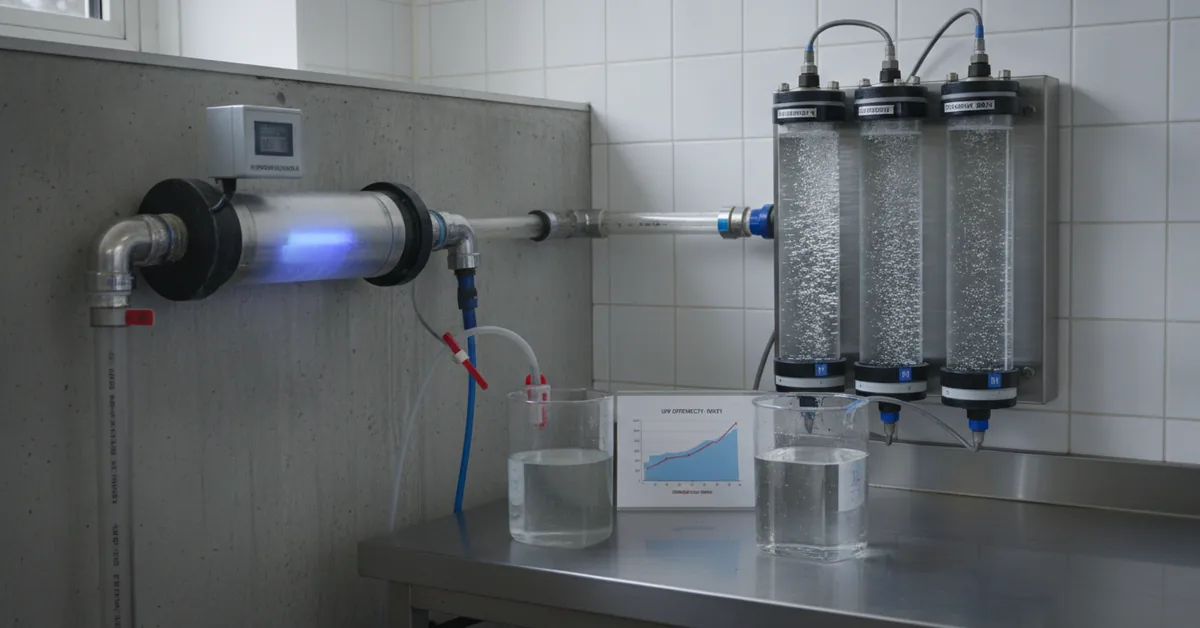
Installing a $10,000 commercial UV system to eliminate severe chloramine odor in a high-traffic indoor aquatic facility is often a costly mistake that fails to address organic loading. Most pool operators, property managers, and high-end residential owners treat Ultraviolet (UV) light and Ozone systems as identical plug-and-play secondary sanitizers. While both technologies reduce pathogen load, UV is strictly a localized disinfectant with zero oxidation capacity, leaving sweat, urea, and organic precursor molecules completely intact in the water column.
Executive Summary: The Technical Reality of Secondary Sanitization
The widespread belief that UV and Ozone deliver equal efficiency in commercial pool water treatment stems from misinterpreting disinfection versus oxidation. While both lower reliance on primary halogen sanitizers, their chemical pathways, site-of-action mechanics, and operational overhead differ fundamentally.
- UV systems disinfect solely inside the reactor chamber, inactivating microorganisms through DNA disruption without destroying the organic waste loading the water.
- Ozone acts as a direct, potent oxidizer, burning up bather waste, urea, and chloramines throughout the hydraulic circuit before reversion to oxygen.
- Medium-pressure UV photolyzes chloramines effectively but requires high electrical draw and frequent quartz sleeve descaling in hard water environments.
- Corona discharge ozone dramatically boosts Oxidation-Reduction Potential (ORP) and acts as a micro-flocculant, enhancing filter efficiency beyond UV capacity.
Disinfection vs. Oxidation: Deconstructing the Science at the Pipe
To understand why these systems are not interchangeable, you have to look at what happens at the molecular level inside your mechanical room. Disinfection means rendering a pathogen (like Cryptosporidium parvum or Giardia) harmless by destroying its cellular structure or disrupting its reproductive DNA. Oxidation, on the other hand, means chemically burning up organic contaminants—sweat, cosmetics, nitrogenous compounds, and dead cellular material—converting them into gases like carbon dioxide and nitrogen that off-gas naturally.
Low-pressure UV lamps emit a monochromatic light wave at 254 nanometers. As water passes through the reactor vessel, this light penetrates the cell walls of bacteria and viruses, forming thymine dimers in their DNA so they cannot replicate. However, the water exiting that UV chamber contains the exact same amount of dissolved organic carbon (DOC) that entered it. UV light adds zero oxidative energy to the pool, meaning your free chlorine baseline still has to do 100% of the heavy lifting to oxidize bather waste. If your pool suffers from heavy organic loading, UV will not prevent the build-up of precursor molecules that form chloramines once water returns to the basin.
Ozone ($O_3$) operates on a completely different chemical plane. Generated via high-voltage corona discharge, ozone is injected into a dedicated contact tank where it directly attacks double bonds in organic molecules. It oxidizes chloramines instantly and breaks down urea—the primary organic nitrogen component in human sweat and urine that causes skin irritation and distinct pool odor. Ozone boasts an oxidation potential of 2.07 electron volts, vastly outperforming standard hypochlorous acid (1.36 eV) and UV radiation. When ozone reacts with organic compounds, it leaves behind pure dissolved oxygen ($O_2$), naturally raising the pool's Oxidation-Reduction Potential (ORP) to optimal targets above 750 mV.
Field Case Study: Why a $15,000 UV Upgrade Failed at a Commercial Resort Pool
A few seasons back, I was called to troubleshoot a 90,000-gallon indoor commercial pool at a high-end resort in Texas. The facility manager was dealing with constant guest complaints about burning eyes and a suffocating chemical smell in the enclosure. Their combined chlorine levels were consistently hovering between 0.8 PPM and 1.2 PPM, well above the state maximum of 0.2 PPM. To fix the issue, their previous contractor had sold them a massive low-pressure UV system installed right after the sand filters.
Six months after installation, the chloramine smell remained intolerable. When I inspected the equipment pad, the issue was glaringly obvious. The facility ran heavy swim-team sessions every morning followed by hotel guest traffic all afternoon. The low-pressure UV unit was successfully inactivating free-floating bacteria, but it could not keep up with the massive load of urea and body oils deposited daily. Because low-pressure UV at 254 nm only breaks down monochloramine efficiently—and requires significantly higher dosage wavelengths to break down dichloramines and trichloramines—the system was completely overwhelmed.
The quartz sleeve inside the UV chamber was also coated in a thick layer of calcium scale, blocking over 60% of the ultraviolet transmittance (%UVT). Because their calcium hardness sat at 450 PPM and water temperature was kept at 84°F, heat from the UV lamps accelerated calcium precipitation directly onto the glass sleeve. The system was running blind.
We retrofitted the pad with a Corona Discharge (CD) Ozone system complete with a side-stream injection pump, a 4-minute contact vessel, and an active carbon off-gas destructor. We also added an automated acid-wash loop for quartz maintenance. Within 72 hours of commissioning the ozone loop, combined chlorine plummeted to a rock-solid 0.1 PPM, water clarity went from slightly hazy to crystal clear with a turbidity reading below 0.15 NTU, and the ambient chloramine smell in the indoor air enclosure vanished entirely.
Direct Comparative Analysis: UV vs. Ozone vs. Advanced Oxidation Processes (AOP)
Choosing between these technologies requires evaluating hydraulic flow, maintenance capacity, safety protocols, and life-cycle costs. Below is a comparative breakdown based on field performance data across commercial and high-end residential upgrades.
| Feature / Parameter | Low/Medium Pressure UV | Corona Discharge Ozone | Hydroxyl-Based AOP |
|---|---|---|---|
| Primary Function | In-line Disinfection (DNA Inactivation) | Oxidation & Secondary Disinfection | Synergistic Hydroxyl Oxidation & Disinfection |
| Oxidation Capacity | None (Zero chemical oxidation) | Very High (2.07 eV Potential) | Extreme (2.80 eV Hydroxyl Radicals) |
| Effect on Combined Chlorine | Moderate (Photolyzes monochloramines only) | Exceptional (Destroys mono-, di-, & trichloramines) | Maximum (Instant destruction of organic precursors) |
| Impact on Water Clarity | None (Relies entirely on mechanical filtration) | High (Acts as a natural micro-flocculant) | High (Pulls micro-particulates into filter beds) |
| Required Safety Hardware | Flow switches, temperature sensor shutdown | Degas vessel, ozone destructor, ambient air monitor | Side-stream venturi, ambient off-gas mitigation |
| Maintenance Intensity | Quartz sleeve wiping & annual lamp replacement | Air dryer desiccant/concentrator maintenance & injector checks | Annual UV lamp replacement & injector check |
While standard UV systems feature a smaller physical footprint and lower initial capital cost, their operational efficiency drops drastically if your water chemistry shifts out of balance or if organic bather waste spikes. Ozone provides true water conditioning alongside pathogen kill, drastically lowering the burden on your primary chlorine feed pumps and reducing overall cyanuric acid degradation rates in outdoor settings.
Step-by-Step Equipment Pad Inspection Protocol
If you operate a commercial pool or a heavily used residential system with secondary sanitization, walk out to your equipment pad today and run through this physical diagnostic protocol to ensure your system is operating at peak efficiency:
- Check the UV Transmittance (%UVT) or Sleeve Clarity: Isolate power to the unit, remove the lamp assembly, and inspect the quartz sleeve. If you see a cloudy film or white calcium deposits, clean the sleeve immediately using a mild muriatic acid solution (10:1 ratio) or specialized scale remover.
- Verify Hydraulic Flow Rates and Differential Pressure: Ensure the flow switch is functional and water velocity through the reactor aligns with the manufacturer's target contact time. Low flow can overheat UV chambers and trigger thermal cutoffs; high flow reduces contact time below lethal pathogen dosages.
- Inspect the Venturi Injector Vacuum (Ozone Systems): Locate the Mazzei injector on the ozone side-stream loop. Use a vacuum gauge to verify that the injector is pulling a strong draft (typically 10 to 15 inches of Mercury). A loss of vacuum indicates a clogged injector port or a failing side-stream booster pump.
- Audit the Ambient Air Preparation Unit: For Corona Discharge ozone units, check the desiccant air dryer or oxygen concentrator feed. If nitrogen compounds enter the corona cell due to moist air feed, the system will produce nitric acid, corroding internal stainless steel lines and rapidly destroying the ozone generator cells.
- Test Water Baseline Parameters: Pull a water sample directly from the pool return before it enters the secondary treatment loop. Ensure free chlorine is at 1.0–3.0 PPM, pH is locked between 7.2 and 7.6, Total Alkalinity is 80–120 PPM, and Calcium Hardness stays strictly under 400 PPM to prevent rapid sleeve scale formation.
Advanced Technical FAQs for Commercial System Upgrades
- How does UV quartz sleeve fouling from calcium hardness impact disinfection dosage, and how is it corrected?
- Calcium carbonate scale builds up on quartz sleeves because UV lamps radiate heat directly into the water layer surrounding the glass. As local water temperature increases right at the sleeve surface, calcium solubility drops, causing mineral precipitation. A scale layer as thin as 1 millimeter can block up to 70% of UV-C light transmittance, dropping your lethal dosage below the 40 mJ/cm² required to kill Cryptosporidium. Correction requires either installing an automated mechanical wiper assembly on the reactor vessel or scheduling quarterly manual acid washes during low-traffic maintenance windows.
- Why does Corona Discharge ozone require a dedicated ambient air dryer or oxygen concentrator, and what happens if dry air isn't supplied?
- Corona discharge units generate ozone by passing dry gas through a high-voltage electrical field (7,000 to 15,000 volts). If ambient air containing moisture enters this electrical arc, the hydrogen and nitrogen molecules react with oxygen to form nitric acid vapor ($HNO_3$). Nitric acid rapidly corrodes the dielectric tubes, destroys rubber check valves, and clogs the Mazzei injection orifice with white ammonium nitrate salt deposits. Utilizing an oxygen concentrator supplies 93% pure dry oxygen with a dew point below -60°F, increasing ozone yield by up to 400% while completely eliminating acid formation.
- Can high-output ozone systems cause off-gassing issues that damage pool room HVAC ductwork or deck hardware?
- Yes, if an ozone system is installed improperly without a degassing chamber and an active off-gas ozone destructor, excess un-dissolved ozone gas will bubble out of the floor inlets and rise into the pool enclosure. Ozone is highly corrosive to stainless steel deck rails, aluminum light fixtures, and galvanised steel HVAC ductwork, accelerating metal oxidation at extreme rates. A properly engineered side-stream ozone loop passes water through a separator tank that strips out un-dissolved gas bubbles, venting them through a catalytic manganese dioxide or heated destruction unit that instantly converts excess $O_3$ back into safe $O_2$ before water returns to the basin.