

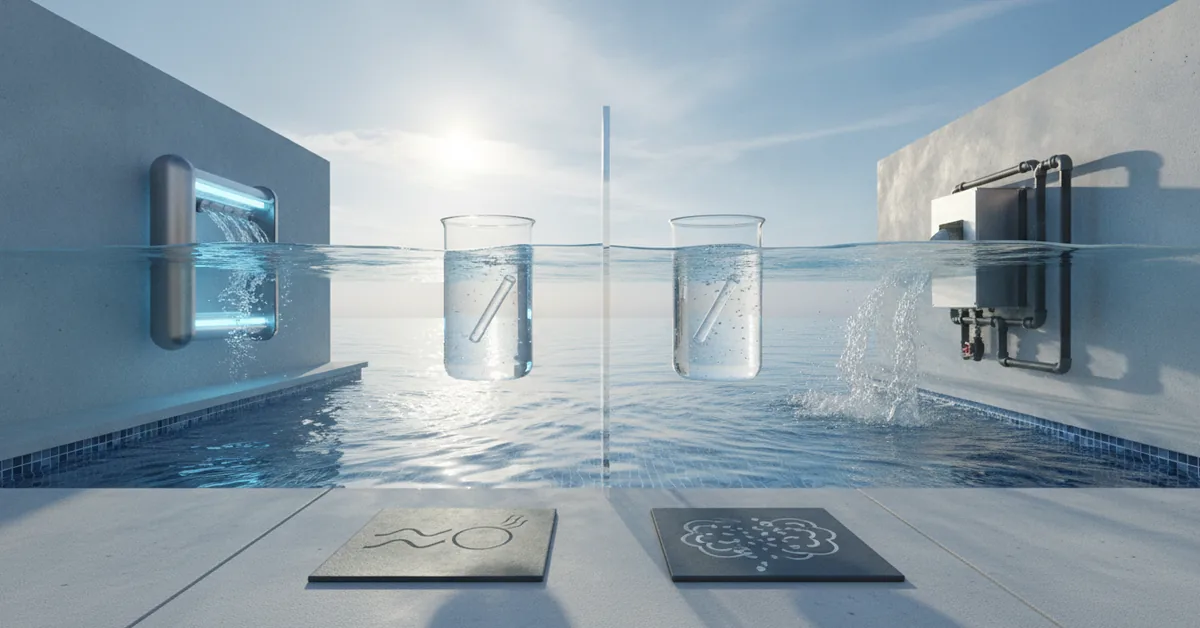
Believing that ultraviolet (UV) systems and ozone generators perform the exact same job simply because pool equipment manufacturers market them as alternative sanitizers is the single most expensive misconception I clear up on equipment pads. On paper, both technologies are sold as magic bullets designed to minimize your dependence on traditional chlorine. In reality, assuming a UV tube and an ozone injector deliver equal sanitation efficiency is like confusing an exhaust fan with an air scrubber. Over my 15 years servicing residential and commercial vessels, I have replaced dozens of burnt-out UV chambers that failed to stop aggressive green algae blooms, purely because the homeowner was misinformed about what UV light can and cannot do compared to dissolved ozone gas.
Executive Summary: Dissecting Secondary Sanitizer Realities
While both systems serve as supplemental sanitizers that reduce combined chlorine (chloramines), their core mechanics operate on entirely different biochemical planes. UV relies on local light radiation to sterilize pathogens passing through a chamber, whereas Ozone introduces a volatile, highly reactive dissolved gas into the circulation pipe to oxidize organic waste and destroy pathogens directly.
- UV Systems: Provide point-of-contact sterilization with zero chemical residual and zero oxidation capacity for non-living organic compounds like sunscreen and sweat.
- Ozone Systems: Generate a powerful chemical oxidizer (O3) capable of destroying both biological pathogens and non-biological contaminants, but require careful off-gas management.
- Hydraulic Dependence: UV sanitation drops to zero if water flow velocity exceeds maximum exposure thresholds or if quartz sleeves become scaled with calcium hardness.
- Chemical Baseline: Neither technology eliminates the statutory need for a persistent primary sanitizer like free chlorine maintained at 1.0 to 3.0 PPM in the open pool vessel.
UV Sanitization: Light-Speed Sterilization with Zero Residual Footprint
To understand ultraviolet pool sanitizers, you have to look closely at germicidal UV-C light calibrated precisely to a 254-nanometer wavelength. As water passes through the vessel on your pad, this radiation penetrates the cell walls of bacteria, viruses, and protozoa, disrupting their DNA and rendering them sterile. When I open up a UV chamber during an annual service, I am looking at a physical contact zone. UV is purely a local sterilizer, not an oxidizer. That means if a leaf falls into your skimmer or a swimmer leaks sweat into the water, UV light does absolutely nothing to break down that non-biological waste until it physically travels through the pipe and hits the lamp chamber.
The primary point of failure I observe in the field is hydraulic bypass caused by variable speed pumps running at high GPM settings. Flow rate dictates contact time; over-pumping renders UV completely useless. If your pump pushes 80 gallons per minute through a UV chamber engineered for a maximum of 45 GPM, the micro-organisms zip past the light too quickly to receive a lethal dose of UV-C radiation. Furthermore, if your calcium hardness exceeds 400 PPM and your Langelier Saturation Index (LSI) creeps positive, a microscopic layer of scale coats the quartz sleeve. That single layer of calcium acts like a blindfold over the UV bulb, dropping your pathogen kill rate down to zero without triggering an alarm on the control panel.
Ozone (O3) Systems: Powerful Oxidation with Chemical Gas Injection
Ozone operates on an entirely different chemistry scale. Instead of waiting for water to pass by a lamp, a Corona Discharge (CD) ozone system creates O3 gas by splitting oxygen molecules with a high-voltage electrical arc. This gas is sucked into your plumbing via a venturi injector, creating micro-bubbles that dissolve into the water stream. Ozone carries an oxidation potential of 2.07 volts, making it far more aggressive than free chlorine (1.36 volts) or hydrogen peroxide. Ozone is an aggressive oxidizer that destroys non-living organic load. It attacks grease, body oils, and urea long before those compounds can bind with chlorine to form irritating chloramines.
However, ozone gas is extremely volatile and highly toxic to breathe. Because of this, an ozone setup requires a dedicated contact vessel and an off-gas degas column to strip excess ozone bubbles out of the water before it returns to the pool through the return jets. On service calls where homeowners complain about faded pool plaster or warped vinyl liners near the returns, it is almost always caused by an improperly plumbed ozone system venting raw O3 straight into the vessel. Improperly installed ozone off-gassing will destroy pool covers and vinyl liners. When installed correctly with a carbon destruct unit, ozone leaves water incredibly clear and dramatically lowers the overall oxidation workload on your primary chlorine pool sanitizer.
Field Case Study: The $3,500 High-Flow UV Miscalculation
Two summers ago, I was brought in to consult on a 32,000-gallon plaster pool in Austin, Texas. The homeowner had installed a premium UV system six months prior, expecting it to cure his constant battle with cloudy water and high chloramine levels (combined chlorine sitting consistently around 0.8 PPM). He had spent over $2,500 on the equipment and installation, yet his pool was still turning pale green every time his family hosted a weekend barbecue.
When I inspected the equipment pad, the issue was immediately obvious. He had a 3-horsepower variable speed pump ramping up to 3,450 RPM during filtration cycles to power his in-floor cleaning head, pushing nearly 95 GPM through a UV unit rated for a maximum flow of 50 GPM. On top of that, his water chemistry showed total hardness at 550 PPM and a quartz sleeve so fouled with white calcium scale that it looked like frosted glass. Contact time and flow rate sizing dictate success on the pad. The UV light was literally doing nothing to sterilize the water, and because UV has zero oxidation capacity, the heavy bather load from his parties was overwhelming his 1.5 PPM chlorine residual.
We completely redesigned his setup. I removed the undersized UV system and installed a commercial-grade Corona Discharge Ozone generator equipped with a venturi injection manifold, a reaction tank, and a thermal off-gas destructor. We regulated his bypass loop to guarantee ideal gas mass transfer regardless of pump speed. Within 72 hours of commissioning the ozone unit, his combined chlorine plummeted to 0.0 PPM, his water achieved brilliant optical clarity, and his weekly chlorine consumption dropped by nearly 60 percent. Combining sanitation strategies requires matching real hydraulic turnover.
Technical Benchmarking: UV vs. Ozone Performance Metrics
To help you evaluate these options objectively, I have mapped out their technical specifications based on real field performance, installation requirements, and chemical efficiency.
| Performance Metric | Ultraviolet (UV-C) Systems | Ozone (Corona Discharge) Systems |
|---|---|---|
| Primary Action Mechanism | Physical cell DNA sterilization via light spectrum | Chemical oxidation and lysis via dissolved O3 gas |
| Oxidation Capacity | None (Requires Advanced Oxidation Process upgrades) | Extremely High (2.07 Volts oxidation potential) |
| Cryptosporidium Inactivation | Extremely High (99.9% at correct radiation dose) | High (Requires adequate contact time in vessel) |
| Sensitivity to Water Turbidity | High (High NTU or cloudiness blocks light transmission) | Low (Gas dissolves and reacts regardless of clarity) |
| Impact of High Pump GPM | Severe (High flow reduces lethal contact time) | Low (Venturi draft accommodates variable flows) |
| Consumable Replacement Cost | $150 - $350 every 9,000 to 12,000 run hours (Lamp) | $200 - $450 every 3 to 5 years (CD Cell / Chip) |
| Risk to Pool Components | Low (Internal vessel containment) | Medium-High (Off-gas can damage covers/piping if unmanaged) |
Ozone excels at non-biological oxidation, while UV shines at instantaneous targeted pathogen sterilization. Choosing between them depends entirely on your specific pool parameters, such as whether your primary struggle is swimmer waste buildup or resistant pathogen control. Neither system eliminates the statutory requirement for a persistent free chlorine residual.
Actionable Diagnostic: Step-by-Step Pad Inspection Checklist
If you currently have a secondary sanitizer installed or are planning an upgrade, walk out to your pool pad today and execute this tactical diagnostic routine:
- Calculate Your Hydraulic Flow Velocity: Check your pump's current GPM output against the maximum rated flow stamped on your UV or Ozone reaction chamber. If your GPM exceeds the rating, throttle back your variable speed pump speed or install a plumbed bypass loop.
- Inspect the Quartz Sleeve (UV Systems): Power down the system, isolate the water valves, and pull out the quartz sleeve. A scaled quartz sleeve acts like a light shield, reducing UV dosage to zero. Clean off any white calcium deposits using a mild acid solution or specialized sleeve cleaner.
- Check the Ozone Injector Check Valve: Look closely at the clear vinyl tubing running from your ozone generator down to the venturi injector. If you see water backed up into that tube, your check valve has failed. Check valve failure on an ozone line allows chlorinated water into the electronics. Replace this valve annually without exception.
- Test Combined Chlorine (CC): Use a FAS-DPD titrating drop test kit to measure your free chlorine versus total chlorine. If your combined chlorine exceeds 0.2 PPM while your secondary sanitizer is active, your system is underperforming or improperly sized for your swimmer load.
- Verify Air Draw (Ozone Systems): Hold a small vacuum gauge or air flow meter up to the ozone generator's air intake port while the pump is running to confirm that the venturi injector is pulling sufficient vacuum.
Advanced Field FAQs: Deep Equipment Diagnostics
- How does water turbidity (NTU) and cyanuric acid (CYA) specifically degrade UV-C dosage efficiency compared to Ozone?
- Water turbidity, measured in Nephelometric Turbidity Units (NTU), introduces suspended microscopic solids that scatter and absorb UV light rays before they can strike micro-organisms. This phenomenon, known as shadowing, directly reduces the UV microwatt-seconds per square centimeter delivered to the water. High cyanuric acid levels do not directly block UV light, but high CYA creates sluggish chlorine kinetics, forcing the UV system to handle a much heavier biological load. Ozone, conversely, is entirely immune to light scattering; as a dissolved gas, O3 oxidizes suspended organic particles regardless of water clarity, actually helping to clarify the water by acting as a micro-flocculent.
- Can high-concentration ozone gas damage titanium heat exchangers in high-efficiency gas pool heaters?
- Yes, off-gassing or undissolved ozone injected upstream of heating equipment will rapidly destroy metallic components. While titanium is highly resistant to standard chemical corrosion, exposure to concentrated, gaseous ozone causes severe surface oxidation, stress-corrosion cracking, and localized pitting inside the heat exchanger manifold over time. To prevent catastrophic heater failure, the ozone injection manifold must always be installed downstream of all heaters, salt chlorine generator cells, and valves, utilizing a dedicated contact column with a carbon off-gas destructor to ensure no raw gas enters critical pad hardware.
- Why does an Advanced Oxidation Process (AOP) system bridge the efficiency gap between standalone UV and Ozone?
- Advanced Oxidation Process (AOP) technology combines UV radiation and Ozone gas within a single system (or combines Ozone with Hydrogen Peroxide). When ozone gas passes through an intense germicidal UV light chamber, a chemical reaction occurs that instantly creates Hydroxyl Radicals (.OH). Hydroxyl radicals are the single most powerful oxidation agents available in water treatment, featuring an oxidation potential of 2.80 volts. They react instantly with contaminants, destroying organic waste and inactivating pathogens in milliseconds, before breaking down cleanly back into oxygen, effectively eliminating the operational weaknesses of standalone UV and Ozone units.