

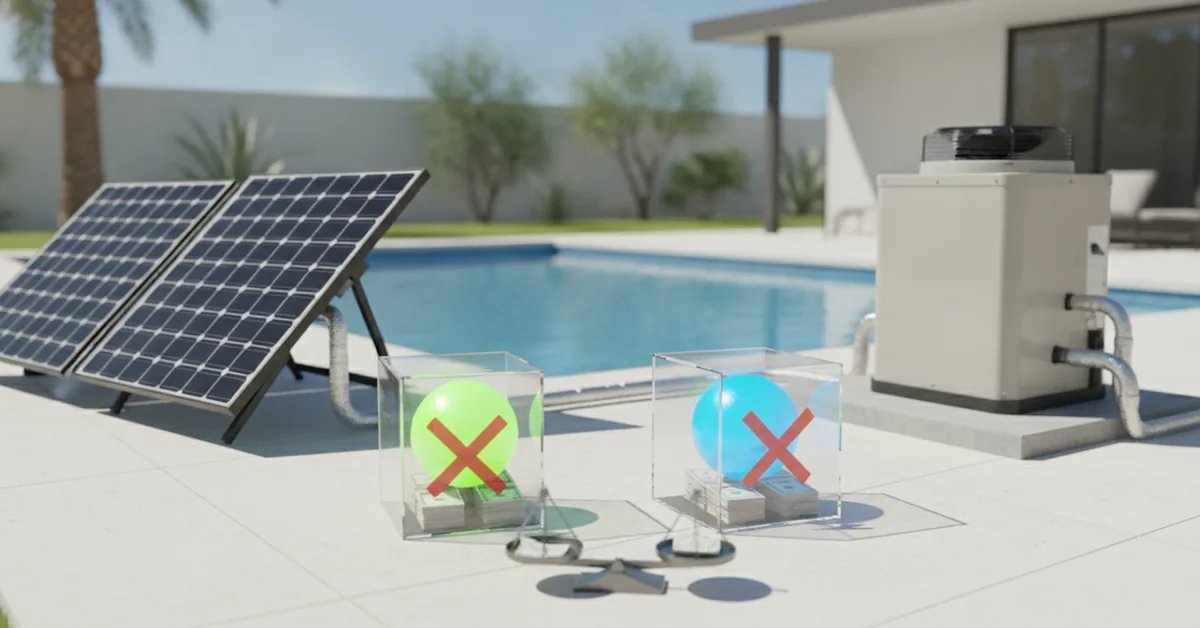
In sun-drenched states like Florida, Arizona, and Texas, believing that solar pool heating provides completely free energy is one of the most widespread and expensive misnomers in residential pool ownership. For over fifteen years on the service trail, I have watched well-meaning homeowners spend thousands of dollars mounting black polypropylene panels across their roofs, only to see their electric bills remain stubbornly high. While solar radiation itself costs nothing, harvesting that heat requires continuous, high-volume hydraulic pressure that completely destroys the efficiency of modern variable-speed pumps. In warm climates, an high-efficiency inverter heat pump running at low flow rates often costs significantly less to operate overall than forcing a filtration pump to push fifty gallons per minute up to a second-story roof.
Executive Briefing: The Thermodynamic and Financial Reality of Warm-Climate Heating
Evaluating pool heating efficiency requires looking beyond the primary energy source to analyze total system hydraulic
Evaluating pool heating efficiency requires looking beyond the primary energy source to analyze total system hydraulic power draw and operational control. While solar heating relies on free sun rays, its extreme head-loss demands often void the energy savings promised by variable-speed filtration pumps.
Below are the core findings established across hundreds of pad upgrades and seasonal diagnostic audits in warm region pools:
- Hydraulic Load Spike: Solar collectors require high pump RPMs to overcome vertical head pressure, consuming up to 2.5 kW per hour in pure pump electricity.
- Thermal Consistency Deficit: Electric heat pumps extract ambient thermal energy regardless of direct sunlight, ensuring reliable water temperatures during cloudy shoulder-season days.
- Variable Speed Synergy: Inverter heat pumps operate effectively at minimal flow rates (25–30 GPM), allowing your main pump to run quietly at low wattage.
- Structural Risk Factors: Solar thermal installations introduce dozens of roof penetrations and high-pressure vacuum relief valves that frequently fail, risking structural leaks.
The Hydraulic Trap: Why Solar Heating Destroys Variable Speed Pump Efficiency
To understand why solar pool heaters are rarely the most efficient choice in warm climates, you have to look at the hydraulics behind the pad. Modern variable-speed pumps save money by running at very low speeds—say, 1,200 to 1,500 RPM—where electric consumption drops to under 200 Watts. However, solar panels require massive fluid pressure to purge air pockets, open the solar 3-way valve, and push hundreds of pounds of water fifteen to twenty-five feet in the air to overcome vertical elevation loss.
When the solar valve actuates, your pump motor must ramp up to 3,000 RPM or higher to maintain the required 45 to 60 Gallons Per Minute (GPM) continuous flow rate across those narrow panel channels. At that speed, that same efficient pump consumes 1,800 to 2,400 Watts every single hour. In warm climates like Tampa or Phoenix, where a pool might call for heat five hours a day during spring and autumn, the electricity consumed purely by the pump motor often exceeds the total operating cost of running a dedicated heat pump on low flow.
Furthermore, the high internal friction inside polypropylene solar collectors adds massive Total Dynamic Head (TDH) to your system. When water travels through tiny 1/4-inch riser tubes on a hot roof, the backpressure on your filtration system skyrockets. I routinely measure system operating pressures jump from a calm 10 PSI up to 28 PSI the moment a solar actuator engages. That sustained internal pressure places immense mechanical strain on pump shaft seals, filter tanks, and multi-port valves, shortening the operational lifespan of your entire pad setup.
Real-World Trench Story: The 3,450 RPM Orlando Overhead Nightmare
A few seasons ago, I took over a service route in Orlando where a client, Miller, was frustrated by electric bills that averaged $220 a month despite having a brand-new variable-speed pump and a massive 10-panel solar heating array on his two-story roof. He bought the solar system under the impression that his water heating would cost absolute zero dollars once installed. He could not figure out why his power bill had barely budged after upgrading his pool pump.
I put my clamp meter on his pump motor and ran a full diagnostic. To keep his solar array primed and prevent the roof vacuum relief valve from hammering open and shut, his installer set the pump automation to override the low-speed schedule and jump straight to 3,450 RPM for eight hours every clear day. His pump was pulling 2.3 kW continuously just to circulate water up to those solar panels! On top of that, on partly cloudy April afternoons, the solar actuator would cycle open and closed every twenty minutes, blowing air pockets into his pool returns and constantly churning up his water chemistry.
We bypassed the rooftop solar panels entirely and installed a 120,000 BTU inverter heat pump right next to the equipment pad. Because the heat pump heat exchanger requires a low, steady flow of just 30 GPM, we reset his variable-speed pump to run at a silent 1,600 RPM (drawing roughly 280 Watts). Even with the heat pump pulling electricity during heating cycles, his total daily power consumption dropped by over 45 percent. His monthly utility bill dropped by $85, his pool stayed a steady 84 degrees regardless of afternoon cloud cover, and he eliminated the risk of a roof leak from aging polypropylene solar plumbing.
Head-to-Head Comparison: Solar Thermal vs. Air-Source Heat Pumps
Comparing these technologies requires looking at direct operational parameters rather than idealized marketing claims. Below is a real-world field comparison of how both systems perform in warm climate environments:
| Performance Metric | Rooftop Solar Thermal Collectors | Modern Inverter Heat Pumps |
|---|---|---|
| Required Flow Rate (GPM) | 45 – 60 GPM (High TDH) | 25 – 45 GPM (Low TDH) |
| Pump Operating Speed | 2,800 – 3,450 RPM (High Wattage) | 1,200 – 1,800 RPM (Low Wattage) |
| Average COP Rating | N/A (Highly Variable on Solar Irradiance) | 5.5 to 7.2 (Stable Ambient Air Heat Transfer) |
| Monthly Hydraulic Power Draw | $65 – $110/month (High Pump RPM) | $15 – $30/month (Low Pump RPM) |
| Temperature Regulation | Weather-Dependent (No Nighttime Heating) | Precise Digital Control (+/- 1°F Any Hour) |
| Common Failure Modes | Roof penetrations, vacuum relief valves, dry rot | Capacitors, fan motors, scale on exchanger |
Step-by-Step System Assessment: How to Audit Your Pool Pad Today
If you are currently running a solar array or trying to choose between equipment upgrades, walk out to your equipment pad and perform this quick operational evaluation:
- Check Filter Operating Pressure: Note your baseline filter tank PSI while running the pump at low speed. Manually trigger your solar valve (or bypass) and watch how many PSI the system jumps. A jump higher than 8 PSI indicates severe hydraulic resistance.
- Verify Power Draw at the Meter: If your variable-speed pump has a onboard display, switch between normal filtration speed and solar/heating speed. Calculate the Wattage difference (RPM vs. power draw curves are non-linear).
- Inspect the Roof Vacuum Relief Valve: Look up at the top edge of your solar panels. If you see water dripping during operation, or if you hear loud suction sounds when the pump turns off, your vacuum valve is failing, introducing destructive air bubbles into your system.
- Evaluate Heat Exchanger Scaling Potential: If running a heat pump, use a qualified water test kit to verify your Langelier Saturation Index (LSI) is between -0.2 and +0.2. Imbalanced water will deposit calcium scale inside a titanium heat exchanger, dropping its coefficient of performance rapidly.
- Calculate True Running Costs: Multiply your local kilowatt-hour rate by the real power consumption of your pump during heating cycles. You may quickly discover that high-RPM solar pumping is costing you far more than a steady, low-GPM heat pump run.
Expert Troubleshooting: Advanced Technical Questions Addressed
- How does high calcium hardness or unbalanced LSI specifically damage a heat pump exchanger compared to a solar panel array?
- High calcium hardness combined with an elevated pH causes calcium carbonate to precipitate out of suspension and bind to hot surfaces. Inside a heat pump, water passes through a ultra-compact, high-efficiency titanium coaxial tube. When scale coats the inside of this tube, it acts as a thermal insulator, preventing heat transfer from the refrigerant to the water and forcing the compressor to run longer at higher pressures, eventually causing thermal overload trips. Solar panels made of polypropylene do not scale as readily due to flexible plastic walls, but high scale will clog the tiny internal manifold channels, causing localized pressure spikes and blowing out collector panel headers.
- Can I run a variable speed pump at 1,500 RPM with an electric heat pump without triggering a low-flow error code?
- Yes, provided your plumbing geometry is designed correctly. Most residential heat pumps require a minimum internal water pressure switch closure equivalent to roughly 20 to 30 GPM. A modern variable-speed pump operating at 1,500 to 1,800 RPM generally produces 30 to 40 GPM on standard 2-inch or 2.5-inch plumbing runs with low head loss. If your heat pump gives a flow error code at low RPM, the culprit is typically a dirty cartridge filter, a clogged skimmer basket, or an undersized plumbing sweep—not an inherent limitation of the heat pump itself.
- In high-humidity warm environments, how does dew point and evaporation impact heat pump COP versus solar collector output?
- High ambient relative humidity actually increases the thermal transfer rate of an air-source heat pump. Moist air carries significantly more latent heat energy than dry air, allowing the evaporator coil to absorb thermal energy faster and boosting the unit's Coefficient of Performance (COP) up to 7.0 or higher. Conversely, solar thermal collectors lose significant efficiency in humid, overcast, or tropical environments because diffuse cloud cover blocks infrared radiation, while high humidity accelerates evaporative heat loss off the surface of the exposed roof panels whenever breezes blow across them.