

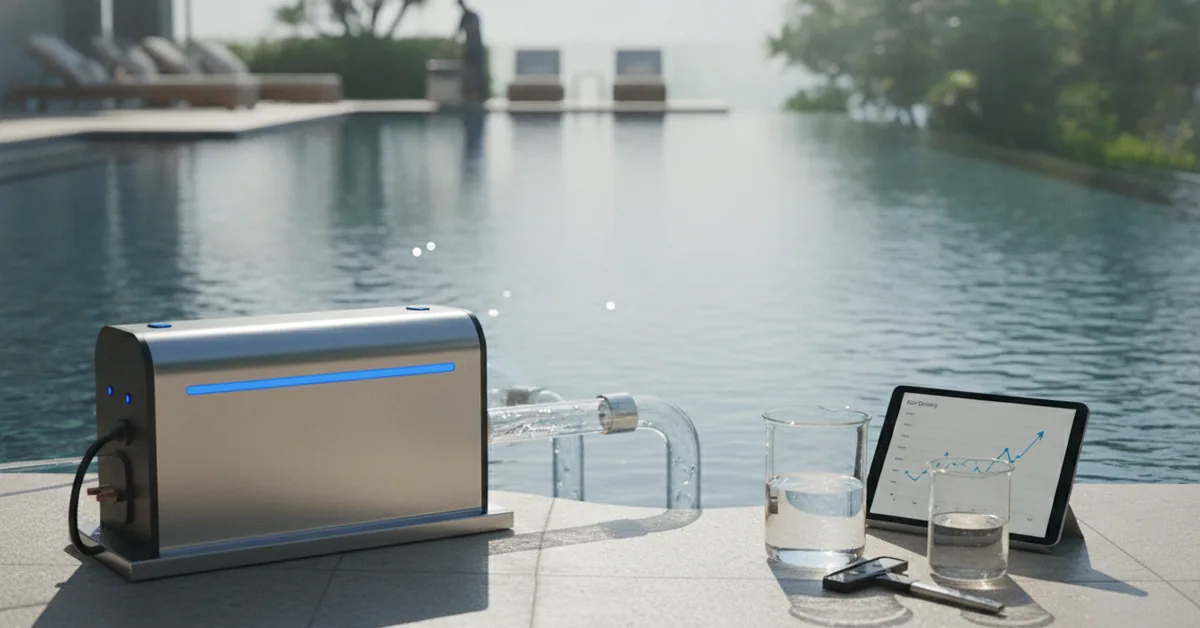
It was a stifling 98-degree Saturday in July when my phone rang. The homeowner on the line was frantic: his 25,000-gallon gunite pool was turning a murky shade of pea-green, just hours before fifty guests were set to arrive for a high school graduation party. In his panic, he had poured six gallons of liquid chlorine into the skimmers and thrown three bags of cal-hypo shock straight into the shallow end. The result? A cloud of suspended calcium, eye-burning chloramine fumes, and a free chlorine level spiking past 15 ppm—yet the water remained stubbornly cloudy. When I arrived at the equipment pad, I noticed a sleek, expensive ultraviolet (UV) sanitizer plumbed right into the return line. The power indicator light on the ballast was dead, the quartz sleeve inside was caked in iron scale, and the bulb hadn't been replaced in three years. The homeowner looked at me and said, 'I paid two grand for that light box because the salesman told me I would never have to worry about chlorine or green water again.'
Executive Summary: The Financial and Biochemical Reality of UV Pool Systems
Ultraviolet (UV) sanitizers are exceptionally powerful physical disinfection units, but they are frequently mis-sold as standalone sanitizing silver bullets. Understanding the genuine payback period and operational value of a residential UV vessel requires separating water flow physics from aggressive equipment marketing.
- Supplemental Disinfection: UV light operates strictly inside the vessel chamber via 254nm irradiation, inactivating chlorine-resistant pathogens like Cryptosporidium instantly, but leaving zero residual sanitizer in the open pool water.
- Chemical Offset Range: A properly sized and maintained UV system can reduce ambient chlorine consumption by 30% to 50% by destroying combined chloramines, but it cannot replace the baseline 1.0 to 3.0 ppm free chlorine requirement.
- True Ownership Costs: ROI calculations must account for annual or bi-annual UV lamp replacements ($150–$300) and routine quartz sleeve cleaning, which offset a portion of the raw chemical savings.
- Air Quality and Bather Comfort: The real return on investment is often non-financial, delivering unmatched water clarity and eliminating the volatile chloramines responsible for harsh chemical smells and red eyes.
The Science of 254 Nanometers: What UV Actually Does (and What It Can't)
In my 15 years servicing residential and commercial pads, I have found that baseline chemistry education clears up 90% of pool owner frustration. A residential UV vessel works by passing water past a low-pressure or medium-pressure mercury vapor lamp that emits light at the germicidal peak of 254 nanometers. As water flows through the contact chamber, this electromagnetic radiation penetrates the cell walls of bacteria, viruses, and protozoa, disrupting their DNA double-helix structures so they can no longer replicate.
Where pool owners get misled is in confusing instantaneous inactivation inside the pipe with residual sanitation out in the basin. Once water leaves that stainless steel or PVC UV chamber, it is immediately exposed to windborne algae spores, organic swimmer waste, and environmental dust. Because UV provides zero oxidation or sanitizing power inside the actual swimming pool, you still need a free available chlorine (FAC) residual maintained between 1.0 and 3.0 ppm. What UV does do extraordinarily well is destroy monochloramines, dichloramines, and trichloramines—the irritating byproducts formed when free chlorine binds to sweat, oils, and urine. By continuously snapping these combined chlorine bonds at the pad, UV frees up your primary sanitizer to do its job out in the deep end, effectively preventing the dreaded chemical lock scenario.
The $2,400 Backyard Case Study: Where the UV ROI Promise Met Texas Heat
Two seasons ago, I audited a pool pad in North Dallas belonging to a client named Mark. Mark had installed a high-output single-lamp UV system on a 20,000-gallon plaster pool powered by a variable speed pump. His goal was straightforward: eliminate his family's skin irritation and slash his monthly chemical bill. When I conducted my initial site assessment, Mark was frustrated. He was still buying three cases of liquid chlorine a month during peak summer, and his optical clarity was mediocre.
When I disassembled the UV vessel, the root causes were glaringly obvious. First, his variable speed pump was running at a low 1,200 RPM flow rate that failed to hit the minimum flow velocity required for optimal mixing in his oversized 3-inch plumbing chamber. Second, his fill water had a High Calcium Hardness reading of 450 ppm and a elevated Langelier Saturation Index (LSI), which had coated the internal quartz sleeve in a thick, milky film of calcium carbonate. The UV light output was literally blocked from reaching the water stream. I soaked the quartz sleeve in a mild muriatic acid bath, recalibrated his variable speed pump schedule to run at 2,200 RPM during peak solar hours, and dialed back his salt chlorine generator output. Over the next 12 months, Mark's liquid shock purchases dropped by 45%, his salt cell run time decreased significantly—extending the lifespan of a $900 electrolytic cell—and his pool achieved that polished, diamond-like clarity that only UV and micro-filtration can produce. The system paid for its operational costs, but only after the physical maintenance parameters were corrected.
Breaking Down the Numbers: Capital Cost, Chemical Offsets, and Maintenance Lifecycles
To determine if a UV system makes financial sense for your pad, you have to run a raw line-item comparison against standard sanitation setups. Below is a realistic operational matrix based on average current industry pricing across a 5-year lifecycle for a standard 20,000-gallon residential pool.
| Sanitation System Type | Upfront Equipment & Install | 5-Year Consumable & Maint. Cost | Pathogen Inactivation Capability | Primary Value Driver |
|---|---|---|---|---|
| Traditional Chlorine Only | $0 (Baseline) | $2,500 – $3,500 (Liquid/Tabs/Shock) | Standard (Slow on Crypto) | Lowest upfront capital investment |
| Salt Water Chlorine Generator (SWG) | $1,800 – $2,800 | $1,000 – $1,400 (Cell replacement/Salt/Acid) | Standard (Slow on Crypto) | Constant automated chlorine production |
| UV System + Low Chlorine (1.0 ppm) | $1,200 – $2,200 | $2,100 – $2,800 (Bulbs/Sleeves/Chlorine) | Exceptional (Instant Crypto Inactivation) | Destroys chloramines, superior water clarity |
| UV + Salt Water Generator Hybrid | $3,000 – $5,000 | $1,800 – $2,400 (Bulbs/Cells/Acid) | Maximum Protection & Clarity | Lowest chemical handling, extended SWG cell life |
When analyzing these metrics, notice that a standalone UV unit added to a traditional chlorine pool rarely yields a dramatic pure-cash saving over 5 years due to the fixed recurring cost of the UV lamps (which typically range from $150 to $300 every 12,000 to 14,000 run hours). Where the monetary ROI becomes compelling is in a hybrid system pairing UV with a Salt Water Chlorine Generator. Because the UV system handles the heavy bio-burden destruction and chloramine breakdown in the pipe, you can turn your salt chlorinator output down by 30% to 50%. This can stretch the lifespan of a $900 salt cell from 3 seasons to 6 seasons, directly transferring hardware savings back into your pocket while delivering public-health-grade water sterilization.
Your Equipment Pad Audit: 5 Steps to Verify UV System Efficiency Today
If you currently own a UV system or are preparing to install one alongside an equipment pad upgrade, walk out to your pad today and execute this operational field check to ensure you are actually capturing your return on investment:
- Inspect the Optical Sight Glass: Look at the designated visual indicator port on the reactor vessel (never look directly at an exposed UV bulb without eye protection). A clear blue glow confirms the lamp is electrically active, but it does not guarantee sufficient UV intensity.
- Calculate Lamp Operating Hours: Check your system's controller for accumulated run hours. Standard low-pressure UV lamps lose roughly 15% to 20% of their germicidal output after 12,000 hours of run time, even if the bulb still emits visible light. If you are past season two on a 24/7 pump schedule, schedule a bulb replacement.
- Perform a Quartz Sleeve Visual Inspection: Power down the pad, isolate the vessel valves, remove the sleeve assembly, and inspect for scale or bio-film. If the glass is clouded by calcium or iron stains, wash it down with a dilute acid solution or dedicated descaling agent; opaque quartz reduces UV transmittance (UVT) dramatically.
- Verify Flow Rate Compliance: Check your pump flow meter or variable speed drive GPM against the UV manufacturer's dosage chart. Ensure your pump is driving water through the vessel at a flow rate that achieves a minimum UV dose of 30 mJ/cm² (millijoules per square centimeter). Excessive flow velocity reduces fluid residence time inside the chamber, rendering the light ineffective.
- Test Free Available Chlorine vs. Combined Chlorine: Use an accurate DPD test kit or digital photometer to measure your chemical levels. Subtract Free Chlorine from Total Chlorine to calculate Combined Chlorine. If your combined chlorine is consistently testing above 0.2 ppm despite an active UV system, your quartz sleeve is dirty, your flow rate is misconfigured, or your lamp output has degraded.
Advanced Pool Engineering FAQs: UV System Diagnostics and Integration
- How does high total dissolved solids (TDS) or iron/manganese in fill water impact UV lamp transmittance?
- High TDS and heavy metals drastically reduce the ultraviolet transmittance (UVT) of the water inside the contact chamber. Dissolved iron and manganese absorb 254nm light wavelengths before they can penetrate biological pathogens, acting as an optical shield for bacteria. Furthermore, these minerals oxidize rapidly inside the warm environment of the reactor chamber, depositing an iron or mineral jacket onto the quartz sleeve. If your source water features iron above 0.3 ppm or hardness above 400 ppm, you must utilize an inline pre-filter or maintain strict LSI balance to prevent complete loss of UV sterilization capacity.
- Why does my UV system show operational status while my cyanuric acid level continues to lock up free chlorine?
- UV light systems do not interact with, break down, or regulate cyanuric acid (CYA / stabilizer) levels in pool water. Cyanuric acid acts as an outdoor chemical shield against sunlight degradation for free chlorine out in the pool basin, but when CYA exceeds 80 to 100 ppm, it causes "chlorine lock," binding available chlorine so tightly that its sanitizing speed drops precipitously. Even though your UV light is destroying chloramines inside the pipe chamber, high CYA levels in the open pool will still lead to localized algae blooms in dead circulation zones. UV is an adjunct to, not a replacement for, controlling your CYA-to-Free-Chlorine ratios.
- Can operating a variable speed pump at low RPMs compromise the inactivation dosage of a UV reactor chamber?
- Operating at low RPMs actually increases the *residence time* (contact time) of the water inside the chamber, which generally increases the total UV dosage ($mJ/cm^2$) delivered to that specific gallon of water. However, if the flow rate drops below the minimum threshold required to trigger the UV unit's internal safety flow switch, the system will shut off the lamp completely to prevent thermal buildup inside the vessel housing. Furthermore, extremely low turbulence can allow particulate settling inside the chamber. You must ensure your low-speed pump curve satisfies the internal flow switch requirements (typically 15 to 20 GPM minimum) while maintaining proper turnover dynamics across the entire filtration system.