

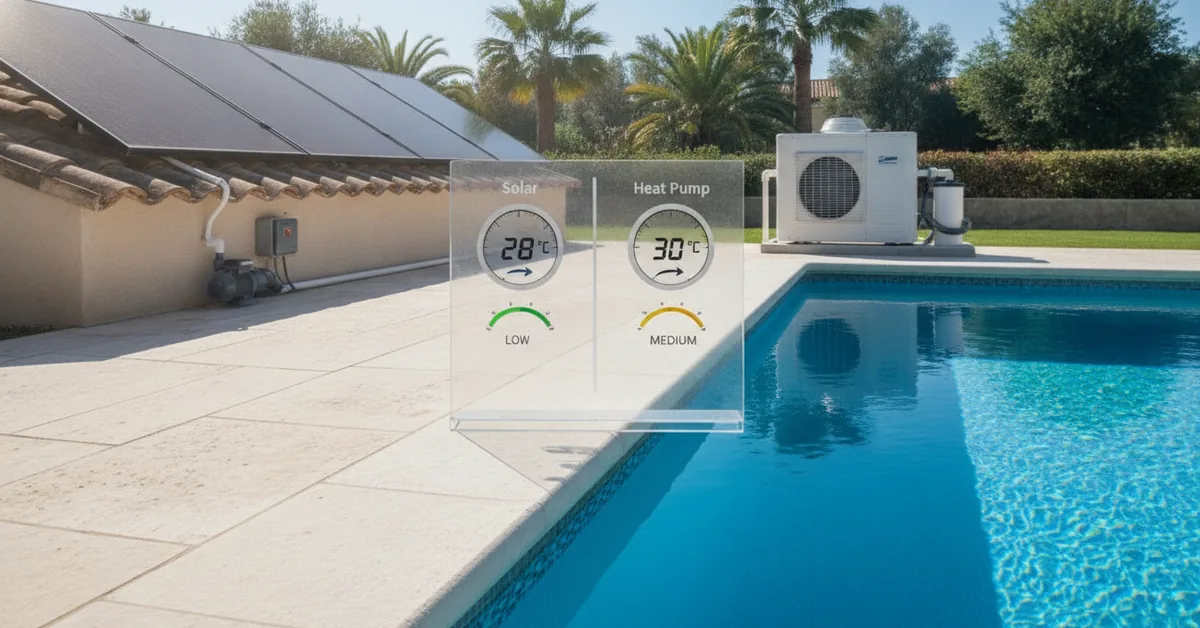
The ambient air in Tampa was a sticky 82 degrees on Thanksgiving morning, but my phone was already blowing up with panicked texts from a long-time client. She had twenty guests arriving at 5:00 PM for an outdoor dinner party, promising an 85-degree heated pool. Instead, she walked out to find her water stuck at a chilly 68 degrees, accompanied by a high-pitched whine from her variable speed pump cavitating on the equipment pad. Her roof-mounted solar thermal array—installed three years prior under the promise of free heating forever—had suffered a combination of vacuum relief valve failure and cloud cover from an early cold front, locking her pump into maximum RPM while feeding cool, aerated water right back into the pool. That morning call highlighted the glaring discrepancy between thermal heating theory and real-world hydraulics on the pool pad.
Executive Summary: Decoupling Thermal Performance From Overhead Power Bills
Choosing between solar thermal collectors and air-source heat pumps in warm climates is not a simple debate between free sunshine and grid power; it is an engineering evaluation of hydraulic head loss, ambient air density, and thermodynamic recovery rates. While solar systems eliminate direct heating energy costs, they introduce massive friction loss that forces pool pumps to consume significantly more kilowatt-hours to maintain circulation.
Understanding how these two systems perform under real field conditions allows pool owners to optimize water temperature without accidentally blowing up their monthly utility statement.
- Heat Pump Efficiency Peaks in Warm Climates: Air-source heat pumps reach peak Coefficient of Performance (COP) ratings between 6.0 and 7.0 when operating in ambient temperatures above 80°F with high relative humidity.
- Hydraulic Parasitic Load: Solar thermal panels often add 15 to 25 feet of dynamic head pressure, requiring variable speed pumps to ramp up from low-wattage filtration speeds (300W) to high-speed lift modes (1,400W+).
- Thermal Recovery Rate Constraints: Solar collectors rely entirely on peak solar irradiance between 10:00 AM and 3:00 PM, whereas heat pumps offer predictable BTUs per hour regardless of overcast skies.
- Footprint and Roof Longevity: A standard 130,000 BTU heat pump requires a compact 3x3 foot pad footprint, while a solar system demands 80% to 100% of the pool's surface area on the roof, adding structural penetration risks and weight load.
The Thermodynamics of Warm Climates: COP vs. Solar Irradiance
When analyzing heat pumps in sunbelt regions like Florida, Arizona, and South Texas, standard manufacturer specs don't tell the whole story. An air-source heat pump operates by extracting ambient heat from surrounding air and transferring it via a titanium heat exchanger into your pool water. In a cold northern climate, these units struggle because there simply isn't enough ambient heat energy to extract. In a warm climate, the scenario flips entirely. When the air temperature is 85°F with 70% relative humidity, a modern heat pump produces far more thermal energy than its electrical input consumes.
This transfer efficiency is measured as the Coefficient of Performance, or COP. A COP rating of 6.0 means that for every 1 unit of electricity consumed to run the compressor and fan, 6 units of heat energy are transferred into the pool. That is a 600% effective efficiency rate. In warm climates, high ambient air temperatures elevate heat pump COP to maximum capacity, turning what northern pool owners consider a heavy electrical load into an exceptionally lean heating solution.
Solar thermal systems harvest heat through unglazed polypropylene panels mounted on your roof. Sun rays warm the black plastic, and pool water pumped through tiny channels absorbs that heat directly. Solar thermal offers an attractive proposition because the thermal energy itself costs zero dollars. However, solar efficiency hinges entirely on peak solar irradiance and solar fraction hours. Overcast days or shorter autumn daylight hours drastically reduce solar recovery rates exactly when swimming demands spike, leaving pool owners reliant on ideal weather rather than thermal demand.
The Hidden Hydraulic Trap: Roof Elevation, Head Loss, and Pump Wattage
As a field technician who audits equipment pads weekly, the most overlooked expense in pool heating systems is parasitic hydraulic loss. Homeowners often look at solar heaters and assume their operational cost is absolute zero. In reality, water is heavy—weighing roughly 8.34 pounds per gallon. Pushing 40 to 50 gallons per minute up to a second-story roof requires significant energy, introducing massive dynamic head pressure into your filtration plumbing.
When an automated solar valve actuates, sending water up 18 feet to a roof array, system pressure often spikes by 10 to 15 PSI on the filter gauge. If you are running a modern variable speed pump scheduled to circulate at an energy-efficient 1,400 RPM (consuming around 250 Watts), that sudden hydraulic head will stall water flow entirely. The solar controller must signal the pump to ramp up to 2,800 or 3,200 RPM to overcome gravity and push past roof friction losses.
At 3,000 RPM, that same pump consumes roughly 1,200 to 1,500 Watts. If your solar heater runs for six hours during peak sun, you are consuming an additional 6 to 7.5 kilowatt-hours of pump electricity daily just to move the water to the heat source. While this is still typically cheaper than running a gas heater, it means solar heating is never completely free to operate when high-RPM pump electrical draw is calculated. Conversely, a heat pump sits directly on the pad next to the filter, introducing negligible hydraulic resistance and allowing variable speed pumps to operate at far lower energy curves.
Field Case Study: Resolving the Phoenix Tile-Roof Efficiency Failure
Two summers ago, I was brought in to consult on a 22,000-gallon plaster pool in Scottsdale, Arizona. The homeowner had installed a massive 450-square-foot roof-mounted solar array to heat his pool during early spring and late autumn. He complained that despite blistering sunny afternoons, his pool wasn't reaching set point, and his electric bills were skyrocketing during the heating season.
Upon inspecting the pad, I immediately noticed his variable speed pump was screaming at 3,450 RPM continuous duty while the solar system was engaged. The total dynamic head on the system exceeded 85 feet. Up on the concrete tile roof, I found the culprit: hard water scale and atmospheric dust had clogged the internal vacuum relief valve, preventing the system from draining properly during off-cycles. The stagnant water in the top headers was overheating during mid-day shutdown, causing local thermal expansion that weakened the collector seals and created air locks in the return lines.
Because of the air lock, the pump had to work at absolute maximum power to force water through the restricted loop, consuming nearly 2.2 kW per hour. I stripped the failed solar plumbing, installed a high-efficiency 130,000 BTU titanium heat pump on the pad, and reconfigured his variable speed pump schedule to run at 1,750 RPM. By shifting from a high-head solar system to a pad-level heat pump, his total operational power draw dropped by 62%, and his pool reached a steady 84°F in forty-eight hours despite occasional desert dust clouding. The system delivered predictable temperatures without burning out pump bearings or stressing roof structures.
Side-by-Side Performance Comparison: Solar vs. Heat Pump
To evaluate these technologies objectively, we must look beyond sales brochures and evaluate how operational constraints impact long-term ownership costs in sunbelt environments.
| Metric / Feature | Solar Thermal System | Air-Source Heat Pump |
|---|---|---|
| Primary Energy Source | Solar Irradiance (Direct Sun) | Ambient Air Thermal Heat + Electricity |
| Average COP / Efficiency Rating | N/A (Thermal collection efficiency ~70%) | 5.5 to 7.0 (In warm/humid climates) |
| Optimal Ambient Temperature | Requires direct, unshaded sunlight | Operates best above 50°F to 60°F |
| Hydraulic Load Impact | High (Adds 10–15 PSI backpressure) | Low (Minimal pad friction loss) |
| Equipment Footprint | 80%–100% of pool surface on roof | 3' x 3' pad footprint |
| Nighttime / Cloud Heating Ability | Zero (Can reverse heat at night) | Full capacity regardless of light |
| 10-Year Estimated Maintenance Risk | Roof leaks, vacuum relief valves, dry rot | Capacitor replacement, fan motor, scale clean |
Step-by-Step Equipment Pad Audit Protocol
If your pool pad features a solar heater or a heat pump, performing a quarterly operational audit ensures you are capturing peak efficiency without dragging down your pump motor performance. Walk out to your equipment pad and perform these five checks:
- Inspect the Actuator Valve and Bypass Alignment: For solar setups, verify that your motorized 3-way valve rotates fully 90 degrees when heating engages. Partial rotation starves the pump and creates extreme high pressure.
- Check the Vacuum Relief Valve for Mineral Crust: On solar systems, check the elevated roof line visually or safely to ensure the vacuum relief valve isn't encrusted with calcium or salt build-up. A stuck valve prevents collectors from draining, leading to pipe damage or panel implosion.
- Measure the Thermal Delta T Across the Jets: Take a digital probe thermometer and test water temperature at the skimmer versus water coming directly out of a return jet. A properly functioning heat pump or solar array should show a 3°F to 5°F rise during low-flow circulation.
- Clear Heat Pump Airflow Obstructions: Check that your heat pump has at least 24 inches of clear perimeter space on all sides and 6 feet of clearance above the top exhaust fan. Restricting exhaust air forces the unit to recirculate cold air, crashing its COP rating.
- Audit Pump RPM and Wattage Draw: Review your variable speed pump control panel when heating turns on. If the pump ramps up over 2,800 RPM to service the heater, calculate the electrical cost difference to determine if a hydraulic bypass adjustment is necessary.
Advanced Field Operations and Hydraulic Troubleshooting
- How does high Calcium Hardness or Total Dissolved Solids (TDS) specifically damage heat exchangers versus solar panels?
- In titanium heat pumps, elevated calcium hardness (above 400 PPM) combined with high pH can create thermal scaling on the heat exchanger wall inside the water jacket, insulating the metal and drastically dropping thermal transfer efficiency. In polypropylene solar panels, scale and elevated TDS form small rough deposits inside the micro-tubes, restricting total flow, throwing off hydraulic balance across the manifold, and forcing the pool pump to operate against excessive dynamic pressure.
- Can running a variable speed pump at low RPMs destroy or air-lock a roof-mounted solar system?
- Yes. If pump RPM is set too low (e.g., under 1,800 RPM), water pressure will be insufficient to push the weight of the water column to the roof line and force open the internal check valves while seating the vacuum relief valve closed. This creates a persistent air-lock scenario where air is continuously injected through the return lines into the pool, starving the pump of prime, causing severe water hammer, and preventing heat absorption.
- Why does my heat pump frost over during chilly spring mornings in warm climates, and how does humidity play a role?
- Air-source heat pumps extract heat by evaporating liquid refrigerant inside the evaporator coil, making the coil skin temperature 10°F to 15°F colder than the surrounding air. When ambient temperatures hover around 45°F to 50°F with high relative humidity, ambient moisture freezes instantly upon contacting the cold evaporator fins. Quality heat pumps feature automated hot-gas defrost cycles that temporarily reverse refrigerant flow to melt frost build-up without shutting down operational logic.