

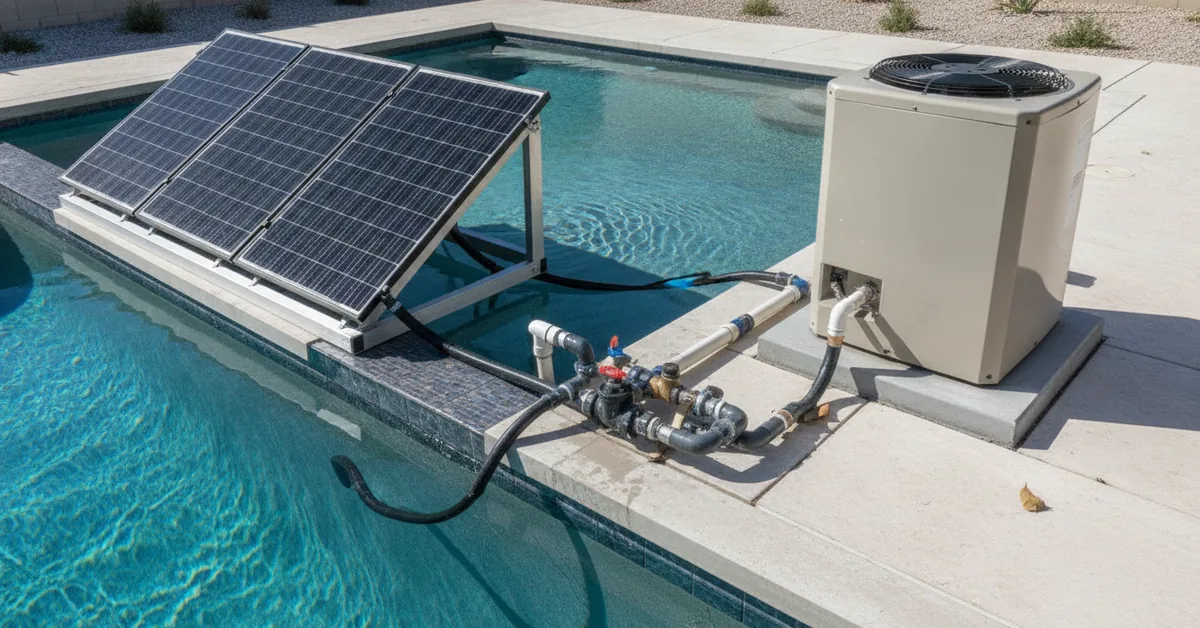
The Reality of Thermal ROI: Solar Collectors vs. Electric Heat Pumps
Selecting the ideal pool heating technology requires balancing upfront mechanical integration against long-term operational expense and regional ambient constraints. While solar thermal arrays offer virtually zero direct energy consumption during operation, their thermal output is strictly tied to solar irradiance and requires higher pump RPMs to overcome vertical elevation head loss.
- Solar thermal systems deliver the lowest operating cost per BTU, provided you have unshaded roof space and a pump calibrated to handle 50 to 70 gallons per minute of flow resistance.
- Air-source heat pumps supply precise, automated temperature management regardless of cloud cover, performing at peak efficiency when ambient air temperatures remain consistently above 50°F to 55°F.
- Integrating a Variable Speed Pump (VSP) is mandatory for both systems to prevent electrical waste caused by excessive dynamic head loss during high-demand heating cycles.
- Deploying a high-grade thermal pool cover reduces evaporative heat loss by up to 70%, serving as the single most effective efficiency multiplier for either system.
Physics on the Pool Pad: Thermodynamics and Hydraulic Resistance
To evaluate these two systems objectively, we must analyze how they convert energy into thermal transfer. Electric heat pumps operate on a refrigeration cycle. The unit pulls ambient air across an evaporator coil containing liquid refrigerant (typically R410A). The compressor pressurizes the warmed gas, sending it to a titanium heat exchanger where heat transfers directly into the passing pool water. A heat pump's efficiency is measured by its Coefficient of Performance (COP), which typically ranges between 5.0 and 7.0 under standard test conditions (80°F air, 80°F water, and 80% relative humidity). A COP of 6.0 means that for every 1 unit of electricity consumed by the compressor and fan, 6 units of heat energy are transferred to the pool.
Solar thermal systems bypass refrigeration cycles entirely. Water is pumped from the filter manifold directly up to an array of unglazed polypropylene collector panels, absorbing radiant heat directly before returning to the pool. The energy consumption of a solar pool heater is strictly limited to the additional electrical draw required by the filtration pump to push water up to the roof and through narrow collector channels. When integrated correctly, solar thermal efficiency exceeds heat pumps during sunny peak hours, but efficiency drops to zero the moment solar radiation falls below the minimum collector threshold.
Trench Story: The $3,200 Heating Mistake in Scottsdale
I was called out to troubleshoot a pool system for a homeowner named Marcus in Scottsdale, Arizona. He had installed a 120,000 BTU heat pump to extend his swimming season into late fall and early spring. By November, his monthly electric bill had jumped by over $400, yet the pool water struggled to stay at 78°F. When I inspected his pad, the problem was immediately obvious: the ambient desert air was dropping to 42°F at night with relative humidity under 20%. The heat pump's evaporator coil was freezing over continuously, forcing the unit into active defrost mode. It was spending hours burning 5.5 kW per hour just running fan cycles to melt ice off its own coils.
We completely overhauled his approach. I installed a 400-square-foot array of unglazed polypropylene solar collectors on his south-facing tile roof and integrated a Jandy 3-way motorized solar valve connected to his automation panel. We set the system to run his Variable Speed Pump at 2,600 RPM only during peak sunlight hours (10:00 AM to 3:30 PM), capturing direct solar BTU gain for $0 in added heating costs. We locked out the heat pump entirely unless the ambient air temperature was above 58°F. By letting solar carry the baseline load and using the heat pump strictly as a secondary booster during humid daylight hours, Marcus slashed his winter electric bill by 65% while keeping his pool at a stable 84°F.
Comparative Energy & Technical Performance Matrix
The table below breaks down the operational parameters, mechanical overhead, and efficiency metrics of solar pool heaters versus air-source heat pumps based on field performance data.
| Performance Metric | Solar Thermal Arrays | Air-Source Heat Pumps |
|---|---|---|
| Primary Energy Input | Direct Solar Irradiance (Free) | Grid Electricity (220V / 40-50 Amp Dedicated Circuit) |
| Average Operational COP | N/A (Purely Hydraulic Draw) | 5.0 to 7.0 (Decreases as ambient air temp drops) |
| Sensitivity to Air Temp | Low (Dependent on sun light, not air temp) | High (Drastic drop in performance below 50°F) |
| Added System Head Loss | 15 to 30 Feet of Head (Roof Height Dependent) | 6 to 12 Feet of Head (Internal Bypass Pressure) |
| Optimal Flow Rate Target | 40 to 70 GPM (High Flow / Low Velocity) | 30 to 60 GPM (Strict Minimum Flow Switch Cutoff) |
| Expected Operating Lifespan | 15 to 20 Years (Polypropylene Construction) | 8 to 12 Years (Compressor and Coil Wear) |
Tuning Flow Rates and Variable Speed Pumps for Maximum Heat Transfer
A major flaw I observe on residential pool pads is running a pump at arbitrary speeds without considering thermodynamic heat exchange. Both solar panels and heat pumps require precise volumetric flow rates (GPM) to maximize energy transfer. Heat pumps rely on an internal water flow switch—typically calibrated to close at 30 GPM. If your Variable Speed Pump drops below this flow threshold, the heat pump shuts down instantly to prevent boiling the water inside the heat exchanger manifold, triggering an external error code on your display.
Solar heating systems demand an entirely different approach to flow dynamics. Pumping water up a two-story roof requires overcoming static elevation head pressure (roughly 0.433 PSI per foot of elevation). When the solar valve actuates, your pump must ramps up to a sufficient RPM to open the roof vacuum relief valve and fill the collectors. Once prime is established and air is purged from the lines, you can dial the pump RPM back down slightly, but you must maintain a laminar flow velocity across the collector channels. If water moves too fast through a heat exchanger or solar panel, the dwell time is reduced; if it moves too slow, high heat differentials cause thermal stress and chemical scaling on internal components.
System Inspection Checklist for the Homeowner
Before calling out a technician or making expensive component upgrades, walk out to your equipment pad and perform these diagnostic steps:
- Inspect the Filter Pressure Gauge: Check your baseline PSI with the filter clean. A dirty filter reduces overall GPM, which can trip a heat pump water pressure switch or prevent solar panels from priming.
- Verify Valve Actuator Operation: Toggle the solar switch on your automation panel and observe the 3-way motorized valve. Ensure the actuator arm turns a full 90 degrees without grinding or stalling.
- Examine the Heat Pump Evaporator Coils: Look through the outer grill of your heat pump. If the aluminum fins are bent, clogged with leaves, or heavy with dust, airflow is restricted, dropping your COP significantly.
- Check Roof Vacuum Relief Valves: For solar owners, look at the top corner of your collector array during operation. If water is dripping continuously from the vacuum relief valve, the internal O-ring or spring has failed, causing loss of system pressure.
- Test Langelier Saturation Index (LSI): Keep water balanced between -0.3 and +0.3 LSI. Scale formation (calcium carbonate precipitation) inside a heat pump's titanium heat exchanger acts as an insulating barrier, destroying efficiency.
Advanced Technical FAQs
- How does operating a variable speed pump at low RPM affect the flow switch and efficiency of a high-efficiency heat pump?
- Operating a VSP at low RPM (e.g., 1,200 to 1,600 RPM) drastically reduces power consumption, but it often drops system flow below the 30-35 GPM threshold required by the heat pump's internal pressure or paddle flow switch. If the flow switch opens, the heat pump shuts off completely to prevent compressor damage. To optimize efficiency, program your automation panel to automatically ramp the VSP up to an engineered target RPM (typically 2,200 to 2,600 RPM) only when the heat pump calls for heat, returning to low-RPM filtration once the set point is reached.
- Can severe chemical imbalance cause physical failure in titanium heat pump exchangers or polypropylene solar collectors?
- Yes. While titanium is highly resistant to localized pitting, running a pool with a low pH (below 7.2) combined with low Calcium Hardness (below 200 PPM) creates aggressive water that slowly strips protective oxide layers, leading to localized erosion under high water velocities. For solar collectors, consistently elevated chlorine levels combined with high water temperatures will degrade lower-grade polypropylene polymers over time, causing structural micro-fissures and joint leaks under normal thermal expansion cycles.
- What is dynamic head loss, and how does roof height impact energy efficiency when upgrading to a solar pool heater?
- Dynamic head loss is the total resistance to flow created by friction against pipe walls, fittings, valves, and vertical elevation change. Every 2.31 feet of vertical elevation adds 1 PSI of static head pressure to your pump hydraulics. When water must be pushed up 20 feet to a second-story roof, your pump must generate roughly 8.6 additional PSI of head pressure just to reach the top manifold. This requires running your pump at higher RPMs, increasing electrical draw (watts consumed) and partially offsetting the zero-fuel benefit of solar heating if the hydraulic plumbing layout is poorly engineered.