

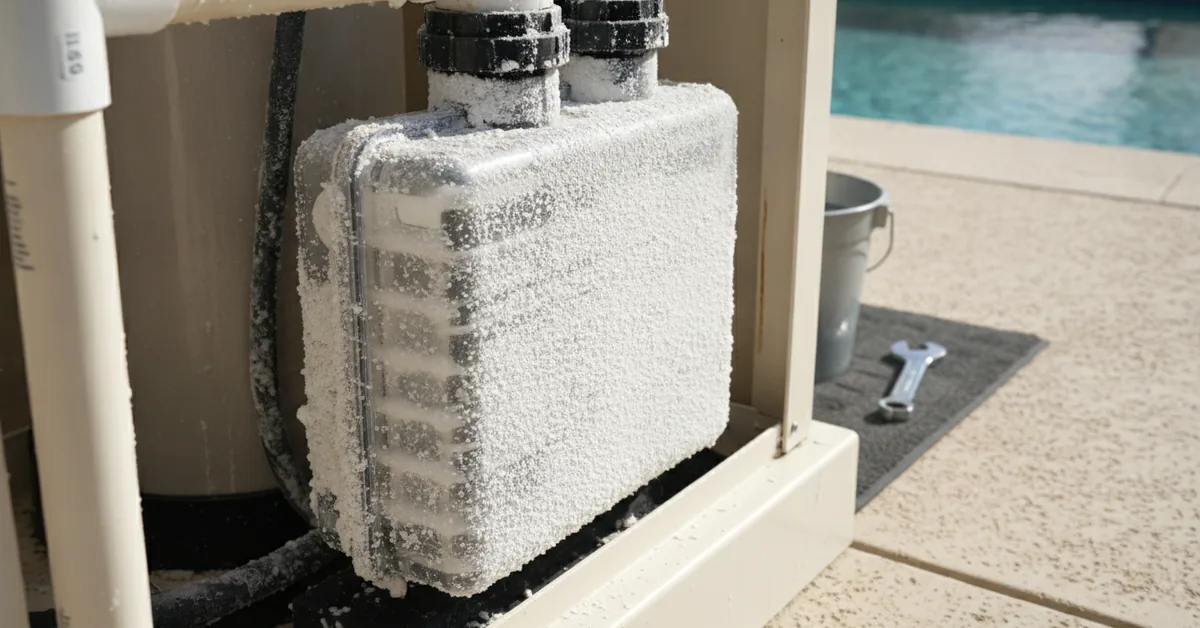
Friday evening, 80 degrees, and thirty guests are due at noon tomorrow for a neighborhood graduation party, but the pool water has suddenly transformed into a murky, milky soup. The control pad on the salt system panel blinks green, displaying a comforting status light, yet a manual DPD fluid test reveals a bone-dry zero free chlorine reading. The homeowner dumped three bags of granular pool shock into the deep end, unaware that calcium carbonate had quietly formed an insulating wall over the cell's titanium plates, choking off electrolysis completely.
Executive Summary: Safeguarding Salt Chlorinators Against Electrolytic Scaling
Calcium carbonate buildup on electrolytic plates silently reduces chlorine output long before system diagnostic lights
Calcium carbonate buildup on electrolytic plates silently reduces chlorine output long before system diagnostic lights alert homeowners to a hardware failure. Maintaining ideal Saturation Index values and establishing a prophylactic inspection schedule remains the single most cost-effective way to preserve your pool pad's primary sanitizer unit.
Ignoring scale formation leads to rapid plate degradation, elevated electrical resistance, and premature cell burnout that costs thousands over the pool's operational lifecycle.
- Calcium scaling insulates electrolytic plates, increasing electrical resistance and artificially reducing free chlorine production by up to 90%.
- Langelier Saturation Index (LSI) management between -0.2 and +0.2 is far more critical for saltwater pools than traditional liquid chlorine setups.
- Unmonitored pH spikes driven by the cell's natural sodium hydroxide byproduct accelerate scale formation when Calcium Hardness exceeds 400 PPM.
- Acid washing a cell too frequently destroys the noble metal ruthenium oxide coating, permanently ruining a $700 to $1,200 cell prematurely.
The Micro-Environment Inside Your Cell: Why Salt Pools Scale Faster
In my 15 years servicing residential automation systems, I have watched hundreds of pool owners stand puzzled beside clear water that yields zero sanitizer residual. What most people fail to realize is that electrolysis creates an extreme localized chemical reaction inside the cell housing. As saltwater passes between the titanium plates, electrical current splits sodium chloride and water into hypochlorous acid and sodium hydroxide. That sodium hydroxide byproduct creates an extreme micro-zone where localized pH rockets above 11.0 directly at the cathode surface.
Even if your overall pool water tests at a pristine 7.5 pH, that intense micro-zone inside the cell causes dissolved calcium to instantly precipitate out of solution and bind to the metal plates. Over time, these white, flaky crusts bridge the gap between plates, choking off water flow and neutralizing the electrical field. When calcium hardness exceeds 400 PPM alongside high total alkalinity, this precipitation process transforms from a slow accumulation into a rapid, aggressive scaling cycle that destroys equipment in months.
A Field Case: The $1,800 Lesson in Scottsdale
I recall a service call in Scottsdale, Arizona, where a client was replacing his OEM salt cell every 18 months like clockwork. He assumed the manufacturer was sending defective units because his control panel continuously threw low salt warnings despite adding salt until his water tasted like seawater. When I unscrewed the union nuts on his cell, the internal plates were completely buried in solid white calcium, looking like a cave stalactite. His pool water had a total alkalinity of 140 PPM, calcium hardness at 550 PPM, and a pH of 8.2. His water was so scale-forming that his cell was acting as a sacrifice zone for calcium precipitation. By recalibrating his water chemistry to a slightly negative LSI (-0.1) using muriatic acid and cyanuric acid balance, his third replacement cell is now entering its fifth year without a single acid wash.
| Chemical Parameter | Ideal Salt Pool Range | High Risk Scaling Threshold | Direct Impact on Electrolytic Cell |
|---|---|---|---|
| pH Level | 7.2 - 7.6 | Above 7.8 | Triggers rapid calcium carbonate precipitation at the cell cathode. |
| Total Alkalinity | 70 - 90 PPM | Above 120 PPM | Drives aggressive pH rise through carbon dioxide outgassing. |
| Calcium Hardness | 200 - 400 PPM | Above 450 PPM | Provides excess raw material for scale bridging titanium plates. |
| LSI (Saturation Index) | -0.2 to +0.2 | Above +0.3 | Causes immediate scaling across cell plates, heater exchangers, and tile lines. |
| Salt Content | 3,000 - 3,500 PPM | Below 2,600 PPM | Forces cell board to draw higher current, accelerating thermal wear on scaled plates. |
Why Diagnostic Control Panels Lie About Low Salt Levels
One of the most destructive traps for pool owners is trusting the low salt readout on their automation panel without verifying salinity with an independent drop test. Modern salt chlorinators do not contain an actual chemical salt sensor. Instead, the main circuit board calculates salinity by measuring the electrical current (amperage) flowing between the plates at a given water temperature. When scale builds up, it acts as an electrical insulator, reducing the amp draw across the cell shell.
The system interprets this low amperage drop as a lack of salt in the water and flashes a warning light. Homeowners regularly respond by dumping 80 to 120 pounds of pool salt directly into the water. This creates an extremely aggressive high salinity environment exceeding 4,500 PPM that short-circuits power supplies and burns out main circuit boards once the scale is finally removed. Always cross-check panel diagnostics with a silver nitrate titration test kit before adjusting salinity levels.
The Hidden Risk of Acid Cleaning: Protecting the Platinum Group Coating
When scale strikes, the knee-jerk reaction for many pool techs and DIY homeowners is to submerge the cell in a bucket of concentrated muriatic acid. While acid quickly dissolves calcium carbonate with a satisfying fizz, it comes at a brutal hidden cost. Titanium plates in salt generators are not plain metal; they are coated with an ultra-thin layer of ruthenium oxide or iridium oxide catalyst valued higher than gold per ounce. This noble metal coating is what allows low-voltage electrolysis to separate salt molecules without destroying the underlying titanium metal structure.
Soaking a cell in aggressive acid solutions eats away a portion of this micro-coating during every single bath. In my service logs, I routinely see cells that were acid-washed every month last fewer than two years. To maximize cell life, reserve acid cleaning as an emergency last resort. Utilize low-pressure water sprays, plastic scraper tools, or mild vinegar solutions whenever possible, and focus primary efforts on maintaining LSI equilibrium to stop scale before it bonds to the catalyst.
Field Inspection Checklist: Step-by-Step Cell Health Audit
Walk out to your pool equipment pad today and execute this diagnostic sequence to ensure your salt chlorine generator is operating at peak efficiency:
- Kill Power to the Automation System: Shut off power at the main breaker panel to ensure no electric current reaches the cell or pump while inspecting hardware.
- Perform Visual Cell Plate Inspection: Unscrew the threaded union nuts on both ends of the cell housing, remove the unit, and look down through the plates toward a bright light source to check for white bridge formations.
- Verify Salinity with Liquid Reagents: Test pool water with a silver nitrate titrator or calibrated digital refractometer rather than trusting control panel readout screen values.
- Measure Langelier Saturation Index (LSI): Test pH, Total Alkalinity, Calcium Hardness, Cyanuric Acid, and Water Temperature to calculate your precise LSI value before adding any balancing chemicals.
- Perform Low-Impact Scale Removal: If scale is present, flush the housing with a high-pressure garden hose nozzle first; if mineral deposits persist, soak the interior in a 10:1 diluted water-to-muriatic acid mixture for no longer than 8 to 10 minutes.
Frequently Asked Questions About Salt Cell Maintenance
- How does high calcium hardness specifically affect a salt chlorine generator cell when the pool water appears crystal clear?
- Even if bulk pool water appears completely clear, high calcium hardness supplies high concentrations of dissolved minerals that immediately drop out of solution inside the cell. The localized electrochemical reaction creates extreme temperatures and a pH above 11.0 near the cathode plates, precipitating calcium carbonate directly onto the metal surface regardless of overall water clarity.
- Why does my salt system continue to report low salt levels even after I added the recommended bags of pool salt?
- Salt chlorinators calculate salinity by measuring amperage across the plates rather than testing chemical salt content directly. Insulating scale deposits block electrical conductivity, causing the control board to incorrectly report low salt. Cleaning the scale from the plates or testing the water independently with a titrator will usually resolve this error without adding unnecessary salt.
- Can running a variable speed pump at ultra-low RPMs increase the rate of scale formation inside my salt cell?
- Yes, running a variable speed pump at low flow rates reduces turbulence inside the cell body, allowing sodium hydroxide and heat to accumulate at higher concentrations near the cathode plates. To mitigate this risk, ensure your system maintains adequate flow velocity (typically above 30 to 35 GPM) or cycle the salt generator output to align with higher pump speed schedules.